

Three-minute read
Iran entered December with an unusual synchrony of disruptions: schools closed across more than a dozen provinces, a major hydropower plant idled, the currency weakening past 116,000 tomans to the dollar, and a senior health official resigning after a bribery allegation. None of these shocks is new on its own—what stands out is how many are hitting at once, and how often the warnings now come from the regime’s own institutions.
One Of the Driest Autumns In 50 Years
On Monday, December 1, Ahad Vazifeh, head of the National Climate and Crisis Management Center, told state media that Iran is experiencing “one of the driest autumns of the past 50 years.”
His framing implied an act of nature, but the details he provided pointed to something else: nearly 70 days into the season, vast regions “have not experienced any rainfall” at all—a pattern that experts note has been intensified by decades of misallocated water, exhausted aquifers, and politically driven dam construction.
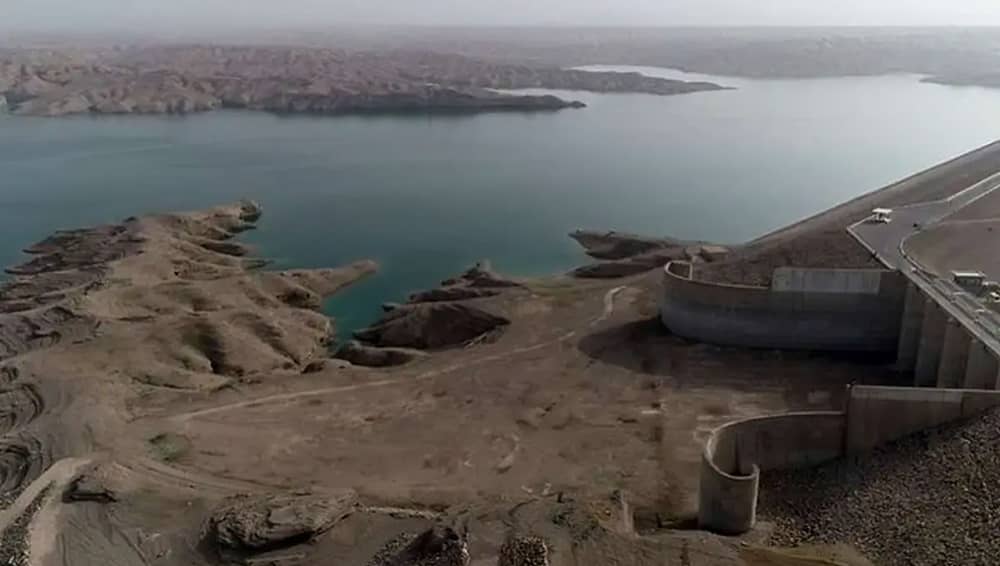
IRNA confirmed the consequences on Monday when it reported that the Karkheh dam’s power plant—touted for years as a triumph of national engineering—has been forced offline because the reservoir now sits roughly 40 meters below its operational level. Only about 1 billion cubic meters of water remain-a shortfall rooted not just in low precipitation but in chronic over-extraction upstream, unregulated agricultural demand, and past political pressure to keep irrigation promises that the river could not support.
Why #Iran Is Running Out of Water, Power — and Patiencehttps://t.co/9ZghlJCNpO
— NCRI-FAC (@iran_policy) August 13, 2025
Smog, Flu, And A Country on Pause
Meanwhile, air pollution and a spreading influenza wave have pushed schools and universities into their ninth consecutive day of closure or remote instruction. By Sunday, November 30, classrooms were shut or online in Tehran, East and West Azerbaijan, Khuzestan, Alborz, Kurdistan, Markazi, Gilan, Isfahan, Kermanshah, Hamedan, Bushehr and Hormozgan. Tehran’s cinemas, galleries and museums were ordered closed on November 30 and December 1.
On Monday, officials said air quality in the capital had reached a “super-critical” phase. Provinces including Tehran, Hamedan, Semnan, Gilan, Alborz and Qom extended shutdowns into December. In Alborz, government offices were instructed to operate with only one-quarter of staff on site.
A new report from the regime’s Environment Organization pointed directly to the fuel mix burned in nearby power plants. According to the agency, sulfur levels in diesel at the Rey, Parand and Montazeri-qaem plants were 120–135 times the legal limit, while mazut emissions at the Rajai plant were 592 times above the standard. State-aligned ecologist Hossein Akhani said official “inaction” had turned air pollution into “a deadly disaster.”
Health authorities warned that the flu wave has not peaked. Deputy minister Raisi said infections are “still rising” and could last until late February or March. Local media in Qom reported that 30–40 percent of clinic visits now involve respiratory symptoms.
The crisis spilled into parliament. MP Alireza Salimi said “the breaths of Tehran and many major cities are numbered,” citing official estimates of 58,000 pollution-related deaths and $18 billion in annual losses. Another lawmaker, Fatemeh Mohammad Beigi, said 37 percent of Iran’s 35 million vehicles are obsolete and polluting, accusing the government of abandoning a scrappage program despite its documented fuel savings. “People are suffocating in environmental pollution,” he said.
#Iran Air Pollution Linked to Nearly 59,000 Deaths Last Year, Health Ministry Official Sayshttps://t.co/q3ThSmXK15
— NCRI-FAC (@iran_policy) November 10, 2025
A Sliding Rial and Regime’s Fuel Plan
Economic pressures layered on top of environmental ones. On Sunday, informal market trackers put the dollar at 116,800 tomans and the euro at 135,450 tomans. IRNA wrote that Tehran’s gold market had a “highly volatile day,” with a full gold coin selling for nearly 123 million tomans after a 2-million-toman jump.
Fuel policy added fresh uncertainty. Ghodrati, spokesman of parliament’s budget and planning commission, claimed that the government’s new gasoline pricing plan—including a third, more expensive tier for consumption above 160 liters per month—was adopted “without informing or coordinating with the Majles.”
Even Western media noted that the change “carries the risk of further public unrest,” drawing a line to previous rounds of fuel protests. Inside Iran, the criticism is less about transparency and more about confusion; officials in the oil ministry have issued contradictory statements on who receives quotas, particularly for new vehicles and dual-fuel cars.
At the same time, wage policy is moving against household budgets. The daily Ebtekar reported that the draft budget for Iran’s new year includes only a 20 percent increase in salaries and pensions—well below inflation on essential goods. Worker and retiree groups, already strained by medical and transport costs, see it as another year of real wage erosion.
Inflation and Exploitation Drive New Wave of Strikes Across #Iran https://t.co/HgBZLuBhZj
— NCRI-FAC (@iran_policy) November 29, 2025
A State Managing by Interruption
Dry skies, dirty air, a weakening currency, improvised fuel policy, an idled dam, and a confluence of intertwined socio-economic crises: the convergence has produced a winter opening in which Iran appears to govern primarily through interruption—shutting schools, throttling power, rotating water supply, issuing last-minute directives, and replacing officials in crisis.
Even in official reporting—and even in regime-aligned analysis—the scale of the problems increasingly spills into view. What remains uncertain is whether the state can shift from emergency closures to structural solutions, or whether early winter’s pattern becomes the template for the months ahead.