

Four-minute read
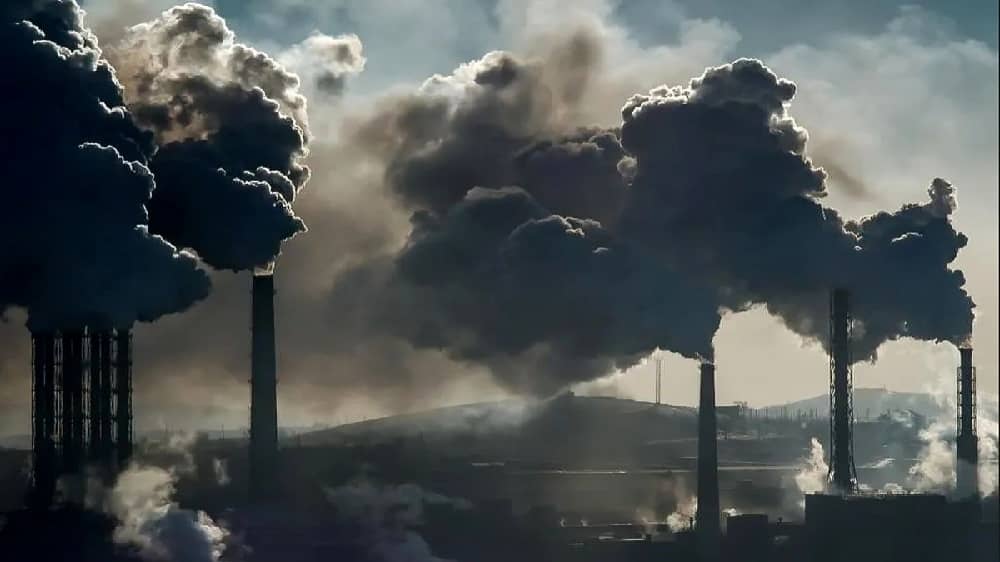
The final days of November arrived with a bleak panorama across Iran: schools shuttered, civil servants ordered to work remotely, hospital wards filling with respiratory cases, and a gray-brown haze hanging over cities from Tehran to Tabriz. By Saturday, November 29, 2025, officials confirmed that 14 provinces had moved to virtual classes due to either air pollution or influenza surges. What Tehran framed as emergency public-health “adjustments” instead revealed a deeper pattern: a state buckling under the combined weight of environmental collapse, economic paralysis, and political fear.
Throughout the first week of Azar, the state-run site Fararu reported that Tehran had become the most polluted city in the world, surpassing Delhi. Anchors on regime television, typically cautious, asked whether the situation had crossed “from a manageable problem into a crisis.” On the horizon loomed another destabilizing decision: the launch of a three-tier gasoline pricing plan—the most significant fuel-policy shift since the hikes that helped trigger the nationwide protests of November 2019.
These are not isolated shocks. They are interacting failures that signal a regime rapidly losing its grip on basic governance.
#Iran Enters the Ration Economy as Food, Fuel and Medicine Slip Beyond Reachhttps://t.co/LRyoRZz0gv
— NCRI-FAC (@iran_policy) November 12, 2025
A Toxic Cloud That Reveals Administrative Decay
The air-quality emergency gripping Iran this month was entirely predictable. Officials have long acknowledged that winter smog worsens when power plants burn mazut, a heavy fuel technically restricted but repeatedly revived whenever gas supplies tighten. On November 26, a deputy health minister admitted that Iran now sees about 58,000 pollution-related deaths annually, based on ministry studies—figures that “no longer require calculation,” he said, because the crisis is visible to the naked eye. By the government’s own account—data points that typically understate the gravity of the crisis—Tehran recorded three times as many “unhealthy for all” days as last year.
Tehran’s governor, Mohammad-Sadegh Motamedian, told state TV on November 26 that more than 70% of the capital’s 4.2 million motorcycles are over 20 years old and heavily polluting. He acknowledged that industrial emission metrics relied on “eight-year-old baselines,” an admission that the regulatory system cannot even measure current conditions.
Meanwhile, ecological stress is advancing on multiple fronts. On November 28, the mayor of Komleh in Langerood confirmed that a 15-hectare forest and orchard fire burned across four ignition points. For a region already strained by drought, the damage underscored how environmental threats outpace the state’s emergency capacity.
The closures that followed—schools and universities in East and West Azerbaijan, Tehran, Isfahan, Ardabil, Bushehr, Khuzestan, Kurdistan, Gilan, Hamedan, and Kermanshah—illustrated the pattern. The government can shut institutions and advise mask use, but it cannot provide clean air. As one state-linked outlet, Rouydad24, summarized on November 27: “From Tehran to Khuzestan, people have become victims of mismanagement.”
Rationed Water, Three-Tier Gasoline, Prosecutors on Alert: Why #Tehran Fears a November Flashpointhttps://t.co/1YWsOEjAQs
— NCRI-FAC (@iran_policy) November 14, 2025
Fuel Hikes and the Shadow Of 2019
While pollution choked the cities, another crisis gathered force. Beginning December 6, the government will introduce a three-tier gasoline system: the long-standing 1,500-toman rationed tier remains; the “station card” rate jumps from 3,000 to 5,000 tomans; and fully unsubsidized purchases rise to roughly 5,000 tomans per liter. New cars receive no quota, and households with multiple vehicles are restricted to a single fuel card.
The warnings from inside the system were immediate, but none of them reflected concern for public welfare. Lawmakers spoke because they fear the street. On November 27, Mohammadreza Sabbaghian cautioned that raising fuel prices without parallel wage adjustments would “have consequences,” a euphemism for unrest. A day earlier, Bijan Bakhti-Dasgerdi insisted the hike “will not fix the deficit” and would only “intensify the fire of inflation,” signaling that the political cost could outweigh any fiscal gain. Abdolkarim Agh-Arkakoli was more explicit: “Every spark can ignite a revolt of the poor.” These are not social-policy arguments; they are warnings from a ruling class worried about its own vulnerability.
Regime-aligned newspapers amplified the anxiety. Jahan-e Sanat likened the measure to “boiled-frog economics,” predicting a shock that would cascade through food and transport. Ettelaat invoked the memory of the 2019 uprising, noting that even if protests do not initially mirror that scale, persistent pressure on already-struggling households could turn any small trigger into a nationwide flashpoint.
The political physics remain unchanged: fuel is the system’s most combustible commodity. Any retreat broadcasts weakness; any price increase courts revolt. Officials, trapped between those “bad versus worse” options, stall for time—until time runs out.
#Iran’s Water, Fuel and Food Crises Reveal a Regime Out of Optionshttps://t.co/HrQZVfjJ3w
— NCRI-FAC (@iran_policy) November 22, 2025
Austerity’s Human Toll
The social consequences of these overlapping crises are increasingly visible. In Khuzestan, two Arab men died by suicide on November 26 amid severe economic pressure, according to reporting confirmed by Iran International. Twenty-three-year-old Maher Sawari, from Dezful, died just hours before his wedding festivities were to begin. In a nearby village, Zowad Naseri ended his life after prolonged unemployment and inability to support his family. Local monitoring indicates at least nine similar cases in Ahvaz and surrounding towns this year, all tied to extreme financial stress.
These deaths do not dominate national headlines, but they expose a grim baseline: millions are living at the edge of economic collapse, with no safety net and few prospects.
Even senior regime-aligned economists now warn that the system is approaching rupture. On November 25, Masoud Nili told officials that Iran’s economy is “between death and survival,” and that decision-making has become “paralyzed” despite the urgency of action.
Why #Iran Is Running Out of Water, Power — and Patiencehttps://t.co/9ZghlJCNpO
— NCRI-FAC (@iran_policy) August 13, 2025
A State Running Out of Room
This week’s convergence—hazardous smog, a politically explosive fuel hike, widening poverty—offers a sharper picture of a system cornered by its own contradictions. Pollution cannot be reduced without fuel reform; fuel reform cannot proceed without compensation; compensation cannot occur without fiscal capacity the state no longer has. Each crisis traps officials between repression and retreat, and neither option stabilizes the system.
The clerical dictatorship weathered periods of hardship before. But today’s emergencies are reinforcing one another, eroding stability faster than the state can respond. Tehran can shutter schools, restrict gatherings, and stagger announcements—but these are gestures, not governance.
The deeper reckoning remains unresolved, drifting through the air like the smog that refuses to lift.