

The economic crisis gripping Iran reached a grim milestone on Monday as the national currency entered a freefall, triggering a fresh wave of protests across the country. On December 1, the US dollar exchange rate shattered historical records, surpassing 122,000 tomans.
According to real-time market data from the “Navasan” website, the dollar, which had hovered around 116,800 Tomans just a day prior, surged past the psychological barrier of 120,000, trading at 122,300 Tomans by midday. This rapid devaluation has decimated the purchasing power of ordinary Iranians and fueling hyperinflation while various sectors of society—from retirees to industrial workers—are protesting and demanding accountability.
Retirees Target Regime’s Economic Empire
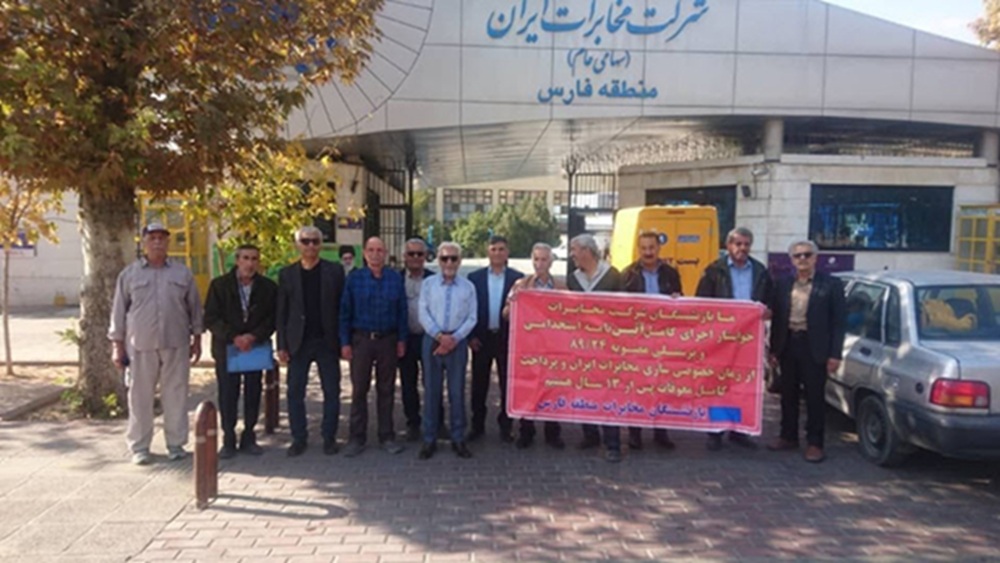
As the currency crumbled, retirees from the Telecommunications Company of Iran (TCI) launched coordinated protests in dozens of cities, including Tehran, Isfahan, Shiraz, Kermanshah, Sanandaj, Ahvaz, Rasht, Khorramabad, Zanjan, and Hamedan.
December 1—Isfahan, central Iran
TCI retirees rallied against unpaid dues and the role of IRGC- and EIKO-linked institutions, saying their wages and insurance have been looted and their living conditions continue to decline.#IranProtests pic.twitter.com/JznJOGlEoi— People's Mojahedin Organization of Iran (PMOI/MEK) (@Mojahedineng) December 1, 2025
The demonstrations were notable for their specific targeting of the regime’s most powerful economic conglomerates. Unlike typical labor disputes focused solely on wages, protesters explicitly named the institutions under the control of Supreme Leader Ali Khamenei. In Isfahan and other cities, retirees chanted, “The Revolutionary Guards and Setad (EIKO) stole our share,” and “The Leadership’s institutions have adopted looting and oppression.”
In Sanandaj and Kermanshah, protesters held placards condemning the “plunder” by the regime’s elite, stating that the major shareholders of the telecom company—specifically the IRGC-affiliated Mobin Trust Consortium and Setad—have refused to implement laws passed in 2010 regarding retiree benefits. Despite the dangerous levels of air pollution in Tehran and other metropolises, the elderly protesters refused to disperse, chanting, “Neither the Majlis [parliament] nor the government cares about the nation.”
Industrial Strikes: Record Production, Empty Tables
Simultaneously, the industrial sector witnessed continued unrest. In Bandar Abbas, workers at the Madkush Steel Company entered the second day of strikes on Monday. Employees report months of unpaid wages and empty promises from management. “The long delay in wage payments has pushed many families into a serious crisis,” workers stated, noting they can no longer afford basic necessities.
December 1—Bandar Abbas, southern Iran
Makoosh Steel workers launched a second day of strike, opposing months-long unpaid wages. They demand immediate payment of arrears and a clear plan to end recurring delays, saying families are pushed to crisis.#IranProtests pic.twitter.com/AHP8MHqfDG— People's Mojahedin Organization of Iran (PMOI/MEK) (@Mojahedineng) December 1, 2025
In Shush, southwest Iran, the strike at the Middle East Sugar Company entered its third consecutive day. The unrest highlights a stark paradox in Iran’s economy: while the company’s board of directors recently acknowledged that workers had achieved a “record-breaking” level of production, the workers themselves are sinking deeper into poverty. Strikers told local media that despite their hard work, “pressure is high, and our tables are shrinking every day.” Their demands include the formation of labor councils, proper job classification, and profit sharing—basic rights that remain unfulfilled despite the factory’s output.
Meanwhile, in Ilam province, the industrial collapse is visible. Workers from shuttered factories, including Chardavol Stone Paper and Pouya Nakh, gathered at the governor’s office. They were joined by employees from Dehloran Cement and Holeilan Petrochemical, protesting that they have received neither wages nor insurance coverage for months. “Who is answerable for our unemployment and livelihood?” they shouted, condemning the state’s neglect of the province’s “wretched industries.”
December 1—Shush, southwest Iran
Middle East Sugar Co. workers continued their strike for a third day, protesting harsh workloads and shrinking livelihoods despite record production. “Pressure and rising costs empty our tables,” they say, vowing to strike until demands are met.… pic.twitter.com/BYC6aTtPZZ— People's Mojahedin Organization of Iran (PMOI/MEK) (@Mojahedineng) December 1, 2025
Systemic Corruption in Different Industries
The protests also shed light on the systemic corruption driving Iran’s economic isolation. In Ilam, poultry farmers rallied outside the governor’s office, warning of total bankruptcy due to skyrocketing feed costs. However, reports indicate the crisis is engineered by state policy.
Since 2019, the government has mandated the use of the “Aryan” chicken breed to claim “self-sufficiency.” According to industry insiders, this breed has low productivity and cannot compete. Yet, to obtain production licenses, farmers are forced to buy “Aryan” chicks. The Secretary of the Poultry Federation confirmed that producers buy the government-mandated chicks to get the paper permit, discard them or use them inefficiently, and then secretly purchase foreign breeds from companies often linked to the same state entities. This cycle creates fake statistics for the government while generating “rent” (corrupt profits) for insiders, leaving the actual producers to face bankruptcy.
December 1—Zanjan, northwest Iran
National Housing Plan applicants rallied after 5 years of delay, denouncing rising costs, broken promises and constant extra payments. Mostly low-income workers say national housing now serves investors, not the poor.#IranProtests pic.twitter.com/vHRquyK730— People's Mojahedin Organization of Iran (PMOI/MEK) (@Mojahedineng) December 1, 2025
In Zanjan, the looting of the working class took a different form. Approximately 5,000 applicants for the “National Housing” project gathered to protest a five-year delay on homes promised to be delivered in two years. Initially told to contribute 150 million tomans for a unit, applicants—mostly low-income workers and tenants—are now being shaken down for over 800 million tomans due to inflation and project mismanagement. “This was supposed to be housing for the deprived,” one protester said. “It turns out National Housing is housing for the capitalists.”
The events of December 1, 2025, paint a picture of a regime at war with its own population. As the dollar soars toward 120,000 tomans, the Iranian people are not merely protesting mismanagement; they are identifying the specific institutions of the Supreme Leader—the IRGC and Setad—as the architects of their misery. With production lines halting and tables shrinking, the chants in the streets indicate that the gap between the ruling kleptocracy and the Iranian nation has become unbridgeable.