

Three-minute read
The last week of November ended with the clerical regime sounding less like a government and more like a shaken security command. Across state outlets, IRGC officials, Friday-prayer clerics, and regime economists described an Iran primed for unrest—and an organized resistance they fear is already inside the country. Their own admissions point to a ruling class bracing for coordinated confrontation, not abstract “foreign plots.”
The Gasoline Shock
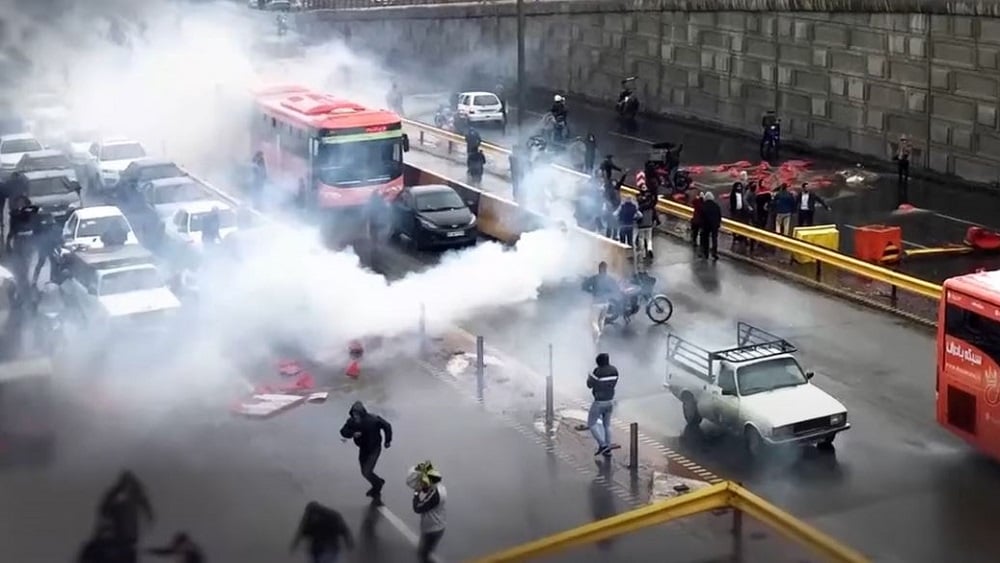
On November 29, state media ran an unusually blunt warning from Hossein Raghfar, a veteran regime economist who normally shields the system behind technical language. This time he did not. According to his interview, the state has raised gasoline prices 15 times, and “none of them reduced the budget deficit.” Instead, he admitted, the policy has trapped Iran in a “vicious cycle of inflation and deficit.”
Raghfar warned that the latest gasoline hike is already generating a “new wave of social inflammation.” In a society battered by collapsing purchasing power and record price volatility, he said, the public is now “more inflamed than at any time.”
Khamenei’s Friday Leaders Reveal Deepening Fear of the @Mojahedineng https://t.co/AbATaTeBED
— NCRI-FAC (@iran_policy) July 20, 2025
Guards Officials Admit What They Previously Denied
The most revealing remarks came from Brig. Gen. Rasul Sanaei-Rad, political deputy in Khamenei’s Ideological-Political Office—one of the system’s innermost security organs. Speaking on November 27, he laid out the kind of scenario the regime does not mention unless it feels vulnerable.
He said:
- “The enemy is still seeking to create unrest in Iran.”
- “Training for the formation of armed resistance cells is underway.”
- “Handguns are entering the country from the west and center into the depth of Iran.”
- “The scenario ahead is to strike at the main pillar of cohesion.”
- “The enemy is preparing a modern, multi-layered hybrid war, combining AI, soft war, and hard war.”
This is not routine propaganda. The regime rarely acknowledges domestic, organized threats unless it believes they are real. By speaking of “armed cells,” “internal traitors,” and “penetration,” Sanaei-Rad confirmed the security establishment is no longer worried about spontaneous demonstrations alone. It is worried about networks capable of turning social anger into coordinated escalation.
#Iran Faces Mounting Crisis: Snapback Mechanism Threats, Nationwide Military Alert, and Fear of Uprisinghttps://t.co/RM2d5Gbltz
— NCRI-FAC (@iran_policy) August 26, 2025
Friday Podiums Signal the Same Fear
The anxiety spilled onto the Friday-prayer circuit. In Shahr-e Kord on November 28, Ali-Asghar Hemmatian said plainly that the Basij was created not merely for the Iran–Iraq War but to confront “internal threats,” naming the “Mojahedin-e Khalq” directly. The clarity is striking. For decades, officials avoided public reference to the early-1980s internal conflict except in historical abstractions. Now they are bringing it into present tense.
Hemmatian told worshippers that the Basij must remain the nationwide shield the regime can call upon if “internal threats” reappear. This is not historical reflection—it is mobilization language. When the system re-invokes the founding logic of the Basij, it is preparing its base for civil-conflict scenarios.
Other clerics repeated similar tones. Their message: unity must be preserved not for economic recovery, but for confronting internal adversaries.
The MEK’s Growing Influence Sparks Iran Regime’s Fear and Desperationhttps://t.co/2cUTDRbhXp
— NCRI-FAC (@iran_policy) May 23, 2023
A Small Clash, But A Big Signal
Then came a telling incident on Friday, November 28. In Qir o Karzin near Shiraz, police and plainclothes forces entered a motorcycle track to confiscate high-cc bikes. What followed—captured in circulating videos—was not a routine enforcement event. Youths resisted, threw stones, and forced the security forces to retreat. Gunfire was heard; the crowd did not disperse.
The scale was local. The symbolism was national.
A security apparatus confident in its coercive power does not retreat from unarmed civilians. A society waiting for permission to push back does not stand its ground with that speed. For a regime deeply sensitive to early signs of defiance, the Shiraz clash was an unmistakable warning: even small confrontations now carry the mechanics of escalation.
#Iranian Officials Warn of “Libya Scenario” Amid Deepening Fear of Uprising and Escalating Crackdownshttps://t.co/vLWWYwIlap
— NCRI-FAC (@iran_policy) June 1, 2025
The Convergence the Regime Fears Most
Across all these statements—Raghfar’s admission of social volatility, Sanaei-Rad’s talk of armed cells, Friday clerics reviving the PMOI frame, and local youths testing the limits of police authority—the regime’s fear converges on one point:
The next unrest may not be spontaneous.
It may be organized.
Officials are not worried only about inflation or gasoline. Those crises matter because they create combustible conditions. But what truly alarms them is the possibility that anger could be channeled by structured networks with political objectives.
Thus, the new emphasis on “hybrid war,” “penetration,” and “the main pillar of cohesion.” The system understands that its repression model—designed for disorganized crowds—struggles against coordinated resistance.
And the pattern of recent state messaging shows a regime trying to inoculate itself psychologically. By insisting that unrest is the work of “trained cells” and “AI-assisted hybrid war,” it prepares its base for a legitimacy crisis: when people rise, it will not be because the system failed, but because “the enemy” manipulated them.
But beneath the rhetoric, the fear is genuine. The clerical dictatorship senses that another nationwide eruption is looming—one with more cohesion, more coordination, and more political direction than the waves of 2017, 2019, or 2022.
For a state that has survived by dividing, confusing, and outlasting its challengers, this is the scenario it never wanted to face: a society ready to explode, and a resistance ready to organize the explosion.