

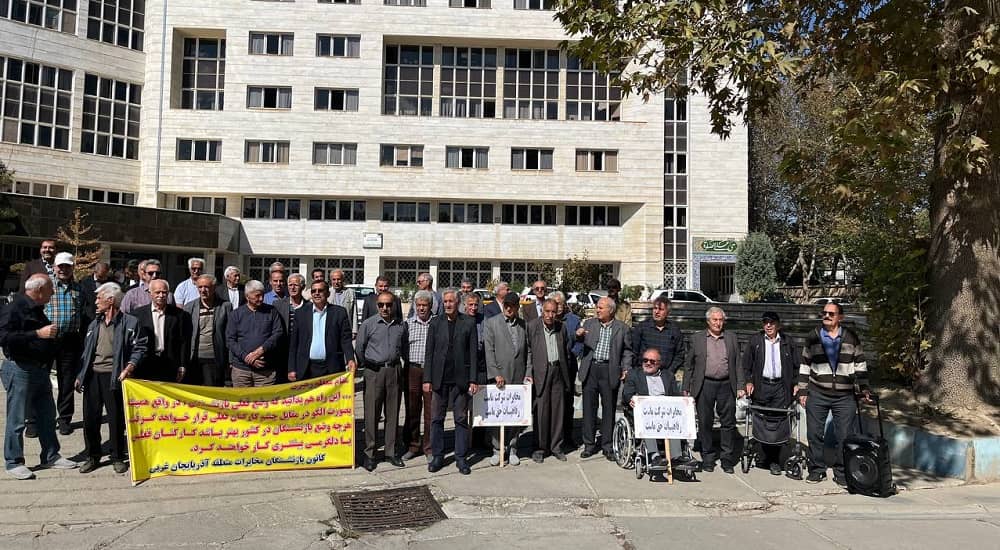
On October 7, 2024, protests unfolded across Iran, involving various sectors, including retirees, oil workers, and marginalized ethnic minorities. These demonstrations were met with violent crackdowns in some areas, reflecting the regime’s ongoing inability to address the deep economic and social crises gripping the country.
In Tehran, retirees of the Telecommunications Company of Iran held protests, demanding an increase in their pensions and denouncing the mismanagement of their funds by the government. Protesters chanted slogans such as “Our tables are empty, enough with the promises!” Their protest was part of a larger, coordinated action in multiple cities, including Shiraz, Kermanshah, Ilam, Rasht, and Tabriz. These retirees accused the government of ignoring their demands and failing to implement long-standing promises for pension reforms, adding to the nationwide frustration with the regime’s economic policies.
In Ilam, workers from the Argavan Petrochemical Plant in Chavar County continued their protests over the arrest of their colleagues. These workers, many of whom had been unemployed for months due to layoffs, gathered in front of the Judiciary Headquarters to demand the release of their detained coworkers. During the protest, two workers attempted self-immolation, with one being the father of a detained worker. Both were stopped before completing the act, but their desperate actions reflected the growing sense of hopelessness among workers facing dire economic conditions. The protesters have been demanding job reinstatement and clarity on their employment status for over three months.
October 7—Rasht, northern Iran
Retirees of Telecommunication Company of Iran resume weekly protest rallies, demanding higher pensions and other basic rights.
"The tyrannical shareholders have stolen our rights," protesters chant#IranProtestspic.twitter.com/Men7kkHoxw— People's Mojahedin Organization of Iran (PMOI/MEK) (@Mojahedineng) October 7, 2024
In Bushehr, employees of the South Pars Gas Company continued their ongoing demonstrations in Asaluyeh. Workers rallied in Site 1 of the gas complex, calling for fair wages, the removal of salary caps, and job security. Similar protests were held at the Fajr Gas Refinery as labor unrest grows in Bushehr Province, a key region in Iran’s oil and gas industries. Workers there are frustrated by the government’s failure to address their demands after months of strikes and protests.
Meanwhile, in Chabahar, Sistan and Baluchestan Province, IRGC forces demolished the homes of Baluchi residents on October 7, using bulldozers to destroy residential areas. This brutal act is part of a larger campaign to seize local land and transfer it to IRGC-controlled commercial interests, further marginalizing the already impoverished Baluchi minority. The residents, left homeless, have condemned the regime for its land-grabbing tactics under the guise of development projects, accusing the regime of deepening their economic struggles.
October 7—Bushehr, southern Iran
Employees of the Fajr Jam Gas Refining Company hold protest rally to reiterate their demands for better wages and working conditions. #IranProtestspic.twitter.com/n7ZhBJxtFH— People's Mojahedin Organization of Iran (PMOI/MEK) (@Mojahedineng) October 7, 2024
Housing protests also took place in Zanjan and Tehran on October 7. In Zanjan, citizens involved in the M-Shesh housing project gathered outside the Governor’s Office to protest delays in the construction of their homes. Many of them have invested large sums of money since 2019 but have yet to receive their promised housing. In Tehran, housing applicants of the Ershad New Town project protested outside the Supreme Court, demanding that the government fulfill its obligations to deliver homes that were promised years ago. These demonstrations reflect the deepening housing crisis across the country, where many Iranians are left without shelter despite having paid into government-backed housing schemes.
In Nasim Shahr, Tehran Province, teachers gathered outside the Department of Education on October 7 to protest the lack of transportation services for educators working in rural areas. The teachers, many of whom travel to remote villages like Akbarabad, have been left without transport services this year due to budget cuts, severely impacting their ability to work. The teachers were told that the Ministry of Education could no longer provide transportation services, leaving them stranded.
October 7—Ardebil, northwest Iran
Retirees of the Telecommunications Company of Iran (TCI) resume rallies to protest low pensions and lack of response by the government. #IranProtests pic.twitter.com/7gvMPkO8DA— People's Mojahedin Organization of Iran (PMOI/MEK) (@Mojahedineng) October 7, 2024
In Khash, also in Sistan and Baluchestan Province, security forces shot and killed a Baluchi fuel porter on October 6, while another porter was severely injured. Fuel porters, known locally as “sukhtbars,” are routinely targeted by security forces. The incident followed a similar attack in Nehbandan on October 5, where another fuel porter died after being pursued by regime forces, resulting in the crash of his vehicle. These porters, who transport fuel across borders for a living, have become frequent victims of state violence as they attempt to survive under harsh economic conditions in southeastern Iran.
The protests across Iran on October 7 reflect a nation in crisis. From Baluchi families facing home demolitions in Chabahar to retirees and workers demanding their rights in Tehran and Bushehr, Iran’s population is rising up against the clerical regime’s oppressive policies. Despite the government’s violent crackdowns, the widespread unrest continues to grow as more citizens demand accountability, justice, and economic stability.