

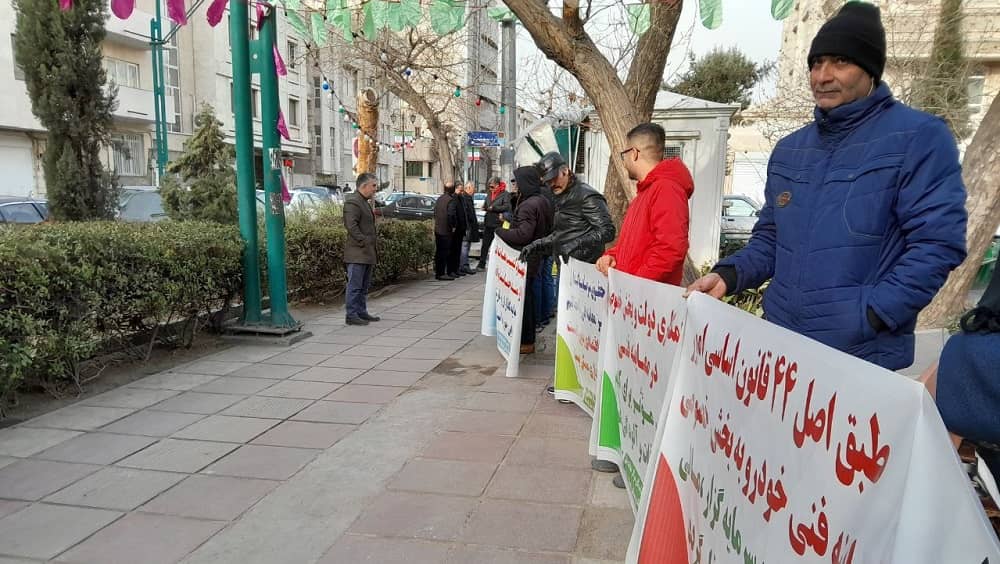
Protests and strikes erupted across multiple sectors in Iran this week, highlighting deepening economic distress, judicial leniency toward security forces, and public outrage over state policies. Workers, business owners, and ordinary citizens took to the streets, reflecting growing frustration with inflation, wage suppression, and state repression. Meanwhile, controversial judicial rulings and security force violence have intensified public anger.
On February 27, workers at the South Pars gas complex in southern Iran joined a growing campaign demanding a 70% wage increase, aligning with similar demands from refinery workers in Iran’s vital energy sector. Employees from the Sixth and Fifth Refineries of South Pars publicly declared their support for the wage hike initiative, calling on all workers to unite in opposition to wage suppression.
On the same day, applicants for the National Housing Plan in Kashan, central Iran, gathered to protest government mismanagement and skyrocketing housing prices. A woman at the protest shouted, “I am not begging!” while another protester lamented, “Two billion, two and a half billion—this is beyond our means, I swear!” The demonstrators, frustrated by years of unfulfilled promises and additional financial demands from authorities, chanted, “We do not want incompetent officials!”
The Iranian regime's suppressive security forces are destroying the homes of impoverished people in Baluchestan, Isfahan, & Kerman. In response, rebellious youth attack regime centers and targets, ensuring the oppressed people that their cries for justice are not ignored. pic.twitter.com/yt5YiK0cc7
— People's Mojahedin Organization of Iran (PMOI/MEK) (@Mojahedineng) February 27, 2025
On February 26, Tehran’s Molavi Bazaar, a major food and commodity market, witnessed mass shop closures as merchants protested harsh government-imposed price controls. Vendors reported being forced to sell Indian rice at an artificially low price of 48,000 tomans per kilo, despite purchasing it at 700,000 tomans per sack. Heavy fines—ranging from 250 to 300 million tomans—were imposed on those who refused to comply, with some shops forcibly shut down.
A merchant at the scene warned, “You cannot regulate the economy by force; the government must find a real solution for the people.” Reports indicate that most wholesale and retail food shops in the area remained closed, significantly impacting trade in the lead-up to the Persian New Year.
Public outrage has surged following the acquittal of a senior military official who shot and killed a young man in Kermanshah’s Taq-e Bostan district. The official, who used his service weapon, was cleared of premeditated murder and instead sentenced to one year in prison for “negligence in the use of firearms.” He was also ordered to pay diya (blood money) for the victim’s death. The ruling has fueled criticism over judicial double standards, as ordinary citizens accused of lesser crimes often face severe penalties, while state agents systematically walk free with impunity.
February 27—Kashan, central Iran
Customers of the state-owned Maskan-e Melli housing company rally to protest the rising prices of homes and unfair conditions of delivering homes.
"We don't want incompetent officials!" protesters chant#IranProtestspic.twitter.com/jo8yGdNacM— People's Mojahedin Organization of Iran (PMOI/MEK) (@Mojahedineng) February 27, 2025
In another sign of economic instability, food and dry goods traders in Tehran launched a strike on February 26, protesting deteriorating business conditions, rising taxes, and government mismanagement. Video footage from Amin al-Sultan Square shows widespread shop closures and protesters chanting, “Bazaaris with honor, support, support!” Strikers urged their colleagues to join the protest, echoing recent demonstrations by merchants across Molavi Bazaar, Southern Khiam, and Meydan-e Qiyam.
Iran’s economy is spiraling as the rial continues its freefall, with the U.S. dollar surpassing 96,000 tomans in unofficial markets. Gold prices have skyrocketed, with the Imami gold coin now valued at 76.5 million tomans. Workers across multiple sectors remain locked in disputes over wage stagnation as authorities continue delaying the determination of minimum wages for 2025.
Meanwhile, outrage erupted in Iran’s Sistan and Baluchestan province after Yousef Shahli-Bar, a five-year-old Baloch child, was shot and killed by security forces in Iranshahr. His mother, Maryam Shahli-Bar, a 32-year-old pregnant woman, was also injured in the attack and later suffered a miscarriage. Witnesses reported that security forces opened fire without warning on the family’s vehicle.
February 26—Kerman, southern Iran
Customers of the state-run Maskan-e Melli housing company rally in front of the governorate, protesting the non-delivery of their homes years after they made payments.#IranProtestspic.twitter.com/Fro31OWqva— People's Mojahedin Organization of Iran (PMOI/MEK) (@Mojahedineng) February 26, 2025
Following the attack, security personnel detained Ramin Shahli-Bar, the child’s father, and transferred him to an undisclosed location. Critics point to the killing as part of the Iranian regime’s systemic oppression of the Baluch minority, which has faced intensified crackdowns over the past year.
The combination of economic decline, escalating protests, judicial double standards, and state violence has fueled speculation that the Iranian regime is facing one of its most precarious moments in recent years. The government’s inability to address core grievances—ranging from wages and housing to economic mismanagement and repression—has only intensified public anger. With strikes spreading across industries, from energy workers to market vendors, and protests persisting in major cities, analysts warn that Iran’s economic and political crises are reaching a breaking point.