

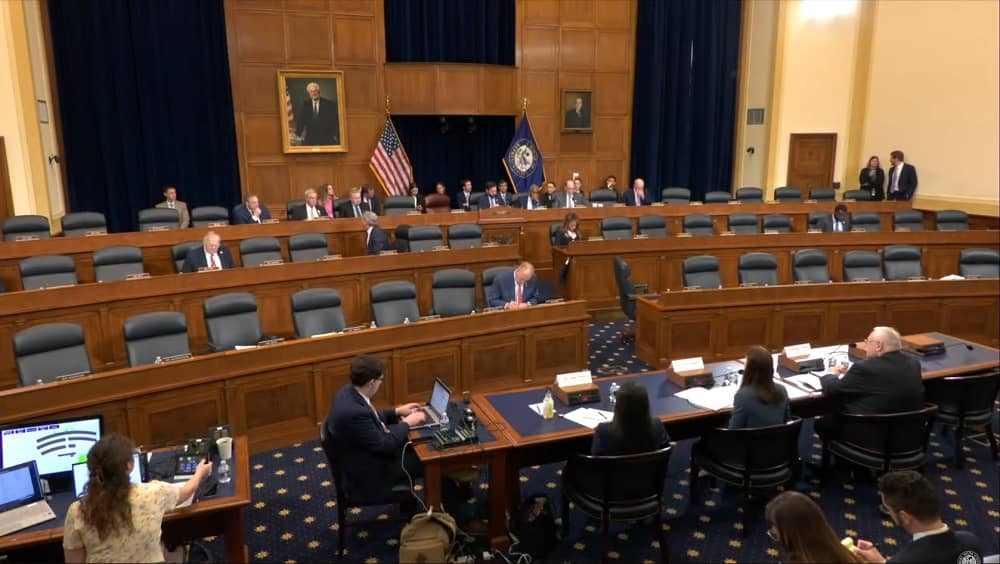
A U.S. congressional hearing on Tuesday, April 1, 2025, highlighted mounting concerns over the Iranian regime’s destabilizing influence across the Middle East and its advancing nuclear capabilities. Lawmakers and experts scrutinized the regime’s ongoing support for proxy groups, its manipulation of international sanctions, and the growing threat posed by its nuclear program.
The hearing, titled “A Return to Maximum Pressure: Comprehensively Countering the Iranian Regime’s Malign Activities,” was convened by the House Foreign Affairs Committee. Chairman Michael Lawler of the Middle East and North Africa Subcommittee delivered scathing opening remarks condemning the clerical dictatorship’s persistent hostility and manipulation of diplomatic engagement.
In his opening remarks, Chairman Lawler drew a sharp contrast between the Trump administration’s “maximum pressure” policy, which he credited with devastating Iran’s economy and diminishing the power of its proxies, and what he described as the misguided policies of the previous administration.
“When President Trump left office over 4 years ago, the Iranian regime and its terror proxies were on their heels. The Trump administration’s maximum pressure policy had devastated Iran’s economy and denied the regime access to critical resources. Mathematically, Iran was cornered and isolated like never before.” Rep Lawler stated.

Rep. Lawler underscored the importance of a stringent approach to countering Iran’s illicit oil trade, particularly involving China. “As part of the maximum pressure, we must fully enforce existing sanctions to stop this illicit oil trade, specifically cutting off Iran’s oil trade with China, which accounts for roughly 90% of oil exports. Last year, Iran made over $50 billion from its illicit oil trade, much of which is controlled by its Revolutionary Guard Corps.”
According to Norman Roule, a former U.S. intelligence official and current advisor at the Center for Strategic and International Studies, the Iranian regime’s nuclear advancements are more alarming than ever. Roule noted that Iran has amassed enough 60% enriched uranium for approximately seven nuclear weapons and could produce weapons-grade material within a week if it chose to proceed. “Iran’s proxy operations remain a major threat, despite recent setbacks,” he added, pointing to the Quds Force’s ambitions to reestablish influence through affiliates in Lebanon, Yemen, and Sudan.
Claire Jungman of United Against Nuclear Iran (UANI) emphasized that Iran’s oil revenue remains the lifeblood of its malign activities, with the IRGC directly controlling up to half of the country’s oil exports. She urged a vigorous enforcement campaign to sanction every vessel, port, and facilitator linked to Iran’s illicit oil trade. “Every barrel of Iranian oil sold on the black market strengthens the IRGC’s hand bankrolling groups like Hamas, Hezbollah, and the Houthis,” she stated.
“Appeasing terrorists does. Not. Work.”
Watch the full hearing NOW: https://t.co/TcHQaM2ms0 pic.twitter.com/Mmz3SZUqVh
— Congressman Mike Lawler (@RepMikeLawler) April 1, 2025
Dana Stroul, Director of Research at The Washington Institute for Near East Policy, argued that Tehran’s power is waning due to concerted efforts by the U.S. and its allies. According to her testimony, the clerical dictatorship’s influence has been severely undermined by Israeli operations against the regime’s proxy network and by U.S.-led regional air defense initiatives. Stroul also highlighted Iran’s domestic struggles, including economic crises, power outages, and escalating public unrest.
Witnesses and lawmakers alike agreed that the window for applying decisive pressure on Tehran is now. As Stroul warned, “Sanctions alone cannot stop Iran’s nuclear program.” Instead, she advocated for a balanced approach combining diplomatic engagement with credible military threats.
The hearing underscored the broad consensus among experts and lawmakers that the Iranian regime’s behavior will not change without sustained enforcement of sanctions and firm military deterrence. Roule concluded his testimony with a warning that Tehran’s ability to weaponize its nuclear program is closer than ever. “Iran looks like a country building a nuclear weapons program, albeit one which has yet to make the final decision because it either believes it will face discovery and ruinous military consequences or that the current approach offers significant diplomatic leverage,” he said.