

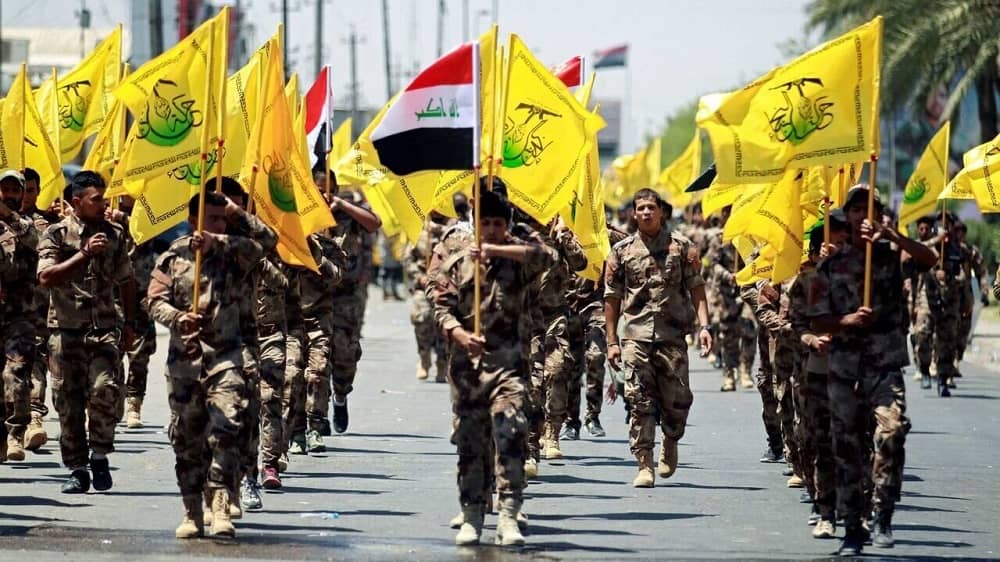
As the United States and Iran prepare to resume indirect nuclear talks in Oman this weekend, Sky News Arabia, citing a detailed report by Asharq Al-Awsat, has revealed that the Iranian regime’s Supreme Leader Ali Khamenei issued a discreet religious directive to Iraqi militias last year. The verbal fatwa, delivered in autumn 2024 through a delegation of Shiite political figures, authorized the militias to pause attacks on U.S. forces as a tactical maneuver, so long as Tehran’s broader influence in Iraq remains intact. The revelation sheds light on the regime’s duplicity: publicly maintaining its aggressive posture while privately seeking to avoid confrontation amid sensitive negotiations.
According to a wide-ranging report by Asharq Al-Awsat, Khamenei issued a verbal fatwa last year to representatives of pro-Iranian Shiite groups in Iraq, granting them permission to avoid provoking American attacks, so long as they do not compromise Tehran’s political influence in Baghdad. The fatwa, described as a doctrine of “damage control,” has been interpreted as a green light for “zero operations” against American forces, at least for now.
“The factions are the ones who determine the fate of their weapons,” said a senior commander of a Shiite militia. “This depends on what best serves the region’s interest, not the decision of any foreign power.”
#Iran News: Tehran Uses #Hezbollah Disarmament Talk as Tactical Move to Delay Escalation Before U.S. Talks – Al-Arabhttps://t.co/My1UBWBee6
— NCRI-FAC (@iran_policy) April 11, 2025
The report confirms that Quds Force commander Esmail Qaani left behind a small Iranian team in Baghdad to oversee the implementation of Khamenei’s orders, as well as to manage internal factional politics amid increasing U.S. pressure. “The priority now is to protect pro-Wilayat al-Faqih forces inside the Iraqi political system,” a Shiite political leader told Asharq Al-Awsat. “They can always revive the militias later if disarmament becomes necessary.”
Meanwhile, Washington has intensified its demands. On April 9, 2025, the Trump administration delivered a new letter to Baghdad, reiterating its insistence on the full disarmament and demobilization of all paramilitary factions outside government control, including the Popular Mobilization Forces (PMF). The letter also called for dismantling drone manufacturing facilities and transferring all weapons to a government-supervised body vetted by the United States.
“There is no ambiguity in the U.S. position,” said an Iraqi official familiar with the discussions. “They want the threat of Iranian-backed militias neutralized not just for now, but for years to come—or at least during Trump’s current term.”
A brief overview on how the #IRGCterrorists Quds Force rearranged the group perceived as the "Iraqi branch of Al-Qaeda" into the "Islamic State of Iraq" and then to #ISIS, helped cracking down on Iraqi and #Syrian uprisings and paved the way to create the PMF. pic.twitter.com/GwacqJhFPH
— NCRI-FAC (@iran_policy) January 18, 2024
Khamenei’s fatwa appears designed to buy time and defuse tensions without relinquishing strategic control. Iraqi sources note that the fatwa was conveyed verbally to a delegation of militia leaders in autumn 2024. When asked if the previous religious justification for attacks on U.S. and Israeli targets was still valid, Khamenei replied simply: “Avoiding harm takes precedence.”
This principle of “damage avoidance” has now become a central talking point within Iraqi pro-Iranian circles. “The aim,” according to a senior figure in one militia, “is not to disarm permanently but to avoid triggering a conflict that could derail negotiations.”
Inside Iraq’s Coordination Framework—a coalition of Shiite parties aligned with Iran—internal debate has shifted from disarmament to political survival. The current strategy, one insider described cynically, is “like sacrificing the fetus to save the mother”—preserve Tehran’s political foothold even if some militias are temporarily sidelined.
#Iran News in Brief
"No to Iranian regime, yes to the will of the #Iraqi people," protestors chant in #Baghdad and Karbala.https://t.co/L4xTMH1vyw pic.twitter.com/3HxMDVOY1f
— NCRI-FAC (@iran_policy) April 16, 2022
Still, divisions remain. Some powerful Shiite leaders are questioning whether continuing to “put all the eggs in Tehran’s basket” is wise, especially as U.S. military deployments in the region increase. Others warn that the regime’s calculated retreat may soon give way to renewed escalation if talks fail.
“There’s a shift happening,” admitted a commander affiliated with the PMF. “We’re caught between Iranian political loyalty and American security and economic pressures. In the end, it will come down to one of two outcomes: surrendering arms, or setting the region on fire again.”
Analysts say the Iranian regime’s duplicity is once again on full display—projecting ideological commitment while pragmatically maneuvering for survival. Even as Tehran signals tactical moderation through backchannels, it retains firm control over its regional proxies. The clerical leadership, observers warn, is not dismantling its apparatus but rather preserving its options should the negotiations with Washington fail.