

Three-minute read
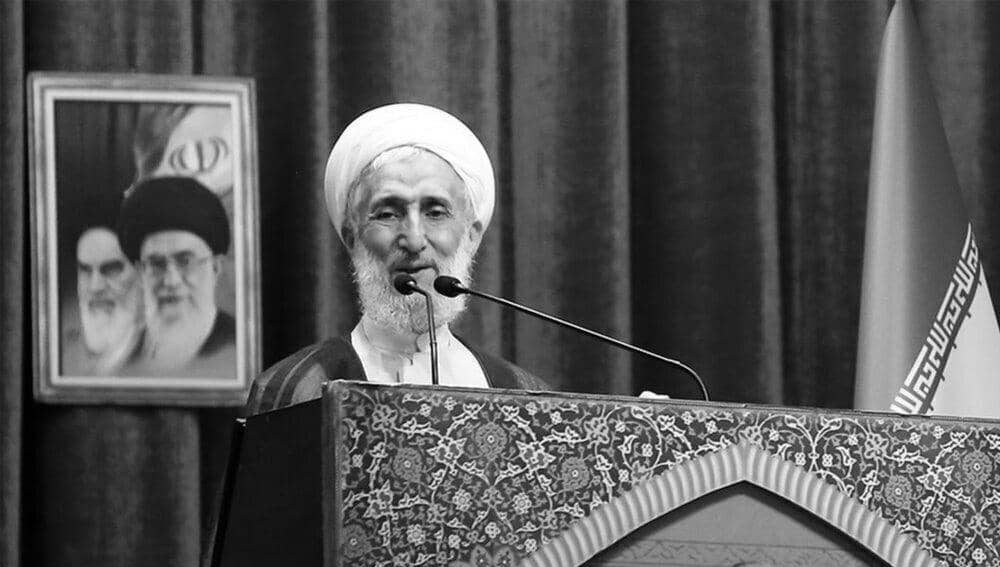
Kazem Seddiqi’s controversial return to Tehran’s Friday Prayer pulpit on July 18, 2025, has sparked significant public and political backlash, reigniting debates around corruption, accountability, and the regime’s impunity toward its insiders. After months of absence caused by his entanglement in a murky financial corruption case involving the illicit transfer of ownership documents for a luxury garden estate in the affluent Ozgol district of Tehran, Seddiqi reappeared before the public to call for “piety” and “unity.”
His re-emergence is part of a broader attempt by the clerical dictatorship—severely weakened by a convergence of crises over the past two years—to fabricate a façade of “national unity” in a system increasingly exposed as hollow and fractured.
Cleric with a Case
Seddiqi had previously refrained from leading Friday prayers following the arrests of his sons and daughter-in-law over allegations of land grabbing and embezzlement in connection with the Ozgol property case. However, without addressing the accusations or providing any accountability, he returned to the high-profile religious platform and once again assumed his roles as Friday Prayer leader and head of the so-called Headquarters for the Promotion of Virtue and Prevention of Vice.
His return comes at a time when the regime is under immense pressure: militarily weakened after the 12-day war, internally destabilized by rising public anger, and increasingly incapable of maintaining the loyalty of its own ranks. The clerical leadership appears desperate to showcase continuity and loyalty—even if it means recycling figures tainted by scandal.
Kazem Seddiqi’s Family Symbolizes Institutionalized Corruption in #Iran’s Regimehttps://t.co/ERNf8NIume
— NCRI-FAC (@iran_policy) June 12, 2025
The Backlash
His presence at the pulpit has been viewed by many as a provocation. Far from calming tensions, it has fueled a fresh round of criticisms — not only from the so-called reformist figures but from within the faction that aligns itself with the Supreme Leader Ali Khamenei. Even former members of parliament and advisers to high-ranking officials like Majlis Speaker Mohammad Bagher Ghalibaf expressed public dismay.
“From the sudden return of the former Friday prayer leader, without any clarification or explanation… I was surprised,” one adviser close to Ghalibaf admitted. Former MP Mostafa Kavakebian remarked that this time, “the outrage from the conservative faction is even louder than from us reformists.” Alireza Moezi, former secretary of the government’s Information Council, denounced Seddiqi’s selection as “more than just an insult to the people.”
Jalal Rashidi-Koochi, an MP aligned with Khamenei, called the move a “deliberate insult to public opinion” and warned that such actions undermine the already fragile sense of national cohesion.
Delving into Iran’s #Corruption Chronicles – Part 1https://t.co/3uRDWFAqxD
— NCRI-FAC (@iran_policy) December 21, 2023
Ahmad Zeidabadi, a political commentator, pointed out the regime’s blatant double standard, asking how someone whose relatives face serious corruption charges can sermonize about piety, while others are barred from public office for far less.
Principlist media figures like Mohsen Maqsoudi and Mohammadamin Salimi—both aligned with Saeed Jalili—joined in the criticism, warning that the decision jeopardizes whatever unity the regime claims to be safeguarding.
A Symbol of the Regime’s Decay
Seddiqi’s return is not simply a personal story of defiance; it is emblematic of the broader problem of institutionalized corruption and lack of accountability within the regime’s power structure. Despite being mired in scandal, he remains in his official positions, shielded by clerical status and political connections.
Friday Prayer Sermon in Tehran Was Interrupted By Protest
Today, according to state news agencies, during the Friday prayer sermon in Tehran, a man from the crowd stood up and while interrupting Kazem Sediqi’s speech#IranProtests #Iran https://t.co/cmRKWjHA5F pic.twitter.com/rVZnE7yxeY
— NCRI-FAC (@iran_policy) March 11, 2022
One scathing commentary published in a state-linked outlet sarcastically compared Seddiqi’s return to the devastation of the Fordow nuclear facility, concluding that this decision may have done even more damage to “national unity.” Another piece described his return as an example of the “law of clinging to the podium,” a jab at those who refuse to relinquish power no matter the cost to public trust.
Mohammad-Ali Abtahi, former presidential chief of staff, commented that if Seddiqi had even a fraction of the piety he preaches, he would voluntarily step back until the legal fate of his sons is clear. Akbar Nabavi, a principlist journalist, lamented that Seddiqi’s refusal to resign from his posts is dragging public trust down further.
Attempt to Downplay Scandal
In his sermon, Seddiqi tried to frame the entire corruption case as a mere “incident” that had already been resolved, making no reference to the ongoing legal troubles of his family members. Instead, he focused on standard regime talking points such as “avoiding division,” “supporting national authority,” and glorifying Khamenei’s leadership after the recent 12-day war. However, public reactions, especially online, were far less forgiving.
Kazem Sedighi, A Khamenei Ally, Exposed to Have Grabbed Billions Worth of Land in #Iran's Capitalhttps://t.co/CmbzjfHMsP pic.twitter.com/cze9r5g7rI
— NCRI-FAC (@iran_policy) March 18, 2024
Seddiqi’s return wasn’t a show of strength—it was a test of Khamenei’s grip. By reinstating one of his closest allies at the regime’s most symbolic pulpit, the Supreme Leader aimed to assert control and revive the image of unity. But the backlash, even from loyalist factions, exposed just how fragile his authority has become.
Far from reinforcing cohesion, the move laid bare the regime’s deep internal fractures and the hollowness of its unity campaign. Seddiqi’s comeback turned into a reminder that even orchestrated displays of power can unravel when the system beneath is this compromised.