

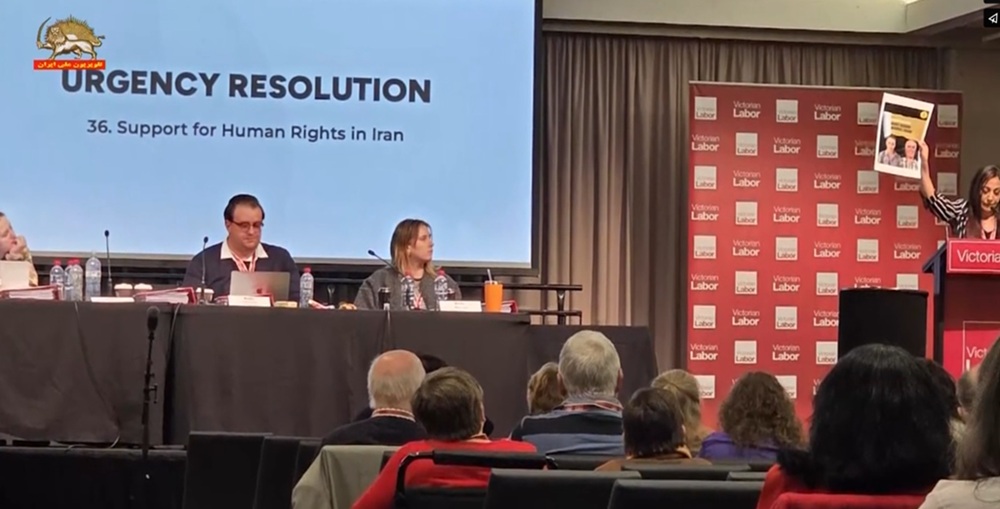
On August 8, 2025, as the Iranian regime accelerated its campaign of state-sanctioned murder, a major Australian political party delivered a powerful message of international solidarity. At its annual state conference in Melbourne, the Labor Party of Victoria passed a unanimous resolution condemning Tehran’s egregious human rights violations and, for the first time, giving its explicit support to the Ten-Point Plan of the Iranian resistance.
The resolution specifically condemned the recent executions of political prisoners Behrouz Ehsani and Mehdi Hassani and expressed grave concern over the potential for a repeat of the 1988 massacre, in which 30,000 political prisoners were systematically executed. By endorsing a democratic, secular, and non-nuclear alternative, the Australian political body has drawn a clear line between the people of Iran and their oppressors.
The Human Face of the Regime’s Brutality
The political weight of the resolution was grounded in the harrowing personal testimony of Fahimeh Koshani, a representative of the Australian-Iranian community. Addressing the conference in Melbourne, she provided a stark account of the regime’s cruelty. “When I was only 14,” she stated, “I was imprisoned for four years and subjected to physical, mental, and sexual torture, for the crime of being the sister of a political prisoner. My brother, at the age of 20, was executed by firing squad simply for reading a newspaper.”
Holding up photos of the recently executed Behrouz Ehsani and Mehdi Hassani, she declared, “Where their voices were silenced, my voice must be raised.” She also issued an urgent plea for Saeed Masouri, a political prisoner who has endured over 25 years of torture and threats of execution. Her message to the international community was unequivocal: “Silence must not become complicity.”
#Australian Group Calls on Government to Halt Death Sentences for Six Political Prisoners in #Iranhttps://t.co/mKiXsv832m
— NCRI-FAC (@iran_policy) December 10, 2024
A Blueprint for Murder in Ghezel Hesar Prison
The names condemned in the Australian resolution are victims of a recent, premeditated atrocity. On Saturday, July 26, over 100 of the regime’s heavily armed guards stormed Unit 4 of Ghezel Hesar prison in a military-style assault. During the raid, they singled out and executed PMOI members Behrouz Ehsani and Mehdi Hassani. In a final act of cruelty, the regime refused to return their bodies to their families, preventing public mourning.
The same raid targeted Saeed Masouri, the veteran prisoner mentioned by Ms. Koshani. In an act of reprisal for his continued resistance, authorities forcibly exiled him to the notoriously brutal prison in Zahedan. This pattern of isolating and eliminating steadfast opponents reveals a systematic plan of terror.
Urgent Crisis: Five More Lives Hang in the Balance
With the brutal raid on Ghezel Hesar serving as a blueprint, the regime is now poised to strike again. On Friday, August 8, five more PMOI supporters on death row were transferred to the same execution site. The men are:
- Vahid Bani Amerian, 33, who holds a master’s degree in management.
- Babak Alipour, 34, a law graduate previously imprisoned for his activism.
- Shahrokh Daneshvarkar, 58, a civil engineer.
- Pouya Ghobadi, 33, an electrical engineer.
- Mohammad Taghavi, 59, a veteran political prisoner from the 1980s.
The regime used an airstrike that damaged Tehran’s Evin Prison in late June as a cynical pretext to launch a violent reshuffling of inmates, separating these men for execution.
European & Australian lawmakers & activists join @Maryam_Rajavi to tell their Govs: Appeasement of #Iran’s terrorist regime would embolden the mullahs & lead to war. To avoid war world powers should support the democratic opposition to achieve a #FreeIran. #IStandWithMaryamRajavi pic.twitter.com/nmEOagGoZD
— NCRI-FAC (@iran_policy) June 29, 2019
A Call for Principled Action
The resolution from the Australian Labor Party of Victoria offers a clear model for international policy at this critical juncture. It demonstrates a commitment to supporting the Iranian people’s democratic aspirations while unequivocally condemning the regime’s murderous actions.
As Fahimeh Koshani urged, the path forward is “not with bombs, not with silence and appeasement, but with principled solidarity.” The international community, including the United Nations and its human rights bodies, must now follow this lead. They must take immediate and decisive action to ascertain the status of the five prisoners and intervene to save their lives. Inaction is complicity in the face of state-sanctioned murder.