

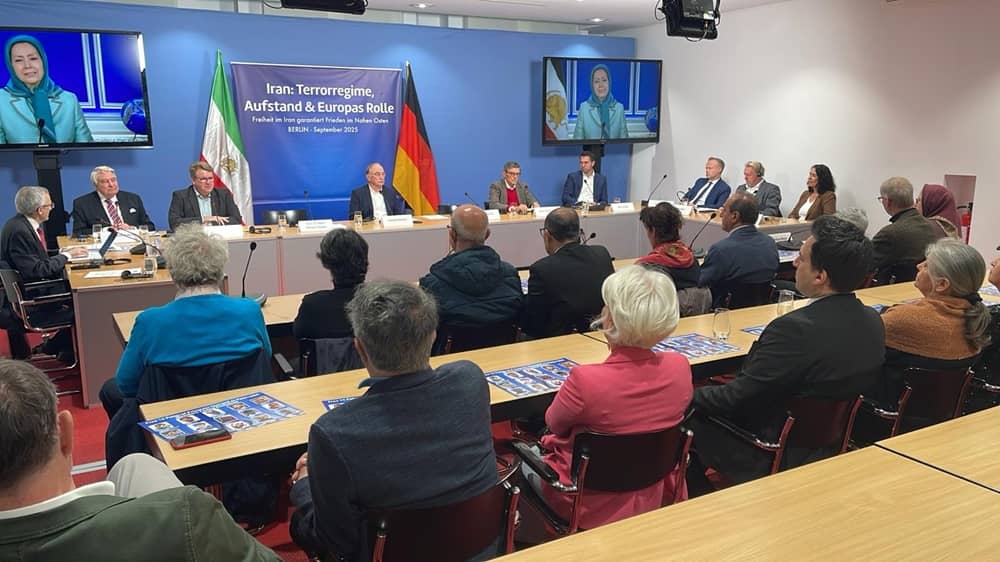
Berlin, 25 September 2025 — In a conference titled “Iran: Reign of Terror, Popular Uprisings, and the Role of Europe,” German members of parliament and former senior diplomats joined Maryam Rajavi, President-elect of the National Council of Resistance of Iran (NCRI), in urging Europe to align sanctions and diplomacy with explicit support for Iran’s organized democratic alternative. Speakers tied their message to large diaspora mobilizations—tens of thousands rallying in Brussels on 6 September for the MEK/PMOI’s 60th anniversary and a major gathering in New York this week—and echoed the opposition’s unifying refrain: “No to Shah, no to mullahs—yes to a democratic republic.” Throughout, the role of Resistance Units inside Iran was described as the engine of change, while Rajavi’s Ten-Point Plan was presented as the concrete framework for transition.
Opening the conference, Maryam Rajavi said that despite intensified repression and a rising number of executions, “important changes are taking place on the people’s front in Iran. These developments point to the progress of the democratic solution.” She linked recent diaspora rallies to domestic unrest: “On September 6, tens of thousands of Iranians gathered in Brussels… Two days ago, Iranians from many U.S. states held a rally in New York, making the same demands.”
Rajavi spotlighted the Resistance Units as the uprising’s catalyst: “Resistance Units are expanding their actions in Tehran and other cities… In one year, the Resistance Units carried out close to 3,000 anti-repression operations and more than 35,000 acts of resistance… in all 31 provinces of the country.” She framed the central dynamic bluntly: “The real equation is the conflict between the people of Iran and the clerical regime… On one side stands the Revolutionary Guards; on the other side is a rebellious force that acts daily against repression.”
On the nuclear file, Mrs. Rajavi recalled the opposition’s exposure of secret sites: “Over the past 34 years, the Iranian Resistance has made 133 revelations about the regime’s nuclear project… Without the role of the Iranian Resistance, the world today would face a fundamentalist regime armed with nuclear weapons.” Quoting Ali Khamenei’s September 23 remarks, she added: “We increased uranium enrichment to 60 percent… there has been a lot of pressure on us to stop, but we did not surrender, and we will not surrender.” She warned that “the fate of more than 400 kilograms of 60-percent enriched uranium remains unknown,” and that talks are stalled: “Everything is uncertain and unclear. There is no clear solution in sight.”
The real equation is the conflict between the people of Iran and the clerical regime.
Since the nationwide uprising in 2017-2018, the people of Iran have shown strongly that they seek to overthrow the regime. They have expressed their historic demand through an organized… pic.twitter.com/6C6UPhSzL8— Maryam Rajavi (@Maryam_Rajavi) September 25, 2025
Rejecting a binary choice, Rajavi said: “The West must accept either that Iran’s religious fascism will take the final step toward building a nuclear weapon or inevitably face war. However, this is a false choice… The real solution is within reach: the overthrow of the regime by the people of Iran and their organized resistance.” She urged Europe to act: “It is time for Germany and all European Union governments to recognize the Iranian people’s struggle to overthrow this regime… [and] to place the Revolutionary Guard Corps (IRGC) on their terror lists.”
She also memorialized repression against MEK activists: “Last month, on Khamenei’s orders, two PMOI members—Behrouz Ehsani and Mehdi Hassani—were hanged… Right now, 14 other members and supporters face death sentences… The sham trial of the PMOI and 104 members and leaders… has continued for two years.” Her lodestar remained the NCRI’s republican platform: “Neither appeasement nor foreign war or intervention will work. The only solution is regime change by the people of Iran and their organized resistance.”
Carsten Müller (CDU), Member of the Bundestag, welcomed cross-party participation and argued that the current rulers in Tehran preclude stability. “With this regime, a solution—toward peace abroad or freedom at home—is not possible,” he said. “We are on the cusp of activating the snapback mechanism. We see sanctions that are sharp and, in my view, must be further tightened.” Pointing to the Brussels rally, he noted: “It was widely noted and made clear that the Iranian people want this regime change.” He endorsed Maryam Rajavi’s Ten-Point Plan as “an important step toward a democratic, secular state under the rule of law,” stressing that the Brussels demonstration showed the Iranian people’s demand for regime change and aligning himself with the call for a democratic republic free from dictatorship.
#BerlinFreeIranKonferenz: Demokratische Alternative zum Mullah-Regime unterstützen!; #IranThirdOption ist die Lösung der #Iran-Krise; #Snapback aktivieren!#NCRIAlternative #No2ShahNo2Mullahs
25. Sept #Berlin – Zahlreiche Abgeordnete des Bundestags sowie führende Persönlichkeiten… pic.twitter.com/InJG5C1sYQ— Javad Dabiran (@JavadDabiran) September 25, 2025
Amb. (ret.) Dr. Hans-Ulrich Seidt, former German Ambassador to Afghanistan, urged a cool-headed assessment. “A sober geopolitical analysis… leads to the conclusion that the regime in Tehran is approaching an existential crisis—perhaps already in it.” He asserted that Tehran’s regional standing has collapsed: “Assad has been toppled; Hezbollah has been largely smashed; the Houthis pushed massively onto the defensive; and Iran thrown back upon itself.” As an emblem of diminished clout, he said: “Ali Larijani traveled to Lebanon to halt Hezbollah’s disarmament… He received no appointment with the president… and was told he would not have been received anyway.” He linked the loss of proxy leverage to “the inner coherence of the system” and rising domestic resistance.
Martin Patzelt, former Member of the Bundestag, drew on his life in the GDR to warn about systematic disinformation: “The resistance can only come from within.” Rejecting smears, he said MEK/NCRI are “organized, strategic, and focused—an intelligently organized opposition force.” He stressed the symbolism of female leadership: “Under a woman… Madam President—this alone is a credential of credibility.” Citing former U.S. official Robert S. Joseph, he added: “There is an organized opposition… ready to draft a new constitution, organize free and fair elections, and establish a democratic government in Tehran.”
In a written message, Prof. Rita Süssmuth, former Bundestag President, called this “a fateful moment.” “Either [Iran] will walk the path toward freedom and democracy or remain in the fetters of rule,” she said. She rejected the claim of no alternative: “There is a democratic alternative—the National Council of Resistance of Iran under Maryam Rajavi… Her steadfastness, leadership, and clear Ten-Point Plan… are a reliable foundation for a democratic and sustainable future.” She tied the struggle to European values: “Not only does the Iranian Resistance need international support—we need it.”
📢 Berlin hosted an Iran policy conference with German dignitaries, MPs & experts discussing a democratic alternative.@Maryam_Rajavi welcomed UN sanctions but urged stronger action & support for Iran’s organized resistance.
Timely coverage: https://t.co/VCByrJP3D1 https://t.co/ReQfMJGE5C pic.twitter.com/FFj3A0Glty
— Safora Sadidi (@SaforaSM) September 25, 2025
Jan Metzler (CDU), Member of the Bundestag, said the Bundestag delegation’s presence was a deliberate “sign of solidarity” with Iran’s democratic opposition. He praised Maryam Rajavi’s leadership, recalling their meeting in Paris: “Your strength and clarity left a deep impression on me.” Metzler stressed that “change arises from courage,” pointing to the sacrifices of Iranians resisting dictatorship. He warned that such commitment demands a political response: “If people in Iran risk everything for freedom, the least we in Germany can do is stand with them.” He thanked NCRI for sustaining the campaign in Europe.
Joachim Rücker, former German Ambassador to Sweden and President of the UN Human Rights Council (2015), centered human rights: “Iran… regularly belongs to the two countries that carry out the most death sentences per year.” Acknowledging UN mechanisms, he pressed for European steps: “The Revolutionary Guards must finally be placed on the EU terror list.” He urged conditioning any engagement on “abolition of the death penalty and the release of political prisoners,” more universal-jurisdiction cases in Europe, and stronger investigation mandates at the UN. He welcomed proceedings in the United States against Parviz Sabeti, a former SAVAK director, to underscore: “A return to the Shah’s past is not an option for the future.”
Leo Dautzenberg, Chair of the German Solidarity Committee for a Free Iran (DSFI) and former MP, tied Iran’s drones and missiles to European security: “They set Ukraine—thus Europe—on fire… Their long-range missiles are within reach across Europe, including Germany.” Reporting from budget debates, he said: “The E3 will activate snapback… and sanctions can be reimposed internationally.” He credited the NCRI/MEK with exposing Natanz and Arak: “Who alerted the world to this danger? The NCRI and the MEK.” On alternatives, he warned: “The return to other forms of dictatorship is no answer to the people’s demands for freedom.” He called for “constructive contacts with the NCRI” across democratic parties.
Ein sehr lesenswerter, sachlicher Artikel von @NorbertWallet in der Stuttgarter Zeitung über die heutige #BerlinFreeIranConference https://t.co/Y2qcO8e4Bh
— Javad Dabiran (@JavadDabiran) September 25, 2025
Mareike Hermeier (Die Linke), Member of the Bundestag, underscored the universal stakes of the Iranian struggle, saying: “As long as even one child suffers under dictatorship, we are all at war.” She denounced the clerical regime’s actions as “crimes, not just situations,” and stressed that repression in Iran cannot be ignored internationally. Hermeier urged continued pressure and direct engagement with parliamentarians: “Please keep reaching out and tell me what I can do. I am ready to act, even if I am new.” She framed solidarity with the Iranian Resistance as part of the global fight for peace and justice.
Dr. Masoumeh Bolourchi, NCRI’s Representative in Germany, highlighted women’s leadership as strategic advantage: “Thanks to tireless efforts, the active participation of women in leadership positions has unleashed women’s potential in our Resistance… Women today play a leading role in all social, political, and operational spheres.” She set out core aims: “We want a republic based on the separation of religion and state; we want an Iran without nuclear weapons; we want equality between women and men.” Tying freedom in Iran to European security, she urged: “Place the Islamic Revolutionary Guard Corps on the terror list. Support the struggle of the people, the youth, and the Resistance Units for freedom in Iran.”
Javad Dabiran, NCRI Foreign Affairs Committee member, previewed a dossier on the regime’s missile and nuclear programs and welcomed snapback as “long overdue,” but warned: “This will by no means remove the danger from the regime… The threat remains as long as the regime exists.” His conclusion: “The mullahs must go—replaced by a free, secular, and democratic republic. Only a free Iran guarantees peace in the region.”
Hochkarätige Konferenz in Berlin: #Iran — Proteste, Sanktionen, Perspektiven #NCRIAlternative #IranThirdOption #No2ShahNo2Mullahs #snapbackhttps://t.co/54wQX8nyj0
— Javad Dabiran (@JavadDabiran) September 26, 2025
Hossein Yaghobi, Co-Chair of the Society of German-Iranians, recalled decades of persecution: “By a religious decree in 1981, the entire organization of the MEK was declared fair game—de facto sentenced to death… An estimated 120,000 people have fallen victim to this madness.” He said an ongoing show trial against 104 MEK leaders reveals whom the regime fears most. Despite intimidation of diaspora Iranians before Brussels and New York, “the answer of the Iranians was clear: they want to walk this path with this Resistance.” His appeal to Berlin: “Let us walk this path together… and end the disgrace overshadowing a nation that once belonged to the world’s great civilizations.”
Mahmoud Mahoutchian, representing the Society of German-Iranians (Lower Saxony), dismantled what he called the regime’s greatest fabrication: “The biggest lie is that there is no alternative… that a democratic alternative has no base in the population.” That claim, he said, is “refuted day by day by the courageous struggle of the Resistance Units in Iran” and by a growing “friendship group of the Iranian Resistance” among MPs who “no longer fall for the regime’s lies.” His forecast: “It will not take much longer before this regime is overthrown.”
Bahram Mavaddat, NCRI member and former Iranian national footballer, underlined the depth of commitment within the Resistance. “Through knowledge we have chosen our path,” he said. “We are convinced that only with this organized Resistance and the MEK can the regime be overthrown.” Mavaddat stressed that decades of sacrifice and discipline have forged a political force capable of leading Iran to freedom and a democratic republic.
#MaryamRajavi auf der #BerlinFreeIranKonferenz: Die richtige Lösung der #Iran-Krise heißt: Regimewechsel durch das iranische Volk und seinen organisierten Widerstand — nicht Krieg, nicht Beschwichtigung. #Berlin #NCRIAlternative #IranThirdOption pic.twitter.com/9w6U4y7D3B
— Javad Dabiran (@JavadDabiran) September 25, 2025
Mehdi Amiri, a former in-country activist now living in North Rhine-Westphalia, described the costs of dissent: “I am a living witness of the MEK Resistance Units… After taking part in the uprisings, I was arrested and spent four months in solitary confinement in the notorious Evin Prison.” After a temporary release, he said, “they took me to one of the intelligence ministry’s safe houses… In one session they tried—with threats and bribes—to get me to cut contact with the MEK, to spy after I left the country, and to help circumvent sanctions; otherwise they would mistreat my family.”
He added: “Exactly those Resistance Units—two of whose members were recently executed for supporting the MEK. Behrouz and Mehdi—honor to them.” He explained the Units’ role: “They remove symbols of the dictatorship… they make the Resistance known by posting photos and placards… and the Resistance Units are the motor of the uprisings. They represent the alternative power in Iran—something not possessed even by the son of the former dictator.” Though “not religious,” he said, “I have seen no one more self-sacrificing and honest.” His plea to Europe: “Support the activities of the Resistance Units and the rights of those in prison. A democratic Iran would be Europe’s best friend in the future Middle East.”