

Four-minute read
As the dollar brushed 127,000 tomans in mid-December and sixteen provinces shut schools because the air and the flu had become too dangerous, something unusual happened in Iran: the voices describing the crisis started to sound like those normally heard in breadlines, not on state TV.
MPs apologized for “empty tables” and admitted they “have no answer” for daily price hikes. Economic ministers spoke of not knowing how to fund salaries and cash transfers. Environmental experts warned of “millions of tons of poison” in the air. Even the judiciary began texting citizens, begging them to “control their anger.”
The state is still in charge. But its own language now betrays just how little control it feels.
A Parliament That Sounds Like a Protest
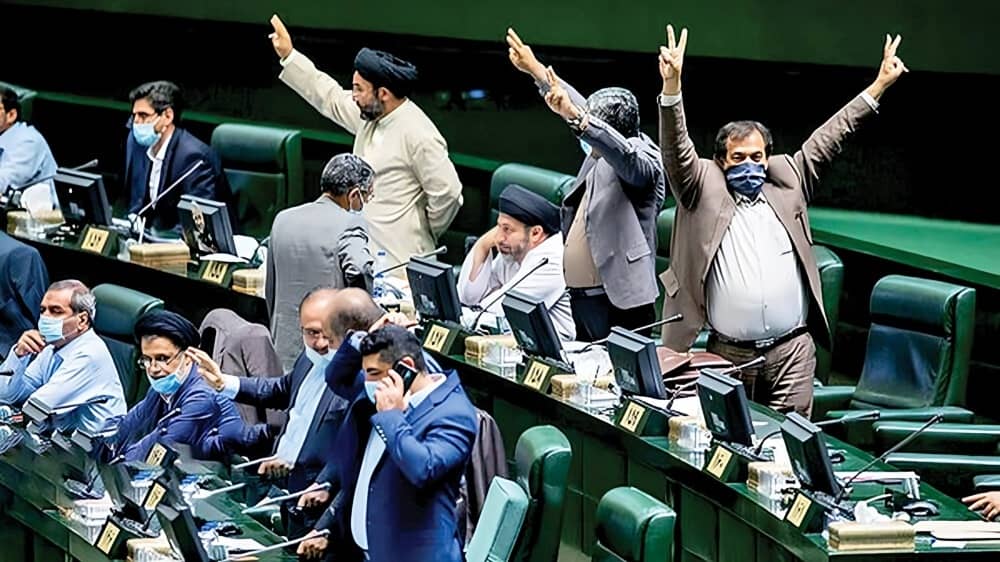
The most striking shift is in parliament, where members now speak openly about panic at the base.
One MP, Abbas Qodrati, told a public session that “people no longer want slogans. They want answers. They want action.” He listed workers, retirees, employees, and farmers saying bluntly: “their situation is not good.” With the exchange rate surging and gold prices climbing, he argued that raising gasoline prices “in these conditions was not wise.”
Another lawmaker admitted that prices for basic goods now rise “weekly and daily” and that representatives “really have no answer” to offer. A colleague apologized “for inflation and the emptying of people’s tables,” noting that the dollar had reached 127,000 tomans “ten minutes ago,” then adding, “I don’t even know what it is now. Is this management?”
Behind these quotes lies a deeper admission: the government’s own economists concede that simply keeping the machinery of the state running has become “very difficult.” The economy minister says the administration is “struggling to find” the money for monthly subsidies and salaries, while small and medium enterprises collapse and unemployment rises by hundreds of thousands in a single quarter. Business leaders echo what the World Bank has already projected: negative growth in 2024 and 2025.
#Iran’s Economic Collapse and Social Unrest Looming in 2025https://t.co/zN1eMj0Spm
— NCRI-FAC (@iran_policy) March 18, 2025
Survival as a Private Burden
While incomes fall, the country’s physical environment is turning hostile in ways even regime experts can no longer spin.
Abdollah Babakhani, a state-aligned energy specialist, now concedes that “mazut and diesel in Iran are not standard.” Mazut from some refineries carries 3.5 percent sulfur—seven times the global norm. Diesel in some cities, he says, has shown sulfur levels 10 to 50 times the international limit. The result, in his own words, is that “several million tons of poison” enter the air every day, a pattern he expects to continue until at least the end of winter.
Health researchers say the toll is already visible. A study for the Health Ministry attributes around 58,000 deaths in 2023 to air pollution—about 15 percent of all deaths among people over 30—of which roughly 8,800 occurred in Tehran. The head of the environment agency admits that 83 percent of Iranian gasoline fails to meet Euro-4 standards and that sulfur in fuel around the capital exceeds legal limits.
Into this smog has arrived a severe wave of influenza A/H3N2. Health officials report that respiratory infections now account for 16–17 percent of all communicable diseases in circulation, well above the global “warning” threshold. At least 101 people have died, including 14 children; in the province of Yazd alone, 1,138 lab-confirmed cases and 13 deaths have been logged. Pediatric wards and respiratory units are reportedly near capacity.
What worries doctors is the interaction of these two forces. The flu strain itself is more aggressive; at the same time, fine particulates from pollution inflame lungs and weaken immune defenses. Officials say this combination sharply raises the odds that a routine infection will lead to hospitalization or death, particularly among the elderly, those with chronic illness, and now school-age children.
#Iranian Officials Warn of “Libya Scenario” Amid Deepening Fear of Uprising and Escalating Crackdownshttps://t.co/vLWWYwIlap
— NCRI-FAC (@iran_policy) June 1, 2025
Sinking Ground and Sinking Banks
Below the visible emergencies lies a quieter, more ominous collapse.
A senior researcher at the Transport Ministry now admits that about 5 percent of Iran’s territory—more than 90,000 square kilometers—is affected by land subsidence. Over 200 cities and some 350 plains are “to varying degrees” sinking. Around Tehran, decades of groundwater overuse have doubled subsidence rates in some districts to 30–31 centimeters per year. In Mashhad, an environment-ministry adviser reports rates of up to 18 centimeters and warns that, without drastic cuts in extraction, the city could become a “sunk plain” within a decade, like parts of central Iran where infrastructure and buildings slowly tear apart.
At the same time, one of the system’s ultimate insiders has torn the veil off the banking sector. Sadeq Amoli-Larijani, former judiciary chief and now chair of the Expediency Council, says the policy of creating private banks was “100 percent wrong” and turned them into “backyards for corrupt activities.” He reveals that for five or six years, the central bank effectively ran Bank Ayandeh—choosing its CEO and board—while the bank’s accumulated losses exploded from 82,000 billion tomans to 550,000 billion. He also warns that Bank Sepah, which absorbed five military-linked banks in 2018, is now insolvent, with a capital-adequacy ratio below zero. Across the system, he notes, only nine banks meet minimum capital standards; most others, on their own official figures, would be classed as bankrupt in any normal jurisdiction.
The irony, of course, is that Larijani himself stands accused of taking enormous bribes from the same financier he now implicates. His revelations confirm what many Iranians already assume: that those diagnosing the rot are deeply entangled in it.
Regime’s Fear Mounts as #Iranian Officials Warn of Economic Collapse and Public Outragehttps://t.co/eYd3ctUroe
— NCRI-FAC (@iran_policy) November 24, 2024
Fury Managed, Not Addressed
The most revealing responses to this convergence of economic, environmental, and institutional breakdown are not technical fixes but attempts to manage public anger.
MPs warn that retirees—whose supplemental insurance contributions the state has just slashed—are “fire beneath the ashes.” Business papers talk of poverty pushing society toward a 40 percent threshold. Political commentators describe a public that has shifted from protest to something more unnerving for the state: cold indifference and the loss of any “horizon of hope.”
The judiciary’s answer is not reform but a text message campaign urging citizens to “control their anger” because, as the SMS explains, anger weakens “understanding, thinking, and analysis.” Parliament’s answer, in part, is a new “protection” bill that would hand the state broadcaster sweeping powers to license, police, fine, throttle, and close almost all audio-visual activity online, with minimal judicial oversight.
The “smog” and the “flu” are not just environmental and epidemiological shocks; they are shorthand for a broader reality in which survival—breathing, eating, getting medicine—has become a private, precarious task. The “fury” is not confined to the street; it now echoes in parliament, in ministries, even in the judiciary’s own warnings.
When Iran’s rulers start talking like the ruled, it is not an act of empathy but an attempt to pre-empt blame. Their sudden displays of concern are meant to deflect public fury, to signal that they, too, are “victims” of mismanagement, and to buy time in a system where the air, the currency, the banks, and even the ground itself are no longer stable—and where the rage this instability generates can no longer be dismissed as marginal or containable.