

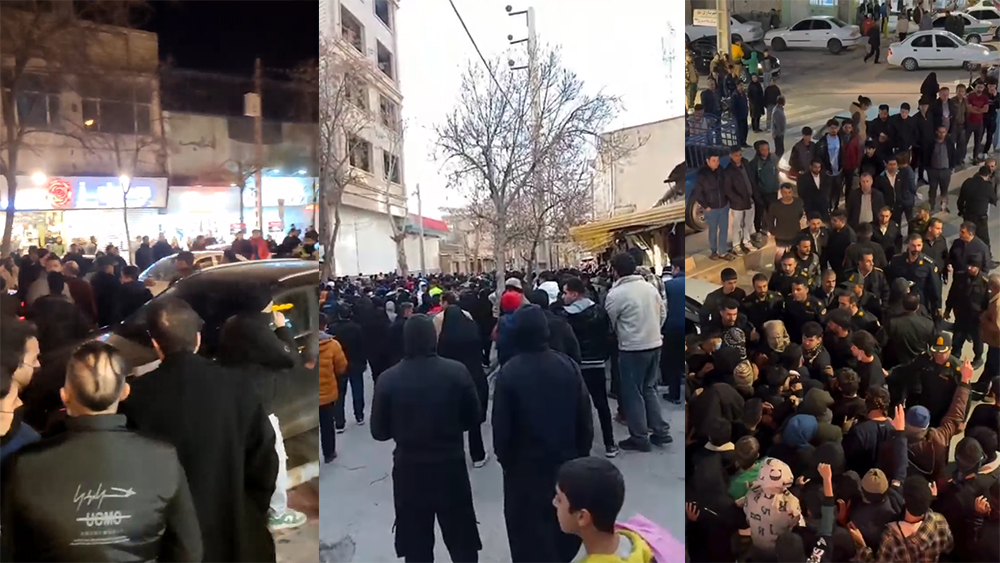
The nationwide uprising in Iran entered a critical new phase on January 1, 2026. What began on December 28, 2025, as a protest by merchants against a catastrophic currency collapse has, by its fifth consecutive day, metamorphosed into a full-scale political insurrection. As of Thursday, January 1, the distinct line between economic grievance and revolutionary demand has dissolved. From the seizure of government buildings in western provinces to the unprecedented chants against the clergy in their traditional stronghold of Qom, the events of the last 24 hours indicate that the wall of fear protecting the theocracy is rapidly crumbling.

The Escalation: From Protest to Urban Resistance
The most dramatic shift in the uprising’s trajectory occurred in western Iran, particularly in the city of Lordegan in the Chaharmahal and Bakhtiari province. On the morning of January 1, heavy confrontations erupted between citizens and state security forces. According to reports from the ground, security units deployed lethal force against unarmed protesters, resulting in at least two confirmed deaths and numerous injuries.
More footage of intense situation in Lordegan as security forces try to stop anti-regime protests through force and bullets and demonstrators continue to resist. Locals report that there are casualties as security forces directly opened fire on civilians.#IranProtests pic.twitter.com/V5ITSfrThY
— People's Mojahedin Organization of Iran (PMOI/MEK) (@Mojahedineng) January 1, 2026
However, the use of live ammunition failed to disperse the crowds. In a display of fury that underscores the depth of public rage, protesters in Lordegan did not retreat but instead advanced upon the city’s administrative center. Demonstrators successfully seized and inflicted heavy damage on several symbols of the regime’s authority, including the Governorate building, the local office of the Foundation of Martyrs (Bonyad Shahid), and the judiciary building. The specific targeting of the Foundation of Martyrs and the Judiciary reflects a direct rejection of the regime’s ideological and repressive apparatus.
This escalation was not isolated to Lordegan. A qualitative shift in tactics was observed in neighboring regions, where youth moved from street demonstrations to the active takeover of security installations. In Azna, protesters occupied a security force base, setting fire to a vehicle used for suppression. Simultaneously, in Farsan, locals besieged a base of the paramilitary Basij force, effectively trapping the regime’s agents inside. In Darreh Shahr, footage emerged of demonstrators tearing down banners of Supreme Leader Ali Khamenei, symbolically dismantling the regime’s presence in the city.
January 1—Azna, western Iran
Protesters occupied a base of security forces and set fire to a vehicle of the regime's repressive forces.#IranProtests pic.twitter.com/dtN2RkI6JD— People's Mojahedin Organization of Iran (PMOI/MEK) (@Mojahedineng) January 1, 2026
Qom Rises Against the Regime
A significant psychological blow to the clerical establishment on day five was the entry of Qom into the uprising. Known as the ideological capital and the regime’s power base, Qom has historically been a city the regime counts on for support or at least passivity.
On Thursday, however, the streets of Qom became the scene of intense clashes. Videos circulating from the city show demonstrators fighting back against security forces and, in several instances, forcing the armed agents to flee. The chants echoing through the streets of Qom—specifically “Mullahs must get lost”—signal a profound ideological collapse. When the populace in the religious heartland explicitly rejects the ruling clergy, the theocracy loses its claim to legitimacy even among its purported constituency.
More footage of protests in Qom and repressive security forces attacking demonstrators.#IranProtests pic.twitter.com/qr2wUhTQzK
— People's Mojahedin Organization of Iran (PMOI/MEK) (@Mojahedineng) January 1, 2026
Economic Paralysis and Capital Defiance
In the capital, Tehran, the economic unrest that sparked the uprising has hardened into political defiance. At the Central Fruit and Vegetable Market (Meidan Tarebar), a vital hub for the city’s food distribution, merchants and protesters stood firm for the second day. Security forces attempted to break the strike using tear gas, but the market remained paralyzed. The slogans here have shifted decisively away from price complaints to fundamental political demands, with crowds chanting “Death to Khamenei” and “No Gaza, No Lebanon, I Sacrifice my Life for Iran.”
January 1—Tehran, Iran
Protests begin in Meidan Tarebar (Central Fruit and Vegetable Market), with demonstrators chanting "Neither Gaza nor Lebanon, my life for Iran," criticizing the regime's foreign aid priorities over domestic economic woes.#IranProtests #IranRevolution pic.twitter.com/eTapfTJ4TG— People's Mojahedin Organization of Iran (PMOI/MEK) (@Mojahedineng) January 1, 2026
The paralysis is nationwide. In Kermanshah, the commercial heart of the city—stretching from Freedom Square to the Ojaq Intersection—experienced a 100% strike. Major commercial passages like Kish, Gol, and Zeytoon remained shuttered. To prevent coordination among protesters and hide the extent of the shutdown, the regime implemented a total internet blackout in the region for several hours. Similarly, in Isfahan, the Ibn Sina Fabric Market joined the general strike, while in the southern port of Bandar Ganaveh, merchants vowed to keep their shops closed indefinitely.
This unrest is fueled by an economy in freefall. With the Iranian rial plummeting to 1.45 million against the US dollar and food inflation exceeding 72%, the Iranian people have concluded that the current system is incapable of reform. This sentiment was captured in the chants heard across multiple cities: “Poverty, corruption, high prices, we’re going for regime change.”
January 1—Hamedan, western Iran
Merchants of the Furniture Market went on strike, blocking roads and chanting anti-regime slogans such as, "Down with inefficient officials!"#IranProtests #IranRevolution pic.twitter.com/2JYyKSn3s6— People's Mojahedin Organization of Iran (PMOI/MEK) (@Mojahedineng) January 1, 2026
Regime Brutality and Student Resilience
Recognizing the dangerous potential of a unified front between the bazaar and the universities, the regime has intensified its crackdown on students. In a cowardly move under the cover of darkness, security agents and plainclothes officers raided the dormitories of Beheshti University (National University) in Tehran overnight. Reports confirm that several female students were abducted during the raid. However, the assault failed to silence the students; facing the dormitories, large groups of students gathered to chant “Disgrace, Disgrace” at the repressors.
January 1—Tehran, Iran
Melli (Beheshti) University
Security forces attacked students’ dormitory after midnight.
Students resisted to prevent their classmates from being arrested.
Security forces reportedly abducted students in their raid.
At least one student hospitalized after… pic.twitter.com/MZWs8mnpMr— People's Mojahedin Organization of Iran (PMOI/MEK) (@Mojahedineng) January 1, 2026
Despite this brutality, the spirit of resistance continues to spread. In Marvdasht, Fars Province, security forces opened fire on a large crowd. The protesters, rather than dispersing, fought back, forcing the agents to retreat and setting fire to a police vehicle. The slogan dominating the streets of Marvdasht—”This is the year of blood, Seyyed Ali [Khamenei] will be overthrown”—encapsulates the resolve of a population that believes the end of the dictatorship is within sight.
Even in the face of live fire in cities like Assad Abad and Eslamabad-e Gharb, and despite the deployment of helicopter units to intimidate the public, the protests have only grown in intensity. In Hamedan, a lone youth was filmed standing directly in the path of advancing security vehicles, a moment of individual defiance that inspired the crowd to hold their ground.
January 1—Kavar, southern Iran
Locals held their protest rally at around sunset. Security forces tried to disperse the crowd by attacking them. Protesters resisted and forced them to retreat. They blocked roads with fire and chanted anti-regime slogans.#IranProtests pic.twitter.com/PQt4XndZxZ— People's Mojahedin Organization of Iran (PMOI/MEK) (@Mojahedineng) January 1, 2026
The Panic of the Dictatorship
The regime’s actions betray a deep sense of panic. Supreme Leader Ali Khamenei’s appointment of IRGC Brigadier General Ahmad Vahidi—a figure internationally wanted for terrorism—as Deputy Commander of the IRGC to oversee the suppression is a clear admission that the standard police forces have failed to contain the unrest.
The events of January 1, 2026, demonstrate that the Iranian people have moved beyond the stage of airing grievances. By burning government centers in Lordegan, chasing security forces out of Qom, and maintaining strikes in the country’s economic arteries, they are actively dismantling the regime’s authority. The sheer breadth of the uprising, spanning from the Kurdish west to the central plateau and the southern ports, suggests that the regime is facing a nationwide challenge it can no longer suppress through fear alone.