

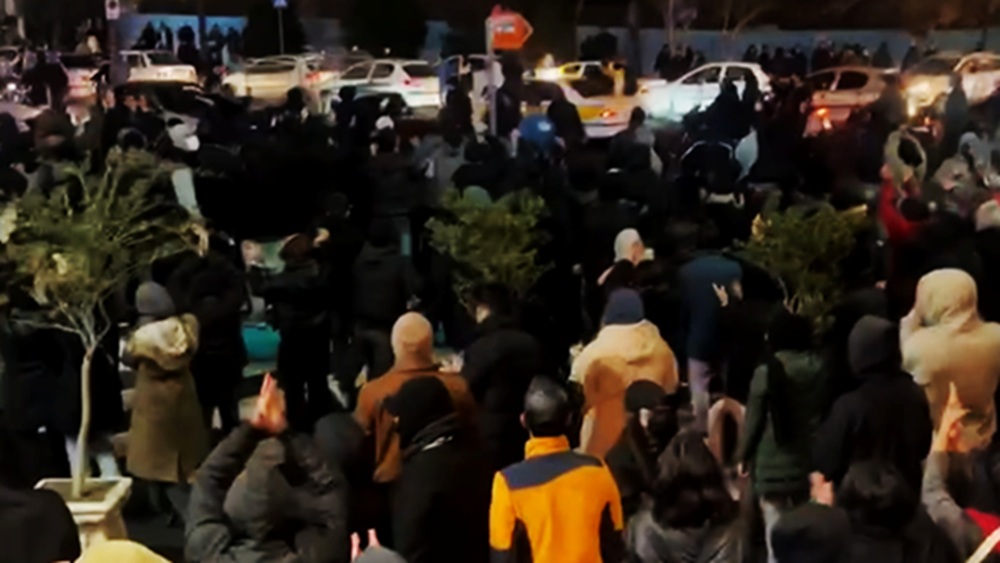
On Saturday, January 3, 2026, the nationwide uprising in Iran reached a critical inflection point. Entering its seventh consecutive day, the protests have evolved into a generalized revolt against the religious dictatorship. The regime’s calculated strategy to utilize a four-day holiday to dampen public momentum has demonstrably failed. Instead of quieting down, the unrest has intensified, expanding from the capital to the provinces, characterized by a marked escalation in state violence and a corresponding fearlessness among the populace.
The events of Saturday—specifically a lethal crackdown in Ilam province and Supreme Leader Ali Khamenei’s terrified public address—indicate that the barrier of fear has been shattered. Despite the deployment of the Islamic Revolutionary Guard Corps (IRGC) and plainclothes agents, the regime appears to be losing control of the streets in key cities.
The Malekshahi Massacre
On Saturday, the western province of Ilam became the scene of a tragedy that has further inflamed public anger. In the city of Malekshahi, security forces resorted to the use of lethal force against a massive rally of youth chanting anti-regime slogans.
January 3—Malekshahi, western Iran
Locals held a large rally and chanted anti-regime slogans such as "Down with Khamenei!" and "Down with the dictator!"
Videos show that the regime's security forces have directly opened fire on protesters and injured several civilians.… pic.twitter.com/6BKerqW7x2— People's Mojahedin Organization of Iran (PMOI/MEK) (@Mojahedineng) January 3, 2026
Eyewitness reports describe a “bloodbath” as uniformed and plainclothes agents opened direct fire on unarmed demonstrators. Local sources indicate that several have been killed and dozens are in critical condition. The severity of the crackdown overwhelmed local medical infrastructure; the Khomeini Hospital in Malekshahi was reported to be overflowing with the wounded, prompting urgent public appeals for blood donations, specifically O-negative.
In the aftermath of the shooting, the regime placed the city under a military siege, deploying a massive contingent of anti-riot units in an attempt to prevent a retaliatory response from a grieving and enraged population. However, rather than retreating, residents have reportedly sworn revenge, turning the city into a flashpoint of resistance.
January 3—Malekshahi, western Iran
The regime deployed a large contingent of anti-riot forces to prevent potential nightly protests after its criminal agents opened fire and killed several civilians earlier in the day.#IranProtests pic.twitter.com/nqffgJaAqK— People's Mojahedin Organization of Iran (PMOI/MEK) (@Mojahedineng) January 3, 2026
Khamenei Breaks Silence, Revealing Regime Fragility
For the first six days of the uprising, Supreme Leader Ali Khamenei remained conspicuously silent. That silence ended on Saturday. Speaking on the anniversary of the elimination of Qasem Soleimani, the former Quds Force commander, Khamenei addressed the nation in a tone that betrayed deep anxiety regarding the stability of his rule.
Attempting to drive a wedge between the public and the street protesters, Khamenei labeled the youth as “rioters” and agents of foreign enemies. “Protest is different from rioting,” he stated. “We talk to the protester… but talking to the rioter is useless; the rioter must be put in their place.” He further added that the “enemy will not rest,” a tacit admission of the threat the current movement poses to the theocratic establishment.
After a week of silence on the people’s uprising, Khamenei reappeared with threats of repression, saying: “Protest is different from rioting. We talk to protesters… but talking to rioters is pointless; rioters must be put in their place. It is absolutely unacceptable for some to…
— Maryam Rajavi (@Maryam_Rajavi) January 3, 2026
Mrs. Maryam Rajavi, President-elect of the National Council of Resistance of Iran (NCRI), responded “Khamenei is right; 80 million Iranians are his enemy,” emphasizing that the mission of the people is to “disrupt the velayat-e faqih regime” and that they will not stand down until democracy is achieved.
Tehran: Defying “Martial Law”
Despite the capital being placed under a virtual lockdown with heavy security presence, the people of Tehran broke the barrier of fear on Saturday night. In the Naziabad district, a working-class stronghold, defiant youth seized control of the streets. Footage from the area shows protesters burning motorcycles and vehicles belonging to suppressive forces while chanting, “Death to Khamenei.”
In Haft Howz, large crowds gathered for the second consecutive night, chanting “Down with the dictator” in direct defiance of the armed forces surrounding them.
January 3—Tehran, Iran
The crowd at Haft Howz continues to grow in defiance of the regime's security measures and threats by the regime's supreme leader. Protesters are chanting, "Down with the dictator!"#IranProtests pic.twitter.com/R3uFeKUY5N— People's Mojahedin Organization of Iran (PMOI/MEK) (@Mojahedineng) January 3, 2026
A Nationwide Cry: From Universities to Dungeons
The uprising has permeated every sector of society. In Mashhad, demonstrators on Rahnamayi Street chanted, “This nation will not be a nation until the mullahs are buried,” while in Shiraz, students and youth blocked roads in the Golshan district with burning tires, facing down tear gas with chants of “Disgrace!”
The scope of the unrest was further evidenced in Kazerun, Fars province, which joined the uprising on Saturday. A massive crowd flooded Shohada Square, forcing security forces to open fire to prevent the gathering from expanding.
More footage of the large protest rally in Mashhad. Protesters are chanting, "Down with the dictator!" and "This nation will not be a nation until the mullahs are buried!"#IranProtests pic.twitter.com/rCo3FpaVPd
— People's Mojahedin Organization of Iran (PMOI/MEK) (@Mojahedineng) January 3, 2026
Solidarity has also poured in from the regime’s prisons, providing moral steel to the movement. Asadollah Hadi, a political prisoner in Ghezel Hesar, issued a letter saluting the “bankrupt guilds” and students, stating that the people are drawing a “new design for a democratic Iran.” Similarly, from Evin Prison, political prisoner Shahin Zoghi-Tabar urged the rebellious youth to disarm regime agents, writing, “Every weapon you take from the mercenaries is one weapon added to the people’s front.”
🚨 EXCLUSIVE: Message from Evin Prison
Political prisoner Shahin Zoghitabar sends a powerful call to the youth of #Iran via Iran NTV (Simay Azadi)
"I feel more free than ever before, for I see fighting dictatorship as true freedom." pic.twitter.com/VdIHa3JfQG— SIMAY AZADI TV (@en_simayazadi) January 2, 2026
As the seventh day concludes, it is evident that the Iranian regime is facing an existential crisis. The authorities have deployed their standard playbook—internet restrictions, mass arrests, tear gas, and live ammunition—yet the protests have only grown in size and ferocity.
The slogans targeting the entirety of the establishment, specifically Ali Khamenei, combined with the willingness of the youth to engage in direct confrontation with security forces, suggest that the Iranian people have passed the point of no return.