

Four-minute read
As the war entered its 13th day, Iran’s clerical regime appeared to be pursuing two parallel objectives: escalating its threats abroad while tightening coercive control at home, in an effort to keep wartime strain from tipping into open unrest.
The clearest indication came in the first written and televised message by Mojtaba Khamenei after the announcement that the Assembly of Experts had selected him. He said he had learned of the decision at the same time as the public, through state television — a claim that strained credulity in a system defined by closed-door clerical power and carefully managed succession. The statement was less an act of transparency than an attempt to dress an opaque transfer of power in the language of humility and surprise.
Mojtaba Khamenei warned that no damage must be allowed to “the unity of the people in all classes and sectors,” and argued that if the people’s power was not visibly present, “neither the leadership nor any of the institutions” would function effectively. He called for an “effective presence in the field,” not only in wartime sacrifice but in social, political, cultural, educational and even “security” roles. He called for maximum turnout in the coming Quds Day observances and said the element of “breaking the enemy” had to be emphasized.
"The regime did not pick #Mojtaba_Khamenei in spite of his security face. It picked him because of it. His notoriety, far from disqualifying him inside the ruling core, made him useful: he is legible to the regime’s own forces as a continuity candidate who will neither surrender…
— NCRI-FAC (@iran_policy) March 9, 2026
The message made plain what the regime now needs from the public: not consent, but mobilization; not trust, but obedience; not calm, but performative loyalty. It praised the population’s “insight,” “steadfastness” and “presence” during the days when, in his telling, the country had been without a leader and commander in chief, and thanked officials, clerics and the regime’s loyal base who had taken part in rallies aimed to portray social capital for a system on edge.
At the same time, Mojtaba Khamenei said Iran must continue an “effective and regret-inducing defense,” must keep using the “lever” of closing the Strait of Hormuz, and had studied the opening of additional fronts if the war continued. He described the so-called Axis of Resistance as “inseparable from the values of the Islamic Republic” and praised Yemen, Hezbollah and Iraqi armed groups for backing his regime. He said the regime would not forgo revenge for its dead and vowed his regime would extract reparations from its enemies — or destroy an equivalent value of their assets if payment was refused.
His message to neighboring states followed the same pattern of menace disguised as restraint. He said Iran had attacked only bases used by the enemy, not the countries themselves, but warned that such attacks would continue and urged those governments to shut down American bases on their soil. The formula was revealing: rather than signaling any break from Ali Khamenei’s long reliance on terrorism, proxy force and regional escalation, Mojtaba was doubling down as the regime’s threats and attacks pushed neighboring states deeper into the war.
The central fact of post-Khamenei Iran is that the regime has entered a crisis of command. The state still carries on with #war and oppression, but the one office that could settle every serious dispute is gone.https://t.co/6JH4qQriPf
— NCRI-FAC (@iran_policy) March 8, 2026
Meanwhile, Ali Larijani, Secretary of the Supreme National Security Council, said that if President Trump cut off Iran’s electricity, “the whole region” would go dark within half an hour, adding that darkness would provide a good opportunity to hunt fleeing American troops. The regime’s president Masoud Pezeshkian said the only way to end the war was for Iran’s rights to be recognized, compensation paid and firm guarantees given against renewed aggression. Former IRGC Chief Mohsen Rezaei said there would be no cease-fire before a decisive outcome. The Revolutionary Guards said more than 50 targets in Israeli cities and American bases in Jordan, Saudi Arabia and Kuwait had been hit.
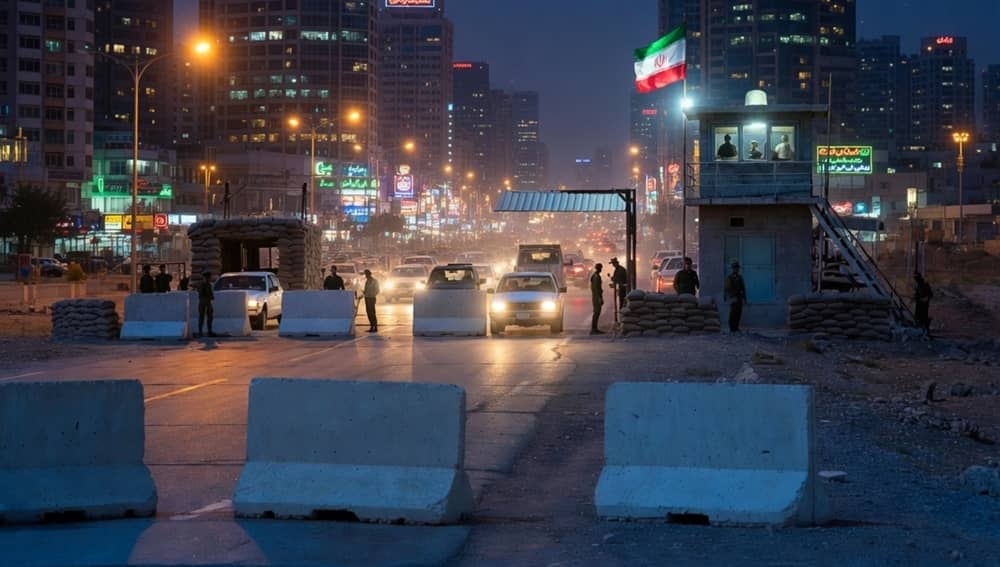
On the ground, the regime’s most visible domestic response has been the expansion and redesign of urban checkpoints.
Checkpoints have spread across cities, especially in and around Tehran. Fars, the Guards-linked news agency, claimed that after Israeli drone strikes on some checkpoints, large numbers of volunteers had come forward to staff them. A Basij official said the street deployment had been altered, a new checkpoint system had been introduced to match anticipated enemy scenarios, and the posts were now operating “more actively than before” under tighter command and more deliberate planning.
Local accounts described something more ominous: a coercive and intimidating street presence intended not only to search for threats, but to impose fear. In Tehran’s District 18, in Vali-e Asr township and along Yaran Street, large numbers of personnel were reported deployed. Near the Saveh Road overpass on the Azadegan route, witnesses described armed men in black carrying heavy weapons and conducting aggressive searches. Other reports said motorists were being stopped more frequently, with trunks and hoods opened and vehicles searched in unusual detail.
What Iran’s rulers appear to fear is not only foreign attack, but the possibility that #IranWar, succession turmoil and visible weakness could create an opening for what they have spent years trying to prevent: another nationwide uprising.https://t.co/sYBjqjGmD9
— NCRI-FAC (@iran_policy) March 10, 2026
One account said even containers of water in cars were being smelled. Another said traffic lanes at checkpoints were being deliberately narrowed so that only one vehicle could pass at a time, creating long lines and forced concentrations of civilians.
Those accounts went further, portraying the checkpoint system as not merely repressive but reckless. Several described a setup that funneled civilians into bottlenecks that could become mass-casualty points in the event of attack, effectively exposing ordinary people to danger while increasing the political cost of any strike.
The regime’s anxiety about unrest is also evident in its reaction to anti-government slogans heard in Tehran at night. Videos and reports said that on Wednesday evening, as drones flew overhead and air defenses fired, residents in northeastern Tehran shouted slogans against the ruling establishment. The significance of those scenes lies not only in the slogans themselves, but in their timing: they came as the state was admitting that armed personnel were being hit in the streets of the capital. The overlap of war, fear and public defiance points to what the leadership appears to understand all too well — that an external conflict can expose, rather than conceal, domestic anger.
Facing an increasingly explosive society, the Iranian regime has ramped up its rhetoric to signal a “firm” crackdown on any signs of #IranProtests. Judicial and military officials are currently using the pretext of regional conflict to justify aggressive internal suppression,…
— NCRI-FAC (@iran_policy) March 6, 2026
The security response has also included arrests. Reuters, citing Iran’s Intelligence Ministry, reported that dozens of people, including at least one foreign national, had been detained.
Taken together, the pattern is clear. The clerical regime appears to see domestic volatility as an immediate threat, and its answer has been to harden rather than ease: no sign of a cease-fire, more calls for revenge, more pressure for demonstrations of loyalty, more checkpoints, more volunteers folded into the security apparatus, more arrests and more propaganda around discipline and unity. In that sense, the regime’s wartime strategy is not only about confronting foreign enemies. It is also about using fear, force and transparent political theater to head off the danger of revolt at home.