

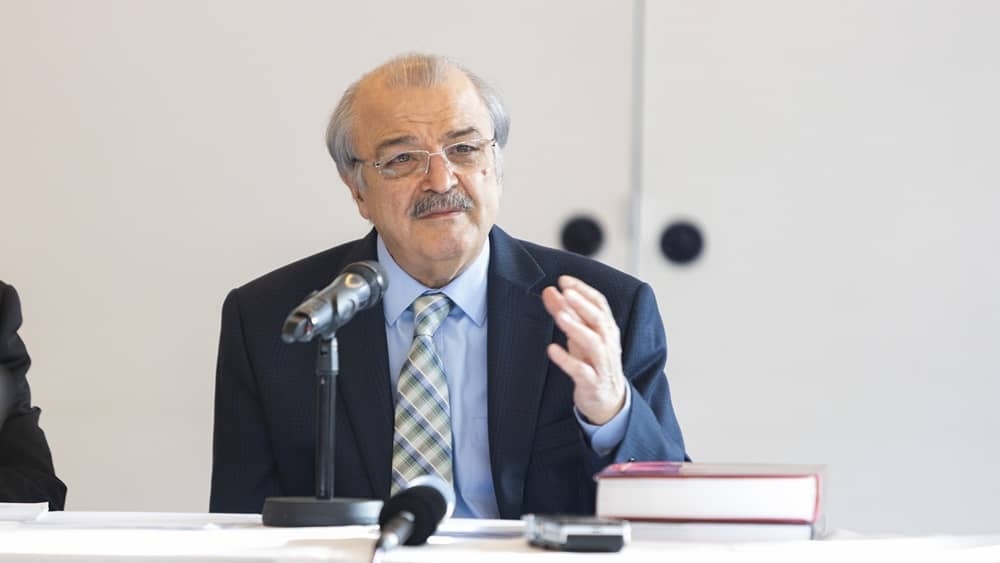
In a press conference held on Thursday, March 12, 2026, Mohammad Mohaddessin, Chairman of the Foreign Affairs Committee of the National Council of Resistance of Iran (NCRI), provided a strategic roadmap for the liberation of Iran, asserting that while external military pressure has shaken the clerical regime, the final blow must come from the Iranian people and their organized Resistance. Speaking on the 12th day of the current conflict, Mohaddessin highlighted that the death of Ali Khamenei on February 28 has created an irreparable void at the heart of the dictatorship, yet he cautioned that air campaigns alone cannot dismantle the vast repressive apparatus that continues to hold the nation hostage.
Mohaddessin described a domestic environment defined by “military-style intimidation,” where the Islamic Revolutionary Guard Corps (IRGC) has deployed heavy weaponry in public squares to stifle dissent. However, he emphasized that the regime is in a state of total deadlock, terrified that the simmering social anger will inevitably merge with the highly active Resistance Units on the ground. Mohaddessin made it clear that the Iranian people are not looking for a return to the past, sharply criticizing the recent attempt to establish a “medieval-style hereditary monarchy” through the appointment of Mojtaba Khamenei. He noted that this transition has already caused significant friction within the regime’s own ranks, proving that the mullahs have no viable future.
At today’s press conference in Paris, I emphasized a simple reality: Foreign war cannot overthrow #Iran’s regime. Only a popular uprising backed by organized resistance can bring democratic change.https://t.co/s5xsoONBVT pic.twitter.com/fzPCiHHW04
— Mohammad Mohaddessin (@Mohaddessin) March 12, 2026
Looking toward a democratic future, Mohaddessin reaffirmed the role of the provisional government announced by the NCRI on February 28. Guided by Maryam Rajavi’s Ten-Point Plan, this body is prepared to manage a six-month transition period to transfer sovereignty to the people through free and fair elections. The NCRI FAC Chairman called on the international community to recognize the fundamental right of the Iranian people to resist the IRGC, noting that true stability in the region can only be achieved through a democratic revolution from within.
Significant Remarks from the Chairman
Regarding the limitations of the current military campaign, Mohaddessin noted that the 12-day war in June and the current conflict have proven that bombings alone cannot overthrow the regime. He stated that even with 50,000 armed soldiers on the ground, the support of the Iranian people and a popular uprising remain the essential components for victory.
He further observed that the regime is deeply concerned about the explosive situation in society, particularly the eruption of an uprising in combination with the Resistance Units. Addressing the leadership crisis, he remarked that the appointment of Mojtaba Khamenei effectively transforms the religious dictatorship into a hereditary monarchy, a move the Iranian people have already rejected through their chants of “Death to the oppressor, whether Shah or Supreme Leader.” On the timeline for change, he concluded that while a specific number of months cannot be predicted, the current momentum is the definitive track for overthrowing the regime.
In December 2022, the NCRI Foreign Affairs Chairman @Mohaddessin provided profound insights into the #IranRevolution that continue to resonate.https://t.co/3IgEdFDYAr
— NCRI-FAC (@iran_policy) August 10, 2023
International Media Coverage Summary
The Paris conference has been documented by major international news agencies, reflecting the global significance of the NCRI’s platform. Reuters provided detailed reporting on Mohaddessin’s strategic assessment, focusing on his assertion that a popular uprising is the only realistic path to toppling the clerical leadership.
Agence France-Presse (AFP) detailed how the appointment of Mojtaba Khamenei has effectively shifted the clerical regime toward a “hereditary monarchy” backed by the Revolutionary Guards, spotlighting the NCRI’s evidence of significant dissent and friction within the Assembly of Experts during the succession.
The Times highlighted Mohammad Mohaddessin’s assertion that even a substantial ground force of 50,000 soldiers would require the critical support of a popular internal uprising to achieve a lasting transition of power.