

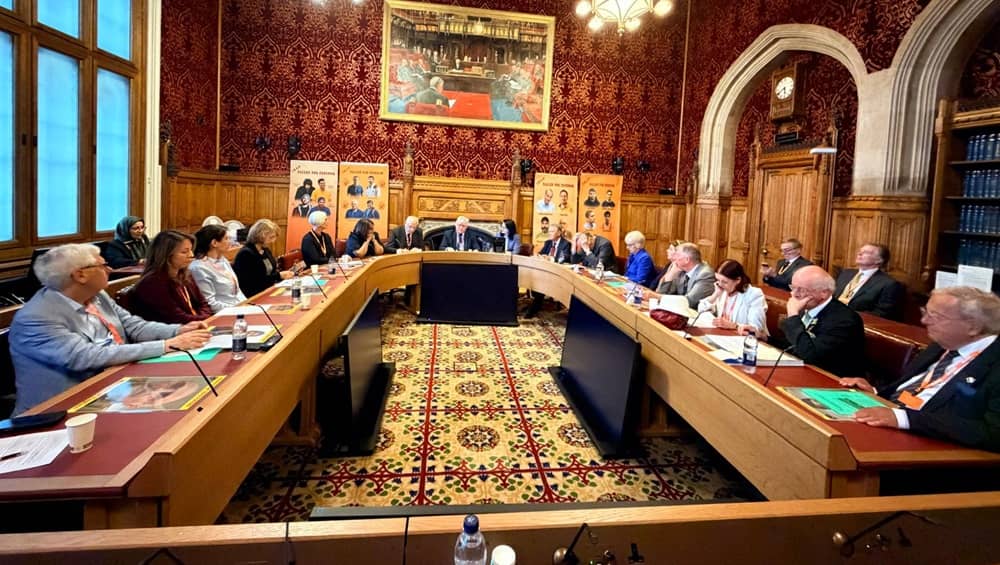
On April 28, 2026, a high-level conference titled “Iran: Towards Peace and Freedom” was convened at the Palace of Westminster, bringing together a broad coalition of British parliamentarians, legal experts, and human rights advocates. The event served as a critical platform to address the “wartime position” recently adopted by the Iranian regime’s judiciary and the consequent spike in political executions. Speakers throughout the session emphasized that the international community must move beyond silence to actively support the organized resistance inside Iran. Central to the discussion was the National Council of Resistance of Iran (NCRI) and its Ten-Point Plan, which participants hailed as the only viable blueprint for a democratic, non-nuclear republic. The assembly also delivered a firm rejection of any return to monarchical rule, characterizing the Pahlavi alternative as a “fake” solution that lacks grassroots legitimacy.
Mrs. Maryam Rajavi, President-elect of the NCRI, delivered the keynote address via video link, warning that the Iranian people are “paying the price of silence” against the regime’s brutality. She detailed a campaign of repression involving the execution of dozens of political prisoners and PMOI members since March.
“The regime is obviously concerned about future uprisings,” Mrs. Rajavi stated. “Through these brutal executions, the regime seeks to terrorize young people and to prevent them from joining the Resistance Units that play a decisive role in organizing and expanding the uprising.” She emphasized that the overthrow of the regime is a task that “will be carried out by the people and their organized resistance,” specifically noting the hundreds of operations carried out by the Liberation Army against repressive forces. She urged the UK to recognize the NCRI’s provisional government and proscribe the IRGC, concluding that “neither Shah nor the mullahs” remains the guiding principle of the Iranian people.
Conference at the UK Parliament: Urgent Action to #StopExecutionsInIran
Today, our people and our country are facing very difficult conditions.
On one hand, they are confronted with the many hardships of war, caused by the regime’s nuclear and terrorist projects.On the other… pic.twitter.com/Ei6zDMbqNC
— Maryam Rajavi (@Maryam_Rajavi) April 28, 2026
Azadeh Zabeti, co-chair of the Committee of Anglo-Iranian Lawyers, opened the meeting by highlighting the “escalating human rights crisis occurring inside of Iran” under the shadow of regional war. She condemned the “sharp and deliberate rise in executions” aimed at silencing dissidents. Citing the remnants of the ousted monarchial dictatorship, Zabeti called them “the great pretenders”—individuals who have recently emerged on the political scene after decades of silence. She remarked, “It is absolutely repugnant that individuals who have been asleep for the near five decades that the Iranian regime has carried out such savage attacks… are now trying to take credit for the work of this committee.” By distinguishing between these opportunistic figures and the “real champions” who have campaigned tirelessly for IRGC proscription, Zabeti reinforced the importance of the NCRI’s long-standing, organized struggle.
Sammy Wilson MP addressed the human cost of the regime’s survival, pointing to the portraits of young protesters recently put to death. “A week ago this young man was alive; today he is dead because he stood up for what he believed in,” Wilson noted. He focused heavily on the need for a truly democratic transition, warning against a return to past dictatorships. Wilson drew a historical parallel to post-war Eastern Europe, noting that dictatorships often recruit from the perpetrators of the previous regime to maintain order. He criticized the Shah’s son for “reaching out to the people who have brutalized his own country,” stating that such a path would not lead to a fair government but to a “dictatorship of the past.” He reaffirmed that the Ten-Point Plan is the only roadmap for a democratic future.
Jim Shannon MP, Chair of the APPG for International Freedom of Religion or Belief, expressed deep solidarity with the Iranian people’s quest for liberty and justice. He highlighted the urgent need to proscribe the Islamic Revolutionary Guard Corps (IRGC), noting that photographs of women facing execution serve as a stark reminder of the regime’s brutality. Shannon praised the National Council of Resistance of Iran (NCRI) and Madam Maryam Rajavi’s Ten-Point Plan, describing it as a “viable democratic alternative” that embraces all ethnic and religious communities in Iran.
He drew a sharp contrast between the inclusive vision of the NCRI and the “division” shown by figures like the son of the ousted Shah. Shannon criticized the Shah’s son for labeling ethnic communities as separatists and placing hope in defecting IRGC commanders, describing such a plan as a “wolf in sheep’s clothing.” He also condemned the regime’s “cyber army” and its judiciary for “waging war against God” to justify expedited death sentences. In conclusion, he urged the United Kingdom to adopt a firmer policy that isolates the regime, rejects a return to past dictatorships, and constructively engages with the NCRI’s provisional government to secure a free and democratic future for Iran.
The People and Political Prisoners Pay the Price of Silence against Executions in Iran#StopExecutionsInIranhttps://t.co/OpLI6BWX1n pic.twitter.com/LxirWftJ30
— Maryam Rajavi (@Maryam_Rajavi) April 28, 2026
Lord Empey paid tribute to the activists who have maintained a constant presence outside Parliament “through fair weather and foul.” He expressed outrage that successive UK governments allowed a “nest of vipers” to operate from the Iranian embassy in London, directing terrorism under diplomatic cover, and suggested the government should “slim down” the embassy to a bare minimum. Lord Empey argued that the regime’s increase in executions is a symptom of extreme vulnerability. “What they are doing is an expression of fear. They are afraid of young men like this,” he said, referencing the martyrs. He urged the government to “grasp the threads” of a new policy by expelling Iranian diplomats and banning the IRGC. While he acknowledged that proscription is not a total solution, he argued it sends an essential message that the UK will no longer tolerate the regime’s “thought processes” of death.
Bob Blackman MP emphasized that the struggle for change in Iran must be led from within the country, not imposed by foreign powers. “To change the regime in Iran is not going to be done from the air… It’s got to be done by the Iranian people themselves,” he stated. He paid tribute to the Resistance Units and the “brave individuals” who risk their lives every day in the streets against one of the most brutal regimes in the world. Blackman strongly rejected any reliance on Reza Pahlavi, the son of the former Shah, noting that he had remained “in total hibernation” until recent uprisings and dismissing his claim that he could unite the Iranian people as “absolute nonsense.” He also condemned Pahlavi’s outreach to the IRGC, calling it “the most brutal terrorist organization there is in the world,” and stressed that “there should be no dealings with the son of the Shah.”
By contrast, Blackman said those who have resisted the regime “year after year after year” are led by President-elect Maryam Rajavi, urging the UK to focus its efforts on supporting Mrs. Rajavi, the NCRI, and the PMOI/MEK. He praised Mrs. Rajavi’s Ten-Point Plan, particularly its commitment to free and fair elections within six months of regime change and to a non-nuclear Iran. He urged immediate legislation to proscribe the IRGC in its entirety, seize its assets, and impose criminal sanctions on anyone promoting the organization. Blackman concluded by saluting those inside Iran who have given their lives for freedom and expressing hope for a free and democratic Iran “with Madam Maryam Rajavi as the President-elect,” followed by an elected leadership chosen by the Iranian people rather than the rule of the mullahs.
Christina Blacklaws, former President of the Law Society of England and Wales, provided a legal analysis of the Iranian regime’s judiciary, calling it a “state repression apparatus” rather than a system of justice. She cited the new directive for a “war posture” in courts as evidence that executions are being used as a “political tool“ to suppress dissent. “Iran does not provide for accountability, the rule of law, or justice for victims,” she argued. Blacklaws stressed that because domestic justice is impossible under “current conditions,” the UK must lead a referral of the regime to the UN Security Council. She called for accountability for “crimes against humanity and indeed in relation to genocide,” insisting that international law must be more than “fine words on paper” to prevent further massacres.
Lord Alton of Liverpool welcomed the decision to finally proscribe the IRGC, noting that parliamentarians have campaigned for this for “far too long.” He addressed the “terrible shedding of blood” through endless executions and shared testimony from his Joint Committee on Human Rights regarding “transnational repression” used by authoritarian regimes to target activists. Lord Alton reaffirmed his commitment to the “third option” proposed by Maryam Rajavi in 2004: democratic change brought about by the Iranian people and their resistance rather than foreign war or appeasement. He argued that any international agreement with Tehran must be conditional on “verifiable improvements” in human rights and an end to executions. He also praised the Ten-Point Plan as the foundation of a modern system committed to transferring power to an elected parliament within six months.
Lord Steve McCabe delivered a resonant address advocating for the NCRI’s provisional government and the Ten-Point Plan to bring democracy, secular governance, and the abolition of the death penalty. He highlighted the “worrying and difficult time” for the Iranian people, noting that while external military action carries risks of civilian injury, the regime has used the threat of war to “crack down on dissent.” Lord McCabe honored the “heroic resistance members” recently executed, specifically naming Hamid Vahidi and Nima Shahi. He emphasized that the Ten-Point Plan is a way to “bring about meaningful change” and a “peaceful transfer of power” led by the Iranian people themselves. He concluded by calling on the UK government to “speak out loudly against these executions” and to finally fulfill the promise to “totally ban” the IRGC.
The former Minister for the Armed Forces, Lord Hamilton of Epsom, highlighted that while he originally joined the movement due to the “appalling way” the regime treats its people, the path to change remains complex. He characterized the regime’s current executions as “nothing short of murder.”
He noted that the international community must confront the reality that the IRGC are now the primary power brokers in Iran, describing them as “just as ruthless” as the clerical leadership. Despite the “very difficult period” caused by the war started by the United States, he pointed to the Iranian National Resistance Council as a positive force for Iran’s future, noting that “eventually, the whole culture” will change.
Baroness Redfern expressed her profound solidarity with the “very brave Iranian people” and political prisoners who risk their lives to resist repression and demand democracy. She emphasized that through the networks and Resistance Units of the NCRI and PMOI, these individuals are assured they are not alone, despite pervasive censorship and internet shutdowns. Baroness Redfern advocated for a decisive shift in UK policy, specifically urging the government to proscribe the IRGC, a move she described as a “long overdue” and significant strike against the regime’s machinery of repression. Central to her vision is the NCRI’s Ten-Point Plan, which offers a provisional framework for a democratic transition grounded in popular sovereignty and remains strictly “free from foreign intervention”. She argued that the January uprising clearly signaled the Iranian people’s rejection of both the current regime and any return to dictatorship. To achieve lasting stability, Redfern called for an immediate end to executions, the protection of detained protesters, and the inclusion of a non-nuclear Iran in any international agreements. Ultimately, she urged the UK to stand firmly with this organized democratic alternative.
Lord Carlile of Berriew CBE KC detailed his extensive history with the NCRI, including his role in the successful de-proscription of the organization. He expressed profound sympathy for the families of those recently killed in Iran, labeling these acts as “murdered in cold blood” by a regime that fears the leadership of “sensible, decent people”. Lord Carlile argued that the Iranian people fundamentally desire a prosperous, democratic country and a new order in the region where they can lead a peaceful, cooperative life. Regarding the IRGC, he noted that while he supports its proscription, he cautioned that it may be a symbolic gesture. He maintained that a ban must be followed by persistent attrition against the IRGC to empower a “civil uprising,” which he views as the only viable path to changing the government.
نمایندگان فراحزبی از مجلس اعیان و عوام بریتانیا خواستار اقدام فوری دولت انگلستان برای لیستگذاری سپاه پاسداران شدند
سهشنبه ۲۸ آوریل ۲۰۲۶ در جلسه ای با شرکت نمایندگان فراحزبی از مجلس اعیان و عوام بریتانیا و نمایندگان شورای ملی مقاومت ایران و نمایندگان جوامع ایرانیان خواستار… pic.twitter.com/lq8XsmCc54— Mohamad Imani (@mehr4ashraf) April 28, 2026
Dr. Leyla Hannbeck, CEO of the Independent Pharmacies Association, dismantled three common misconceptions about Iran. She firmly rejected the idea that Iranians desire a return to the monarchy, noting that the Pahlavi era was defined by “massive inequalities, oppression, and one-party rule” enforced by the SAVAK. She also corrected the narrative that Iran is not ready for democracy, arguing that unlike other nations in the region, Iran possesses a highly organized resistance in the NCRI. “It is a democratic platform designed to avoid such outcomes,” she explained. Dr. Hannbeck urged the UK to engage actively with the NCRI’s provisional government, stating that it represents the “true democratic aspirations” of the people and provides the necessary framework for an organized transition.
Dr. Jocelyn Scott, former judge and filmmaker, characterized each execution as a “massacre in itself” and criticized the international community’s historic inaction. “Were ambassadors expelled? Were embassies shut down? Not a one,” she remarked. Dr. Scott argued that the Iranian people do not seek foreign military intervention or “demolishing schoolhouses,” but rather the recognition of their right to self-determination. She stated that the recognition of Mrs. Rajavi’s provisional government is the only path to “full equality between women and men” and a “non-nuclear Iran.” She made a direct plea to the UK government to “stand up and speak out” for those whose right to life was denied and to use the International Criminal Court to prosecute the regime’s leaders.
Councilor Robert Ward of Croydon shared his insights from 40 years of experience in the oil industry, including time in pre-revolutionary Iran. He criticized the UK government for being silent for “far too long,” noting that such silence is easily interpreted by the Iranian regime as agreement. Ward dismissed the son of the Shah as a viable alternative, noting a lack of “grassroots support inside the country” and a reliance on outside forces to achieve change. Ultimately, Ward enthusiastically supported the NCRI and the leadership of Madam Rajavi as the true route to freedom, expressing his hope that 2026 would be the year this vision becomes a reality.
Naghmeh Rajabi, an Iranian woman and supporter of the Resistance, expressed her heartfelt thanks to the parliamentarians, noting that the “overdue” proscription of the IRGC is the direct result of their support. She described the Ten-Point Plan as the “blueprint for a free and democratic Iran” and praised Mrs. Maryam Rajavi as a “charismatic” and “inspirational leader” who has paid a significant personal price for the cause.
Rajabi argued that the organized resistance is the “only way” forward, stating, “We don’t want to replace a dictator with another dictator and to centralize power in one person, one individual who’s just going to repeat this cycle.” She highlighted that for 47 years, the Iranian people have been paying the ultimate price for true democracy. She called for an immediate end to the policy of appeasement and urged the international community to stand with the organized resistance, noting that if there were an “easy way” to achieve freedom, it would have been found.
Baroness Verma delivered the closing remarks, expressing gratitude to the attendees whose presence gives parliamentarians “hope that the message gets out over and beyond just the four walls of a parliamentary committee room.” Earlier in the session, she questioned why the West remains so silent, comparing the current atrocities in Iran to the events that led to World War II and describing the IRGC’s activities as “terrorism at a global scale.”
She acknowledged that while the work of British supporters is only a “tiny part” of the struggle, they are dedicated to amplifying the voices of the “great people in Iran” who are “taking the fight on every single day.” Baroness Verma reassured the Iranian diaspora and the resistance that the fight for policy shifts would continue, stating that parliamentarians will never “shy away from calling things out.” “Be rest assured that we will keep fighting the fight for you,” she concluded, pledging the committee’s eternal support for the realization of a free and democratic republic.