

Three-minute read
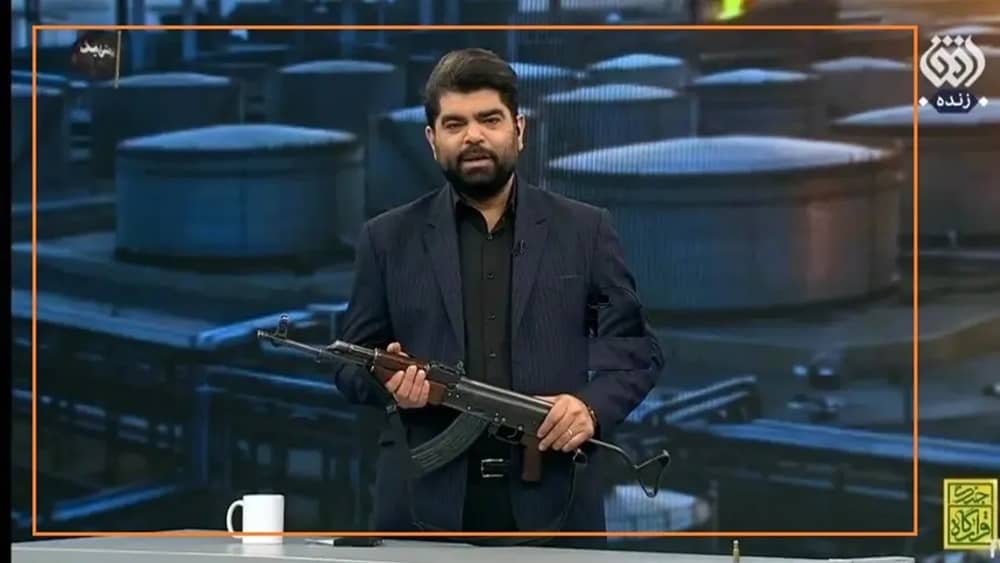
On May 16, 2026, Iranian state television crossed into open spectacle. On the Ofogh network, presenter Hossein Hosseini disassembled and reassembled a Kalashnikov before firing live rounds into a UAE flag in the studio. The same day, Channel 3’s Mobina Nasiri pledged that “in case of need, she and all women will join the war as cannon-fodder.”
In the midst of a total economy and resource crisis, IRIB Channel 1 framed civilian drills in mosques and city squares as “public defense,” calling on citizens to preserve fuel, water and power by declaring: “One liter less petrol, one bulb off, one bucket of water less… equals successful civil defense against the enemy.”
These broadcasts were not about arming the Iranian people. The regime knows that is the most dangerous thing it could do. In reality, it continues to execute anyone who independently grabs arms or believes in using them against the state. The televised gunplay is pure political theater, intended solely to preserve the loyalty of its own demoralized base—the only remaining fragment of social capital the Islamic Republic still possesses.
By staging these shows, the regime hopes to rally its demoralized faithful while intimidating a restive society exhausted by endless crises — and to warn foreign enemies that any ground invasion would confront something far worse than Iraq or Afghanistan.
"The “message” being sent through these executions is indeed one of #terror, but the response from the streets suggests a different conclusion: the only way to end the cycle of executions is to remove the hand that holds the rope," writes @SaforaSM https://t.co/5dpRWUpgOV
— NCRI-FAC (@iran_policy) April 5, 2026
Propaganda as Panic
The militarized pageantry coincides with explicit warnings of renewed war. State media outlet Nowandish reported on May 16 that “one of the regional countries” had privately warned Tehran of the high probability of fighting resuming after diplomatic deadlock in Beijing. Former IRGC commander and MP Ismail Kowsari, speaking on IRIB News on May 16, demanded universal readiness: “Woman and man… if they see any point occupied by the Zionist or American regime, they can confront it.” Night rallies in Arak’s Martyrs’ Square and elsewhere featured children in military uniforms—regime-orchestrated optics only.
Yet the regime’s actual policy is the opposite of broad armament. Police chief Ahmadreza Radan announced on May 17 that 6,500 “homeland-sellers and spies” have been arrested since the war began, including 567 “special cases” tied to opposition groups.
Beneath the gun-toting presenters lies economic freefall.
Petrol production has fallen to 105 million liters daily against 135 million in demand, creating a permanent 30-million-liter deficit. Long queues stretch through Mashhad, Bandar Abbas and Jiroft. Citizens vented on state television: “Ten liters of petrol—200,000 tomans. By God!” Regime economist Yazdizadeh, interviewed on House of Economy on May 16, called the currency policy “two economic coups” that handed the rial’s value to exporters who profit from its collapse.
Pharmacies tell an even darker story. On May 17, association spokesman Hadi Ahmadi told Mehr News that insurance debts have quadrupled; Social Security alone owes private pharmacies 15 trillion tomans. Dialysis centers are turning away patients. Serum and antibiotics are rationed. These daily humiliations explain the regime’s harsh warmongering rhetoric: it has no solutions, only distractions.
"Iran is grappling with a multi-layered socio-economic crisis that has intensified in recent weeks, combining runaway food #inflation, severe water shortages, a prolonged internet blackout, and growing shortages in essential medicines," @MansoreGolestan writes.…
— NCRI-FAC (@iran_policy) May 11, 2026
Digital Siege and Elite Infighting
The information war is equally lost. After four months of total internet blackout, the regime’s own replacement apps—Rubika and Bale—crashed nationwide on May 16. Black-market Iraqi SIM cards have proliferated, prompting security officials like Ghazanfari to panic about “information and security threats.” A new “sanitization” committee under VP Mohammad-Reza Aref is widely viewed as the prelude to permanent tiered “Internet Pro” pricing that extracts yet more money from impoverished citizens. Even regime MP Pourdehghan admitted citizens are furious about “discrimination… and strange names like Internet Pro.”
Factional paralysis compounds the crisis. Extremists and revisionist factions clash publicly over negotiation versus escalation. Osman Salari, deputy chairman of the Majlis Judicial Committee, felt compelled to remind everyone via ISNA on May 17 that “the first and last word on war and peace belongs exclusively to the Leader.” Speaker Ghalibaf was suddenly appointed special envoy to China with expanded powers—proposed by the regime’s president Masoud Pezeshkian but approved by Mojtaba Khamenei—while Kayhan’s Shariatmadari listed Saudi Arabia, UAE, Kuwait, Qatar, Jordan and Bahrain as “marked targets for revenge.”
"If the regime's model of #Internet censorship succeeds, it will not remain confined to Iran. It will become a blueprint for authoritarian survival in the twenty-first century and beyond," @MasumehBolurchi writes.https://t.co/MUPWa702g9
— NCRI-FAC (@iran_policy) May 7, 2026
External Isolation and the Endgame
Externally, adventurism has backfired. A drone strike hit the perimeter generator of the UAE’s Barakah nuclear plant on May 17, triggering an IAEA alert and immediate global suspicion pointing at Tehran. At the BRICS foreign ministers’ meeting in Delhi, the UAE accused the regime in Iran of repeated attacks on civilian infrastructure since February 28; no joint communiqué emerged.
The regime’s only remaining social capital is its fading, demoralized base—the hard-core loyalists who still attend night rallies and cheer the televised Kalashnikov drills. Every gun-toting presenter, every threat to close the Strait of Hormuz, every staged mosque training session is an act of desperation to keep that base mobilized and the rest of society too terrified or exhausted to act.
The Libyan parallel circulating on Iranian social media is telling. In 2011, a state TV presenter waved a gun days before Qaddafi fell. Today, Iranian state television is doing the same—on a far larger scale—while the regime quietly executes anyone who takes the message literally. The harder the terrorist regime fights to survive through spectacle, the faster it hastens the very disintegration it dreads. The cameras keep rolling, the queues keep growing, and the endgame has begun.