

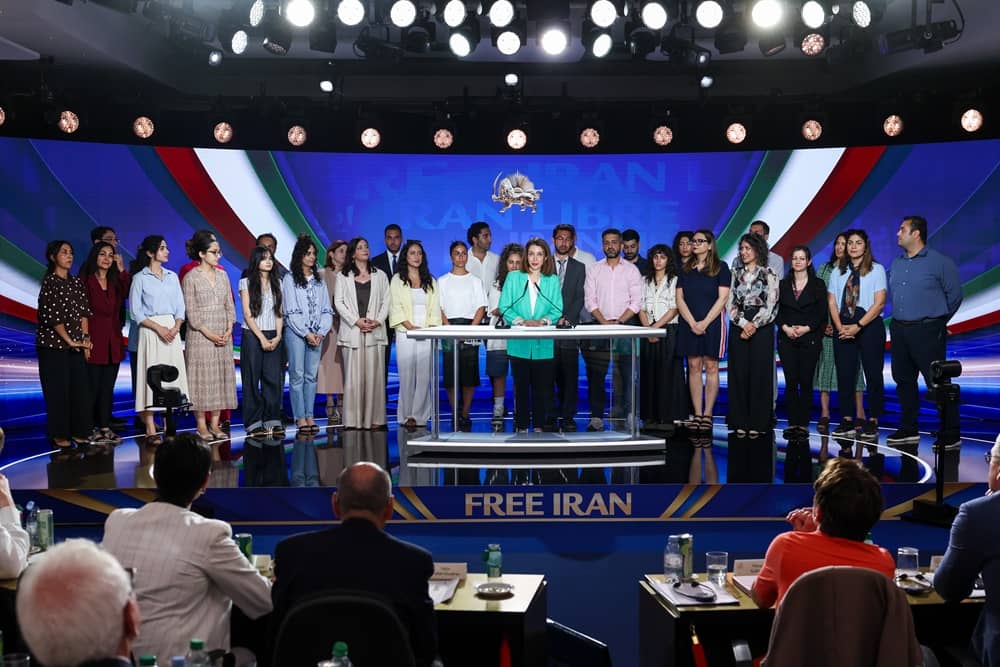
The full text of Mahan Taraj‘s speech follows:

Merci. Thank you.
Distinguished guests, dear friends, dear brothers and sisters in Ashraf 3.
45 years ago, on June 20th, 1981, half a million Iranians marched peacefully in the streets of Tehran. They marched for freedom. They marched for democracy.
The regime answered them with bullets. Among those fleeing the gunfire were my parents. My mother was eight months pregnant. One month later, I was born. In a way, my life began in the shadow of June 20th, 1981.
When I was six years old, my parents left Iran and found refuge in France.
I grew up in freedom, in safety, in a country governed by the rule of law. Though I’m painfully aware that, even here, the rule of law can sometimes be compromised, as we saw this week with the arbitrary ban on the Iranian Resistance demonstration in Paris.
I studied law and built my professional life in France. As I grew older, I didn’t want to inherit my parents’ political convictions automatically.
I wanted to understand for myself. I wanted to judge based on facts, with the critical mind that my legal education had taught me.
So I studied, I questioned, and I compared. And the more I learned, the clearer my conclusion became.
I chose to support the National Council of Resistance of Iran and the PMOI because I found in their vision the principles that I believe in most deeply: democracy, pluralism, human rights, equality between women and men, the separation of religion and state, and the rule of law.
My journey is not unique. It is the journey of many in my generation—children of exile who grew up in free societies and who, through reflection and conviction, found their way to the Iranian Resistance.
But today, I want to speak about another journey. A journey that demands infinitely more courage.
The men and women inside Iran have known nothing but dictatorship. They have lived under censorship, repression, and fear. And yet, they are arriving at exactly the same conclusion. They too are choosing resistance. They too are choosing freedom.
Think of activists such as Vahid Bani-Amerian. He was an engineer [and a] physics teacher.
He knew the price. He knew that torture and execution were real possibilities.
Yet he chose to stand up. The regime executed him, but it couldn’t kill what he represented, because there are thousands more like him.
The Resistance Units across Iran continue to risk everything because they believe that their country can be free.
Our journeys began in different places. Ours began in the safety of countries like France, Europe, and the US. Theirs began inside Iran, under the shadow of repression and the gallows.
But we are all part of the same struggle for freedom. We are united by the same conviction that the Iranian people deserve a democratic, secular republic [in] Iran.
The blood spilled on June 20th, 1981, was not in vain. It lives on in every person who refuses to surrender to tyranny. It lives on in every act of resistance. It lives on in the international support for the Iranian people’s right to freedom and democracy.
It runs in the veins of successive generations, right down to the third generation fighting today, inside Iran and across the world.
And together, we will not rest. We will not rest until the dawn of a free republic finally breaks over Iran. Thank you.