

Four-minute read
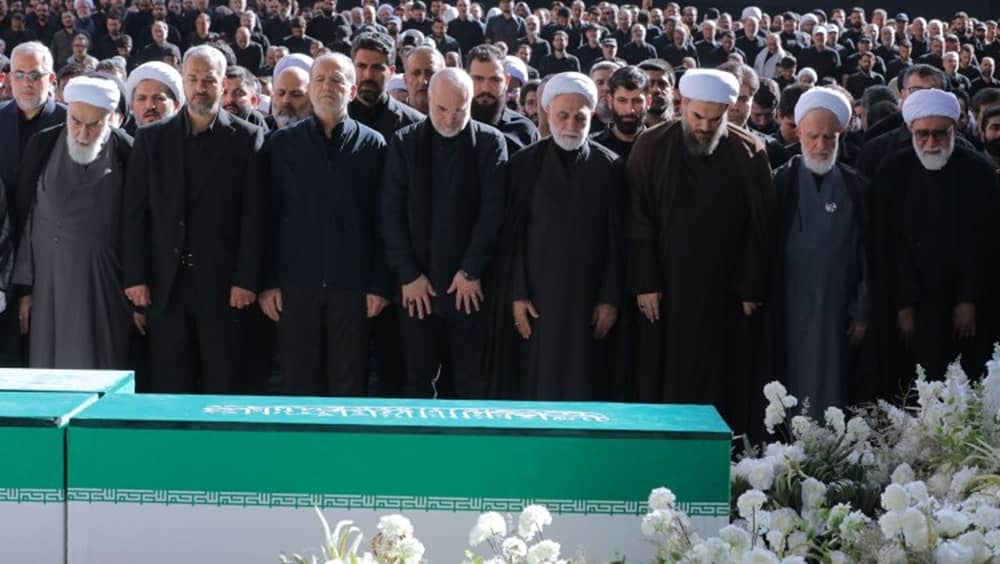
As the Iranian regime stages the delayed funeral of Ali Khamenei after thirty-seven years in power, it seeks to transform a burial into a theater of legitimacy. The preparations have followed the choreography of a major state event: security roadblocks, organized transportation, public announcements, arranged ceremonial spaces, and restricted access for journalists, whose movements were tightly controlled by official escorts, translators, and state-mandated guides. Along Vali-Asr Avenue, roads gave way to reception and mourning stations distributing food and water. The funeral, set to continue in Tehran, other Iranian cities, and even into neighboring Iraq, aims to do far more than bury a leader. It seeks to manufacture the image of national veneration. But no ceremony can erase the repression, executions, censorship, misogynistic control, persecution of minorities, and regional violence that marked his reign.
Khamenei’s responsibility was not merely symbolic. Under the Iranian Constitution, the Supreme Leader dictates state policy, commands the armed forces, declares war and peace, and appoints the heads of the judiciary, state broadcasting, the Islamic Revolutionary Guard Corps (IRGC), and other high-ranking security apparatuses. In practice, he held ultimate authority over the institutions tasked with domestic repression: the IRGC, the Basij, the intelligence apparatus, the judiciary, and state propaganda. The crimes committed under his rule were not isolated excesses. They formed a recurring pattern in which major protest movements were treated as existential threats.
This pattern was evident in the suppression of the 1999 student protests, the 2009 Green Movement, the 2017–2018 protests, and, most notably, the November 2019 uprising. During the demonstrations triggered by a fuel price hike in 2019, security forces opened fire on protesters nationwide. Reuters, citing official Iranian sources, reported approximately 1,500 deaths; Amnesty International documented at least 304 fatalities and thousands of arrests. According to reports by Reuters, Khamenei ordered that the protests be stopped by any means necessary. The message was unequivocal: faced with dissent, the regime chose a bloodbath over reform.
"The Shah learned too late that a throne built on spectacle collapses when the audience stops clapping. The men who replaced him, now staging their own pageant over #Khamenei’s coffin, have learned nothing at all. The Iranian people, however, have learned everything," @khansari_m…
— NCRI-FAC (@iran_policy) July 3, 2026
The same logic guided the crackdown following the death of Jina Mahsa Amini in September 2022 while in the custody of the morality police. A UN-mandated fact-finding mission later concluded that her death was unlawful and caused by physical violence sustained in custody. It established that the ensuing crackdown involved extrajudicial executions, arbitrary arrests, torture, ill-treatment, rape, and sexual violence, and that some of these violations amounted to crimes against humanity. More than 750 people were reportedly killed and over 20,000 arrested. Women and girls were the primary targets of a system that criminalized their bodies, imposed the mandatory hijab, and treated demands for equality as sedition.
The latest and most devastating of the domestic atrocities associated with Khamenei’s reign occurred during the January 2026 uprising. The protests, born out of economic collapse and political anger in late December 2025, sharply intensified in early January. On January 8, Iran was plunged into a severe communications blackout. Doctors, hospitals, eyewitnesses, and human rights networks described security forces firing live ammunition into crowds, specifically targeting the head, neck, and abdomen. The exact death toll remains contested, as the regime cut off communications, intimidated medical staff, and controlled access to bodies. But the core fact remains clear: thousands were killed or injured for defying clerical rule.
Executions constituted another pillar of Khamenei’s system of fear. Iran remained one of the world’s leading executioners throughout his tenure. The UN reported that Iran executed at least 901 people in 2024, including 31 women; Amnesty International recorded at least 853 executions in 2023. Revolutionary courts routinely relied on vague charges such as moharebeh—”enmity against God”—and “corruption on earth,” often following coerced confessions, the denial of genuine legal representation, and allegations of torture. The death penalty served not only as a punishment but as political theater: a warning to protesters, minorities, dissidents, and prisoners of conscience.
"The death of Ali Khamenei continues to plunge the clerical dictatorship into a volatile #crisis, exposing severe cracks within the Iranian regime’s ruling establishment," writes Farid Mahoutchi. https://t.co/lM40VfP8iv
— NCRI-FAC (@iran_policy) July 5, 2026
Khamenei also presided over institutionalized discrimination. Baha’is, Christians, Sunni Muslims, Gonabadi Dervishes, Kurds, Baluchis, Arabs, and other minorities endured arbitrary detentions, property confiscations, exclusion from education or employment, and a disproportionate use of the death penalty. Women’s rights activists, lawyers, teachers, trade unionists, journalists, and students were treated as security threats. Prisons like Evin and Ghezel Hesar became synonymous with prolonged solitary confinement, forced confessions, medical deprivation, and torture. The judiciary did not restrain this machine; it enabled it.
Khamenei’s crimes were not confined to Iran’s borders. Through the IRGC’s Quds Force, his regime built a regional network of armed proxies and client militias. In Syria, Iran provided advisors, weapons, logistics, and allied militias to preserve Bashar Al-Assad’s dictatorship during a war that devastated Syrian society. Reuters reported in late 2024 that Iran still viewed Assad as a central pillar of its “Axis of Resistance” and sought to supply him with missiles, drones, and advisors. In Yemen, a UN report cited by Reuters concluded that the Houthis’ rise as a major military force was made possible by support from Iran’s IRGC, Hezbollah, and Iraqi specialists.
"The funeral of the century is a burial of something larger than one man. It is the burial of the pretense that the Iranian regime commands the faith of its people or the obedience of its own institutions," Farid Mahoutchi writes on #Khamenei's burial theatrics.…
— NCRI-FAC (@iran_policy) July 2, 2026
The funeral must therefore be understood as an orchestrated spectacle, not as history. Public mourning under an authoritarian regime is not a free plebiscite; it unfolds in a climate of censorship, surveillance, fear, clientelism, and coerced loyalty. The contrast was even starker on Sunday, July 5, 2026, during the regime’s staged ceremonies and the public procession of Khamenei’s body. Despite the high alert status of security forces and the presence of surveillance cameras, opposition reports indicated that the Resistance Units of the People’s Mojahedin Organization of Iran (PMOI/MEK), in Tehran and other cities, conducted a campaign against religious fascism and in support of Iranian opposition leader Maryam Rajavi. In Tehran, leaflets calling for uprising and revolt against the high cost of living were distributed and posted at bus stations, on school walls, in parks, and in other public spaces.
Khamenei’s legacy is not found in the choreography of his funeral, but in the graves of protesters, the execution chambers of Iranian prisons, the blinded eyes of young demonstrators, the silenced newspapers, the persecuted minorities, the abused women, and the ruins left by proxy wars. To portray such a figure as popular is to confuse fear with consent and spectacle with legitimacy. He leaves behind one of the most abysmal human rights records in the contemporary Middle East.