

Three-minute read
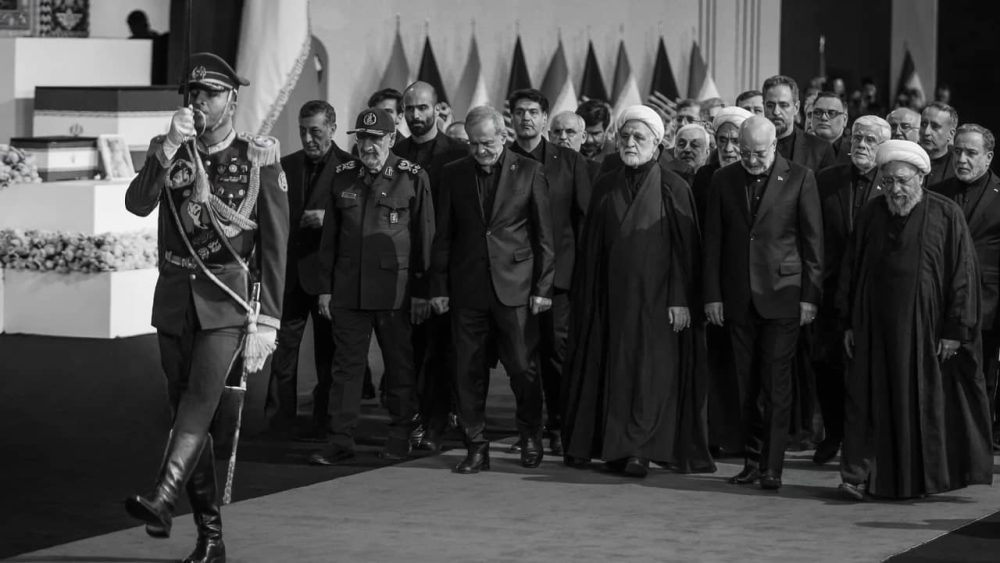
The multi-day state funeral for the Iranian regime’s slain Supreme Leader Ali Khamenei was meticulously designed to project unshakeable institutional power. Instead, the heavily militarized ceremonies in Tehran have laid bare the deep political instability and bitter factional warfare engulfing the clerical dictatorship. Orchestrated in the shadow of a fragile ceasefire, the massive processions highlight a ruling establishment that is fundamentally divided on how to manage its survival.
At the center of this projected transition is a glaring absence. While state television broadcast images of Khamenei’s other sons praying over the coffins at Tehran’s Imam Khomeini Grand Mosalla on July 5, 2026, the newly designated Supreme Leader, Mojtaba Khamenei, remained entirely out of public view.
Since claiming leadership, Mojtaba has remained entirely out of public view throughout the ceremonies. While the reasons for his conspicuous absence remain the subject of intense speculation, the regime’s inability to present him at such a pivotal moment—despite having already mobilized massive crowds and implemented extraordinary security measures—suggests that the political cost of showcasing him currently outweighs the risks of his invisibility. Rather than projecting the intended image of seamless continuity and strength, this vacuum has deepened internal fissures. His prolonged disappearance has emboldened various factions and political figures to openly challenge or undermine the authority of the Supreme Leader’s office, a development that signifies a fundamental weakening of the transition’s perceived legitimacy.
"#Khamenei’s legacy is not found in the choreography of his funeral, but in the graves of protesters, the execution chambers of Iranian prisons, the blinded eyes of young demonstrators, the silenced newspapers, the persecuted minorities, the abused women, and the ruins left by…
— NCRI-FAC (@iran_policy) July 7, 2026
A Legislature Paralyzed by Infighting
Rather than addressing the nation’s severe socio-economic crises, the regime’s parliament, the Majlis, has descended into a fierce turf war over state resources. The hardline ruling coalition has sharply fractured, primarily pitting parliamentary speaker Mohammad Bagher Ghalibaf against the ultra-extremist Paydari Front. State media explicitly characterizes these disputes over critical budgetary and national security committees not as ideological debates, but as power struggles aimed at capturing lucrative government contracts and institutional leverage.
The executive branch has openly acknowledged these widening rifts, breaking the facade of solidarity. On July 4, 2026, the state-run Iranian Students’ News Agency (ISNA) reported that the regime’s president Masoud Pezeshkian launched a direct critique of his rivals during an international forum. “They talk about unity, but they criticize the opposing side, widen the social gap, and want to eliminate the opposing side,” Pezeshkian stated, adding that such egotism prevents any real political consensus.
While Pezeshkian publicly pledged his allegiance to the new Supreme Leader, his remarks underscore a governing apparatus incapable of forming a cohesive political front. To mitigate this internal chaos, the new leadership is defaulting to its most reliable tool: domestic repression. State media announced the reappointment of hardline cleric Gholam-Hossein Mohseni-Ejei as the head of the judiciary, signaling that the state intends to rely heavily on its punitive apparatus to maintain control over an alienated public.
"The death of Ali Khamenei continues to plunge the clerical dictatorship into a volatile #crisis, exposing severe cracks within the Iranian regime’s ruling establishment," writes Farid Mahoutchi. https://t.co/lM40VfP8iv
— NCRI-FAC (@iran_policy) July 5, 2026
Economic Meltdown and Labor Unrest
This factional warfare is unfolding against the backdrop of a catastrophic economic collapse. According to recent macroeconomic data published by the state-affiliated media outlet Fararu, Iran’s point-to-point inflation rate has reached a staggering 88 percent, driven by a 53 percent expansion in liquidity. The publication bluntly warned that the unchecked printing of money by state banks is systematically destroying the middle class and rapidly expanding “the army of the poor,” pushing society toward an explosive breaking point.
This fiscal emergency was severely worsened by the regime’s abrupt elimination of preferential currency exchange rates for essential goods. On July 4, 2026, Masoudi, the head of the Agricultural Commission of Iran’s Chamber of Cooperatives, told state media that the sudden policy shift caused a devastating price shock. He noted that “production costs went up five to six times overnight,” emphasizing that internal economic mismanagement has exacted a heavier toll on domestic industries than external conflicts.
The real-world consequences of this elite mismanagement are visible in a widening wave of labor unrest. In Sirjan, copper mine workers recently staged strikes over three months of unpaid wages. Concurrently, the state-aligned Ensaf News reported on July 5, 2026, that industrial workers at the Iran Berk factory had extended their protest into a sixth consecutive day. Denied their salaries and state insurance benefits, these striking workers illustrate a populace completely divorced from the clerical elite’s internal battles, signaling that the most profound threat to the regime comes from within.