

THIS PAGE WILL BE UPDATED WITH THE LATEST NEWS
UPDATE: 5:00 PM CEST
Iranian Underground Takes Down 600 Regime Websites Following US Airstrikes
 As the Iran/US ceasefire broke down last night brave Iranian students humiliated the dictatorship in Tehran by taking over more than 600 government-controlled university websites. The regime of Ayatollah Mojtaba Khamenei – who has made no appearance at week-long funeral rallies for his father Ali Khamenei, backing claims he has been seriously injured in a US air strike – came under fire from American missiles which rained down on 80 strategic sites last early this morning. At almost the same time, students supporting the People’s Mojahedin Organization of Iran (PMOI/ MEK) triggered their own raids on the websites.
Sites belonging to state-run K.N. Toosi University of Technology, Tarbiat Modares University,and the University of Isfahan were hit as hackers replaced front pages with slogans celebrating the Iranian resistance The slogans included:
“Death to the ruthless King Mojtaba”
“Curse be upon the bloodthirsty Khomeini”
UPDATE: 4:30 PM CEST
US Hits More Than 80 Iran Targets, Reimposes Oil Sanctions

US strikes on Iran: The US military “completed” a new round of strikes on Iran, hitting over 80 targets, according to a statement late Tuesday from US Central Command. The US also reimposed sanctions on Iranian oil sales in retaliation for attacks on commercial ships near the Strait of Hormuz.
Iran responds: With the ceasefire between the two countries on increasingly shaky ground, Iran warned early Wednesday that it would deliver a “crushing response” to the US strikes. A short time later, air defenses were activated in both Bahrain and Kuwait.
Local impact: Iranian state media reported explosions on Kharg island, a vital hub for Tehran’s oil exports, as well as in the port cities of Bandar Abbas and Sirik and on Qeshm Island. The attacks happened as Iran holds a funeral for the late supreme leader.
NATO summit: Security in the Strait of Hormuz was expected to be discussed by US President Donald Trump and other NATO leaders as they gather in Ankara, Turkey.
Ministry of Foreign Affairs Summons Iran’s Deputy Ambassador, Delivers Protest Note Over Targeting of Qatari Tanker Al Rekayyat
The State of Qatar expressed its strong condemnation and denunciation of the targeting of the Qatari tanker Al Rekayyat while it was transiting near the Strait of Hormuz, stressing that this attack amounts to a grave violation of the safety of international navigation, a direct threat to global energy supply security, and a clear and flagrant breach of international law.
This came in the protest note HE Director of the Protocol Department at the Ministry of Foreign Affairs Ibrahim bin Yousef Fakhro handed to Deputy Ambassador of the Islamic Republic of Iran to the State of Qatar, Mohsen Mohammad Ghanei, during his summoning to the Ministry’s headquarters on Tuesday.
The note outlined the State of Qatar’s unequivocal rejection of this assault and the threat it poses to the security of international navigation and the stability of the region.
The note demanded that the Islamic Republic of Iran immediately cease any practices that compromise the security of the region and refrain from endangering international shipping and global energy supplies.
U.S. Revokes Iran Oil Sanctions Waiver After Attack on Tankers

The Trump administration on Tuesday revoked a waiver allowing the sale of Iranian oil after three tankers were attacked in the Strait of Hormuz, the latest twist in a conflict that has stretched on for months. Last month, the Treasury Department issued a general license allowing Iran to produce, sell and deliver oil for two months. The exemption represented a major shift in America’s approach toward Iran, which has been heavily sanctioned for decades.
The exemption, if made permanent, could have helped Iran reshape its economy by allowing its oil to be openly sold on global markets.
Iran has not directly claimed responsibility for the attacks. But its government has asserted that it has sole control of the waterway, and it has been blamed for other such attacks during the war with the United States and Israel.
Free Iran Summit Sees Global Leaders Declare Regime at ‘Weakest Hour’

Hundreds of former heads of government, cabinet ministers, lawmakers, diplomats, military commanders, and other senior political figures gathered at the National Council of Resistance of Iran’s annual Free Iran World Summit outside Paris, declaring Iran’s ruling clerical regime is now at its weakest point since the 1979 Islamic Revolution while insisting the NCRI has emerged as the organized democratic alternative capable of leading a post-regime transition.
The annual summit, held during the final weekend of June, was originally scheduled as a one-day conference following the movement’s planned mass rally in Paris. French authorities, however, imposed a last-minute ban on the outdoor demonstration, citing “security concerns,” prompting organizers to expand the conference into a two-day event at the NCRI’s headquarters in Auvers-sur-Oise.
The summit also coincided with initial implementation of the recently signed Memorandum of Understanding between Washington and Tehran, reached after months of regional conflict. The agreement is intended to end hostilities while establishing a diplomatic framework for addressing Tehran’s nuclear program and other outstanding disputes.
UPDATE: 7:00 AM CEST
Iran’s Parliament Is Not a House of the People—It Is a Battlefield for Power
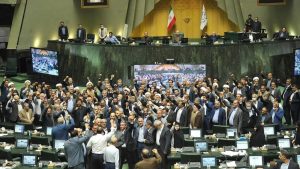
In democratic societies, parliaments embody the principle of popular sovereignty. Legislators are elected to represent citizens, scrutinize governments, and craft laws that advance the public interest. Debate, political competition, and ideological diversity are not signs of weakness but essential features of pluralistic governance.
Under Iran’s clerical dictatorship, however, this institution has been stripped of its fundamental purpose. The regime’s parliament has evolved into something entirely different: a stage where rival factions compete not over policies that improve the lives of ordinary Iranians, but over influence, patronage, and access to the levers of power. While millions of citizens struggle with soaring inflation, unemployment, housing insecurity, and the steady erosion of purchasing power, parliamentary politics revolve around an altogether different set of priorities.
The widening gap between the suffering of the public and the preoccupations of the political elite has become one of the clearest indicators of the regime’s structural failure.
The contradiction is difficult to ignore.
Iran faces a succession of interconnected crises. Inflation continues to devastate household budgets. Economic stagnation has left many young people without meaningful employment. Housing costs have become prohibitive, while repeated energy shortages and deteriorating public services further undermine living standards.
The Iran Regime’s Oligarchs Are Turning on Each Other
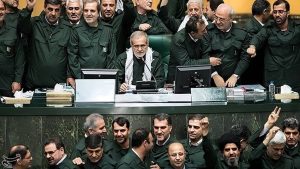
Authoritarian systems often appear strongest when power is concentrated in a single individual. Yet that same concentration can become their greatest weakness once the central authority disappears. The Iran regime is now confronting precisely this dilemma.
The increasingly visible infighting among the regime’s ruling elite is not simply another episode of factional politics. It reflects a deeper struggle over who will inherit influence, wealth, and political control in a system that has lost the figure capable of imposing discipline on competing power centers.
For decades, the regime’s various oligarchic networks—including the clerical establishment, the Revolutionary Guards, intelligence institutions, and politically connected economic interests—operated under the arbitration of a supreme leader whose authority ultimately settled disputes. With that unifying force gone, old rivalries are resurfacing with new intensity.
Iran’s Water Collapse Exposes Decades of Regime Mismanagement
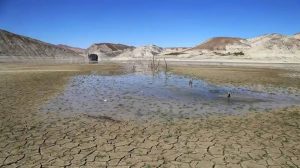
The steady decline of Iran’s renewable water resources has once again exposed one of the country’s most serious long-term crises. While regime officials often blame drought and climate change for worsening water shortages, mounting scientific evidence points to a far deeper problem: decades of unsustainable resource management under the Iran regime.
Recent warnings from water experts make clear that the country is no longer facing a temporary shortage caused by fluctuating rainfall. Instead, Iran is confronting a structural water crisis driven by excessive groundwater extraction, poor agricultural policies, politically motivated development projects, and a system of governance that has consistently prioritized short-term political objectives over long-term environmental sustainability.
The result is a crisis that threatens not only drinking water supplies but also agriculture, food security, economic stability, and social cohesion.
The latest assessment presented by Banafsheh Zahraei, head of the Water Institute at the University of Tehran, illustrates the scale of the deterioration.
According to Zahraei, Iran’s renewable water resources have fallen from approximately 110 billion cubic meters to just 92 billion cubic meters in recent years.
Iran Regime Faces Mounting Oil Revenue Crisis as Global Market Shifts
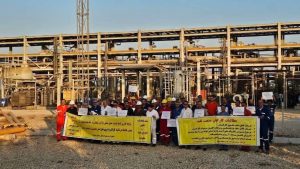
The Iran regime is facing a new challenge to one of its most important sources of revenue. As China reduces its appetite for imported crude and global oil supplies continue to increase, Tehran may find it increasingly difficult to sell its oil—even if geopolitical tensions ease and restrictions on energy exports become less severe.
Recent reports by CNBC and other international media suggest that the regime’s long-standing dependence on China as its primary oil customer is becoming a growing strategic vulnerability rather than a reliable economic lifeline.
For years, China has served as the principal destination for Iranian crude exports, often purchasing discounted oil despite international sanctions. That relationship, however, appears to be changing.
According to recent trade data, China’s crude oil imports have fallen sharply. In May 2026, imports declined by 29 percent year-on-year to 7.82 million barrels per day, the lowest level recorded since February 2018.
The slowdown extends to Iranian oil specifically. Bloomberg reported that China’s imports of Iranian crude dropped by more than 50 percent in June, falling to approximately 654,000 barrels per day.
Ejei’s Reappointment Signals the Regime’s Commitment to Judicial Repression

The reappointment of Gholamhossein Mohseni Ejei as head of the Iran regime’s judiciary is far more than a routine administrative decision. It is a political statement about the direction of the regime under Mojtaba Khamenei and a clear indication that the judiciary will remain an instrument of repression rather than justice. By extending Ejei’s five-year term, the regime has chosen continuity over reform, reinforcing a judicial system that has long operated in close coordination with the intelligence services and security apparatus.
Few officials better embody the fusion of intelligence, political control, and judicial authority than Mohseni Ejei.
Since the early years following the 1979 revolution, he has occupied influential positions within the Revolutionary Prosecutor’s Office, the Ministry of Intelligence, the Attorney General’s Office, and eventually the judiciary itself. Throughout his career, Ejei has been associated less with legal reform than with politically sensitive prosecutions, forced confessions, and the suppression of dissent.
Oil Tanker Attacked Near the Strait of Hormuz

The United Kingdom Maritime Trade Operations (UKMTO), a British maritime security monitoring organization, reported that an oil tanker sailing south approximately 8 nautical miles east of Limah, Oman, was struck on its port side by an unidentified projectile, causing a fire to break out on board.
According to the report, no casualties or environmental pollution have been reported, and authorities are investigating the incident. Passing vessels have also been advised to navigate with caution and report any suspicious activity to UKMTO.
The attack occurred along one of the world’s most strategically important energy shipping routes, where any maritime tension can quickly take on major security and economic implications. Media reports, citing U.S. officials, say the Islamic Revolutionary Guard Corps (IRGC) of the Iranian regime fired on commercial vessels in the Strait of Hormuz on Monday night, damaging at least two ships. Officials have not yet officially attributed direct responsibility for the attack.
In previous similar incidents, attacks on ships in the waters around Oman and the Strait of Hormuz have not remained isolated maritime incidents and have rapidly escalated into military crises. It appears that the Iranian regime has once again taken global trade routes and energy security hostage.
Arrested Iranian Protesters in Critical Conditions, Human Rights Bodies Warn

Iran Human Rights (IHR), a Norway-based human rights organization, on Monday, July 6, expressed concern over the growing wave of executions of political prisoners in recent months and stressed that halting executions must be one of the main conditions of any agreement with the Iranian regime.
In a report, the human rights organization warned of an escalation in executions in Iran in the coming months and said officials of the Iranian regime have accelerated the execution of prisoners, particularly political activists, following the ceasefire with the United States and Israel. According to the report, at least 101 Iranians were executed in June alone. At the same time, HRANA News Agency, an Iranian human rights news outlet, reported that Kamal Khan-Babaei, who was arrested during the January 2026 protests and is being held in Choobindar Prison in Qazvin, has been sentenced to death by Branch One of the Qazvin Revolutionary Court on the charge of “moharebeh” (“waging war against God”).
According to HRANA, one of the allegations cited against Mr. Khan-Babaei was “breaking two surveillance cameras.”
Kamal Khan-Babaei was arrested on January 15 and spent 10 days in a detention center operated by Iran’s Ministry of Intelligence, where he was interrogated and beaten in an effort to extract a forced confession.
Iran – Nightmare of Evin: British Couple’s Hunger Strike; Scenario of State-Sponsored Hostage-Taking

The systematic exploitation of foreign nationals and dual citizens as “leverage” constitutes one of the darkest dimensions of human rights violations in the Islamic Republic. The case of Craig Foreman and his wife, Dr. Lindsay Foreman, a British tourist couple who were captured during a motorcycle tour and sentenced to imprisonment on fabricated charges, while having a tour guide, is a textbook example of the state-sponsored hostage-taking in Iran. The critical situation of this couple, who are currently on a prolonged hunger strike in Evin Prison, not only reflects the systematic torture inflicted upon foreign nationals but also exposes the catastrophic reality and human rights violations against prisoners in Iran; a structure in which the prison has been transformed into a graveyard for international law and human dignity.
According to the latest documented human rights reports, following the unjust rejection of their appeal in June 2026, Craig and Lindsay Foreman went on a protest hunger strike to challenge their politically motivated sentences, the ban on contact with their families, and severe judicial deprivations. Pressure on the couple intensified significantly after they spoke about the staggering number of executions during an interview with a foreign media outlet.