

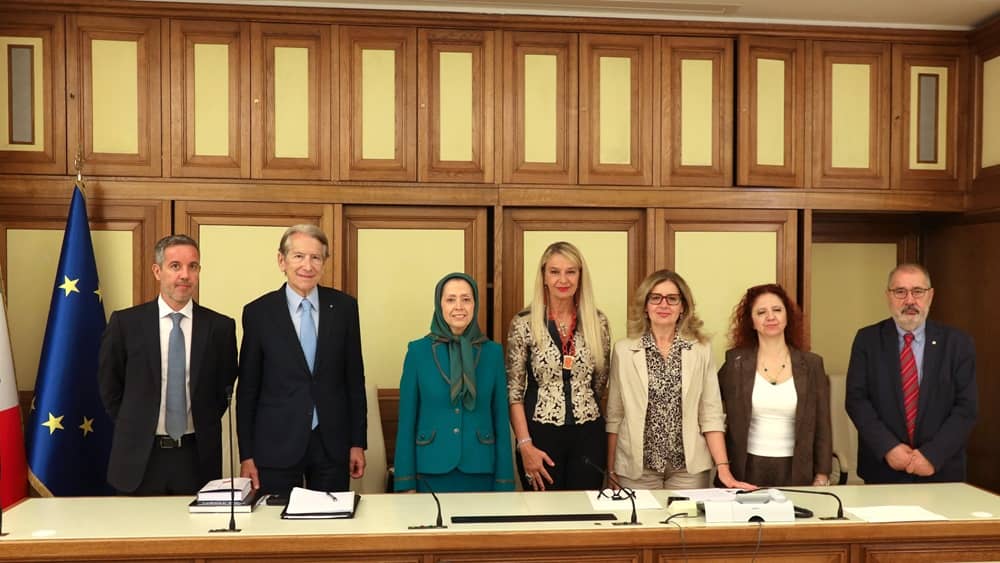
On July 16, 2026, the Human Rights Commission of the Italian Senate convened an official hearing with Mrs. Maryam Rajavi, the President-elect of the National Council of Resistance of Iran (NCRI). The session was conducted with a formal, official invitation extended by the Senate Commission and was broadcast live and officially on the Italian Senate’s dedicated WebTV platform (webtv.senato.it). Opened by the Commission’s President, Senator Stefania Pucciarelli, the hearing served as a major European platform to expose the clerical regime’s escalating domestic atrocities and to lay out a decisive, human rights-driven foreign policy roadmap for Italy and the wider European Union.
Addressing the distinguished panel of Italian senators, Mrs. Maryam Rajavi expounded on the critical human rights crisis unfolding across Iran. She highlighted a catastrophic surge in arbitrary executions and mass arrests, noting that the ruling mullahs have weaponized the death penalty to terrorize the public and preempt popular uprisings. Mrs. Rajavi reminded the committee of Italy’s historical legacy as a global pioneer in the movement to abolish the death penalty, urging Rome to lead the European Union in establishing firm accountability for Tehran’s systematic abuses. During her address, Mrs. Rajavi remarked: “The Iranian people and their Resistance look to Italy—historically a global pioneer in the movement to abolish the death penalty—to lead the way within the European Union in spearheading decisive measures against the ongoing executions and massacres in Iran.”
Citing the execution of political prisoners as well as ten members of the MEK Resistance Units in the last months, Mrs. Rajavi warned, “The issuance of death sentences continues unabated. The most recent and egregious case involves Arghavan Fallahi, a 25-year-old woman who has endured months of solitary confinement and severe torture, and whose father also remains unjustly imprisoned.”
“For the free Iran of tomorrow, we advocate for a complete ban on torture and the total abolition of the death penalty,” she stated. “For over four decades, standing in direct opposition to Khomeini, we have declared the mullahs’ Sharia laws and their retributive penal code (Qesas) to be profoundly inhumane and entirely incompatible with the true teachings of Islam.”
In Commissione #DirittiUmani, incontro con @Maryam_Rajavi @iran_policy. Diretta → https://t.co/aoJ2dxiixH pic.twitter.com/WIArtphSdK
— Senato Repubblica (@SenatoStampa) July 16, 2026
The NCRI President-elect added, “In tomorrow’s Iran, the separation of religion and state, complete gender equality, and all individual and social rights and liberties will be fully guaranteed in accordance with the Universal Declaration of Human Rights. All apparatuses of repression, censorship, and inquisitorial control will be dismantled.”
To translate this moral responsibility into concrete political action, Mrs. Rajavi presented three decisive, urgent policy demands to the Italian Senate and the European leadership:
- Conditional Relations: Conditioning all diplomatic and trade relations with the regime on an immediate halt to executions.
- Universal Jurisdiction: Prosecuting the ruling perpetrators of these atrocities under the internationally recognized principle of universal jurisdiction to dismantle the culture of systemic impunity.
- Multilateral Accountability: Referring Iran’s human rights violations to the UN Security Council, ensuring that any future agreements are strictly contingent upon a halt to executions, and compelling the regime to grant UN fact-finding missions and special rapporteurs unrestricted access to Iranian prisons and prisoners, especially the political detainees.
Senator Stefania Pucciarelli, President of the Senate’s Human Rights Commission, opened the session by welcoming Mrs. Rajavi and expressing the commission’s profound solidarity with the Iranian people in their struggle against grave human rights violations. Pointing to the commission’s long-standing dedication to humanitarian initiatives, Senator Pucciarelli strongly condemned the regime’s systematic execution of political dissidents. She emphasized that the official live-stream of the hearing on the Senate’s web platform reflected the chamber’s institutional commitment to ensuring that the plight and the voice of the Iranian democratic opposition are heard transparently by the global community.
“Respect for human rights in Iran is among the priorities of this commission, Senator Pucciarelli said. “We express our profound solidarity with the Iranian people and particularly with Iranian women, who are suffering due to a regime and have been suffering for too long. Also, through the work of this commission, we seek to advance the protection of human rights [everywhere].”
Address to the #HumanRights Commission of the Italian Senate
The Iranian people and their Resistance look to Italy—historically a global pioneer in the movement to abolish the death penalty—to lead the way within the European Union in spearheading decisive measures against the… pic.twitter.com/BTzZMLN7IF
— Maryam Rajavi (@Maryam_Rajavi) July 16, 2026
Adding a vital historical and geopolitical perspective, Senator Giulio Terzi (FdI) characterized the hearing as an “extremely important opportunity” to address the threat posed by the mullahs’ regime. Senator Terzi presented shocking statistical data regarding the regime’s reliance on the death penalty, noting that over 818 arbitrary executions had been recorded in the current year alone. He strongly endorsed the NCRI’s “No to Executions” campaign and drew special attention to the ongoing hunger strikes carried out every Tuesday by political prisoners across more than 25 Iranian prisons, describing their 45-week struggle as an inspiring battle for civilization and freedom. Senator Terzi also reminded the panel of the regime’s global network of terror, pointing to the 1993 assassination of the NCRI’s Rome representative, Mohammad-Hossein Naghdi, by Tehran’s intelligence agents as a grim reminder of the regime’s cross-border reach.
Senator Terzi added, “When one truly understands the Iranian Resistance movement that you represent, one must acknowledge, at the very least, that this movement is the one most closely aligned with the fundamental concepts of the rule of law and the defense of human rights that we support, and which Madame Rajavi has reiterated today.”
“[The NCRI represents] a very broad, vast, and deep-rooted resistance; a resistance that does not want to restore an oppressive monarchy, but to realize a new Iran of democracy and certainty, not only of hope. This movement is gaining, on a rising wave, consensus and success,” the former Italian foreign minister stated.
#Iran. Terzi (FdI) : un onore ascoltare in Senato Maryam Rajavi, presidente eletta del Consiglio Nazionale della Resistenza Iranianahttps://t.co/d4FJLO538e
“Oggi l’Iran vive sempre più sprofondato nel baratro delle terribili violazioni di diritti umani e delle atrocità che il… pic.twitter.com/kmAnHwRiZn— Giulio Terzi (@GiulioTerzi) July 16, 2026
Senator Gisella Naturale expressed profound concern over the relentless, boundless suffering inflicted by the Iranian regime, noting the tragic lack of any positive glimmers of hope for a cessation of these atrocities. She voiced a deep worry that the Iranian Resistance continues to suffer heavy casualties, which threatens to hinder the consolidation of a force strong enough to effectively overthrow the regime. Recognizing the complex geopolitical reality, Senator Naturale remarked on the apparent limitation of foreign nations like Italy to intervene directly in what must ultimately be a struggle resolved by the Iranian people and the diverse facets of the resistance itself. However, she insisted that Italy has a clear moral obligation to actively protect Iranian diaspora members living in Italy, who endure severe existential distress and anxiety over the safety of their loved ones back home.
Addressing Mrs. Rajavi, the senator said, “We in Italy can do nothing but thank you for your testimony, which brings attention back to this tragedy—which, although so far from us, is very alive in our sensitivity towards human rights, which continue to be trampled in this terrible way. In a state with such a profound culture, it seems incredible that these massacres still continue. Our closeness has always been particularly strong, and our hope and wish is to soon return to living in Iran in a lasting peace, where human rights can be protected and finally become real rights.”
Iran. Terzi (FdI) : un onore ascoltare in Senato Maryam Rajavi, presidente eletta del Consiglio Nazionale della Resistenza Iraniana https://t.co/1Z6A8Eqj9v via @vocedelpatriota
— 🇮🇹 La Voce del Patriota (@vocedelpatriota) July 16, 2026
Senator Bartolomeo Amidei commended the hearing for refocusing public attention from commercial interests, like Strait of Hormuz oil tankers, back to the critical issue of human rights and repression in Iran. Formally requesting that Mrs. Rajavi’s testimony be archived, Amidei warned of an accelerated bloody crackdown following reports that Tehran Prosecutor Ali Salehi has established specialized sections to expedite death sentences for protesters. While noting the heavy toll paid by the MEK since 1988, he urged all resistance factions to unite under the common goal of overthrowing the regime. Amidei called on European governments to demand an end to executions, hostage releases, and restored internet access, and highlighted his direct appeal to Interior Minister Matteo Piantedosi and Foreign Minister Antonio Tajani to grant automatic passport renewals for Iranian students and workers in Italy.
Addressing the commission, he stated: “I believe that at a time when world public opinion, and also Italian public opinion, is more focused on the oil tankers passing through the Strait of Hormuz, turning the spotlight on what is happening in terms of repression, of the lives and deaths of those who protested against the regime, is fundamental.”