

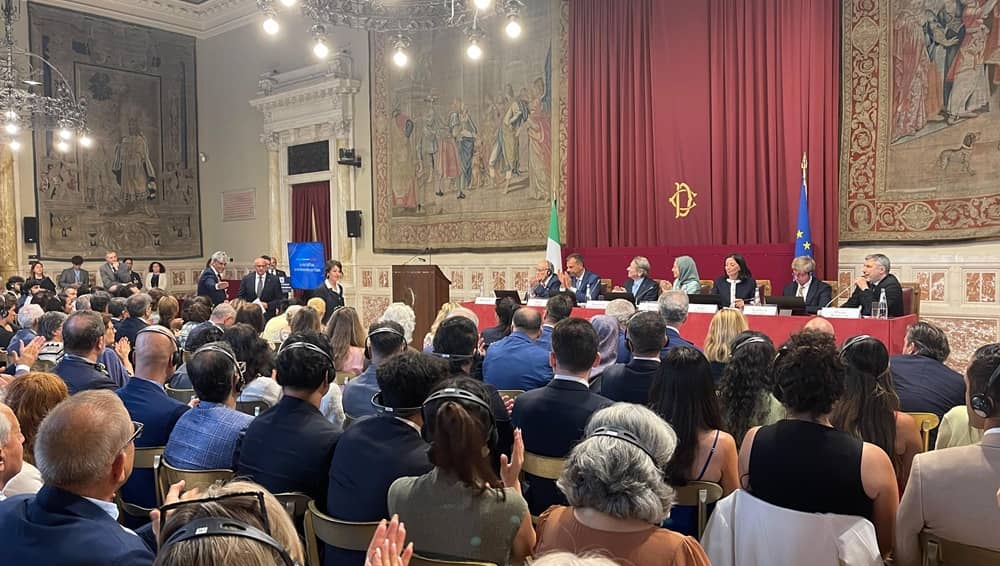
On July 16, 2026, the Italian Chamber of Deputies hosted a landmark conference titled “Iran’s Crisis: The Democratic Path Forward” in Rome’s Regina Hall. Bringing together prominent Italian lawmakers, former international officials, and the Iranian democratic opposition, the event addressed the spiraling domestic crisis in Iran, regional conflicts, and the global security implications of the current regime’s belligerence. Lawmakers strongly advocated for maintaining the proscription of the Islamic Revolutionary Guard Corps (IRGC), ending the disastrous Western policy of appeasement, and rejecting all forms of dictatorship—including both the ruling theocracy and any restoration of the defunct monarchy. Ultimately, the gathering underscored that lasting global peace and security remain inextricably linked to supporting the Iranian people and their organized Resistance Units in establishing a free, secular, and democratic republic.
As the keynote speaker, Mrs. Maryam Rajavi, President-elect of the National Council of Resistance of Iran (NCRI), outlined the severe impasse facing the ruling religious dictatorship. She stressed that the clerical regime survives only through domestic suppression, the pursuit of nuclear weapons, and regional warmongering. Presenting the NCRI’s Ten-Point Plan as a blueprint for a democratic republic, Mrs. Rajavi declared, “We seek a democratic republic based on the separation of religion and state, gender equality, and the abolition of the death penalty; a non-nuclear Iran, free of weapons of mass destruction, founded upon peace, coexistence, and international and regional cooperation.”
She firmly dismissed any return to the dictatorial past, noting the opportunistic campaigns of the Shah’s son run contrary to the people’s democratic aspirations. Instead, Mrs. Rajavi emphasized the true strength of the Iranian Resistance, stating that the organized movement of Resistance Units remains the genuine force capable of bringing down the regime.
“I must emphasize that by ignoring the Iranian people and their organized resistance, Europe has deprived itself of its most effective leverage in its policy toward Iran,” she stressed.
Over the past four decades, the dominant policy in the West was the attempt to change the regime's behavior. However, this produced the exact opposite results, as it ultimately paved the way for war.
As long as this regime remains in power, the region will never see peace and… pic.twitter.com/5sl2yveMS3
— Maryam Rajavi (@Maryam_Rajavi) July 16, 2026
“As long as this regime remains in power, the region will never see peace and tranquility,” Mrs. Rajavi warned. “No matter how much financial resources and commercial contracts it receives, it will never abandon its warmongering. It is a profound mistake to believe that a day will ever come when this regime abandons its hostility toward Iranian society and the international community to embrace peace and coexistence.”
The NCRI President-elect concluded: “Let me make it clear that Europe will regain its credibility in the Middle East only when it plays an effective and active role at the very epicenter of the region’s crisis, namely, in Iran. And this is nothing other than recognizing the will of the Iranian people to overthrow the regime and establish a democratic republic.”
The conference’s organizer, Naike Gruppioni, Member of the Foreign Affairs Committee of the Chamber of Deputies, echoed this vision by emphasizing the moral and institutional duty of Western democracies to support the Iranian people’s struggle. She welcomed Mrs. Rajavi as the certainty and hope for millions of Iranians yearning for a free and peaceful nation. Highlighting the strength of the Iranian Resistance, Gruppioni explicitly endorsed the movement’s democratic roadmap.
“Hers [Maryam Rajavi’s] is a vision that looks to the future and continues to inspire those who believe that change can be born from the strength of ideas and the will of the people, the Italian MP said. “With courage, determination, and extraordinary consistency, she has continued for years to carry forward a battle founded on the universal values of freedom, democracy, the rule of law…”
🇮🇹 MP @naike_gruppioni said it was both a great responsibility and an honour to host, in the Italian Parliament, a conference dedicated to a free Iran and the defence of human rights.
Addressing #MaryamRajavi directly, she said that her presence represented far more than that of… pic.twitter.com/lEYO6ZX33f— Javad Dabiran (@JavadDabiran) July 16, 2026
“Her Ten-Point Plan constitutes a clear and credible political proposal for a free, pluralistic Iran that respects human dignity,” she stated. Gruppioni warned that in the face of a regime that oppresses women and youth, silence from the international community amounts to complicity. She called on democratic nations to take concrete political action, insisting that defending human rights must translate into a firm rejection of the current dictatorship.
Adding to the global consensus, former Mayor of New York and former US Federal Prosecutor Rudy Giuliani delivered a sharp critique of both the ruling regime and any efforts to resurrect the monarchy, declaring the NCRI and MEK as the only viable democratic alternative. Mayor Giuliani vehemently dismissed the aspirations of the Shah’s son, labeling him a “nepo baby” surrounded by SAVAK remnants, and contrasted him with the decades-long sacrifice of the organized resistance.
Addressing the potential for a return to monarchist rule, Giuliani dismissed the notion with a pointed challenge, stating, “When they give you the Shah, bring him to me. And tell him, when he returns the money that he stole and the food that he took out of the mouths of his people, maybe we can give him a job in the post office.”
🇮🇹 Conference on Iran's Democratic Future Held at the Italian Parliament
A conference titled "The Iranian Crisis and a Democratic Solution for the Future" was held today at the Italian parliament.pic.twitter.com/owvNh1rjCe
The event featured speeches by Italian lawmakers, Mrs.…
— SIMAY AZADI TV (@en_simayazadi) July 16, 2026
He emphasized that the MEK has earned its legitimacy through blood and rigorous planning, specifically praising Maryam Rajavi’s transition government framework and the Ten-Point Plan for protecting civil liberties and women’s rights. Condemning the Western policy of appeasement as entirely futile, Giuliani argued that the religious dictatorship cannot be defeated with words alone and must be confronted from within by an organized, brave force.
Expressing his absolute confidence in the opposition’s leadership, he declared: “We know what we’re getting in Madame Rajavi and we know what we’re getting in the MEK and the NCRI and the various groups that have been working not for a day, not for a week, not for a month, for 47 years and before that against the Shah.”
Highlighting the regime’s efforts against the Iranian Resistance and their relentless propaganda, Mayor Giuliani said,” The only way we can do [confront] that, and this is where political support is enormously important, is my people in all these governments, all over Europe, all over the United States, and every place else we have to go, standing up and saying, we got an answer, MEK is the answer.”
At the 🇮🇹Parliament, Patrick Kennedy condemned the Iranian regime’s executions, terrorism, nuclear ambitions, and crimes against its own people, saying it had lost all legitimacy. He stressed that repeated attempts at engagement had failed and that the regime’s greatest fear was… pic.twitter.com/0huFlqFhRK
— Javad Dabiran (@JavadDabiran) July 16, 2026
Providing an institutional perspective, Fabio Rampelli, Member of the Italian Parliament, underscored the broad political support for the Iranian people’s libertarian aspirations. He pointed to the UN Human Rights Council’s ongoing investigations into the regime’s severe abuses, including mass arrests and executions used as political deterrence. Rampelli strongly condemned Tehran’s destructive foreign policy, which relies on the IRGC and proxy networks to destabilize the globe.
“The military aid provided to the Russian Federation in the war of aggression against Ukraine with the transfer of drones and ballistic missiles, the support to non-state armed groups in the Middle East and the Red Sea area, the Houthis, so to speak, and the actions that have hindered free navigation in the Strait of Hormuz have contributed to a crisis involving essential energy and commercial routes,” he noted. By outlining these threats, Rampelli reinforced the absolute necessity of halting the regime’s export of terrorism.
Expanding on the international security threat, Giulio Terzi, President of the EU Policies Committee of the Italian Senate and former Foreign Minister, delivered a scathing critique of the Iranian regime, comparing its atrocities to the worst totalitarian plagues of the 20th century. Senator Terzi categorically rejected the policy of appeasement, arguing that maintaining dialogue with Tehran only allows the regime to arm itself and massacre dissidents. He vehemently dismissed the idea of returning to a monarchy, criticizing the Shah’s son for deflecting questions about his father’s dictatorial legacy.
“This is a bit the mental attitude of a monarch who would like to propose himself with self-painted noble titles and who is certainly not up to representing that charge of freedom, of strength, and of will to go forward of the Iranian people which is that of Maryam Rajavi,” Terzi declared. He praised the MEK for its profound courage, asserting that European policy must firmly recognize this organized opposition.
Speaking at the 🇮🇹Parliament, #MaryamRajavi referred to the failure of the West’s four-decade policy of trying to “change the regime’s behavior.” She said the policy had produced the opposite result and ultimately led to war.
According to Rajavi, recent developments show that… pic.twitter.com/GTGCKXAeEm
— Javad Dabiran (@JavadDabiran) July 16, 2026
Senator Marco Scurria expanded on the historical resonance of the Iranian struggle, drawing powerful parallels between the fall of the Berlin Wall and the imminent collapse of theocracy in Tehran. He expressed deep skepticism toward international negotiations with the regime, emphasizing its status as a central hub of global terrorism that consistently deceives the world while violently suppressing its citizens. Senator Scurria argued that the organized resistance provides the essential alternative needed to shatter the regime’s wall of tyranny.
Directing his remarks to the Iranian diaspora and those fighting inside the country, Scurria proclaimed, “Tell them that there is no prison that can stop the wind of freedom.” He added, “Tell them that there is no fear that can subdue millions of citizens, and that there is a struggle worth fighting so that a people can have a free and democratic future.” Senator Scurria concluded by praising Mrs. Rajavi and the Resistance Units for their immense courage.
Former US Representative Patrick Kennedy concluded the discussion by framing the Iranian crisis as the premier human rights imperative of our time. Kennedy condemned the mullahs as the world’s leading state sponsor of terrorism and the top executioner of its own people. He stressed that historical attempts at peaceful negotiations and “grand bargains” have repeatedly failed, proving that ending appeasement and suppressing the IRGC’s terror network is the only viable path forward.
Acknowledging the strength of the Iranian Resistance, Kennedy declared, “We need to be supporting Maryam Rajavi and NCRI and the legions of organized Resistance Units throughout Iran, the MEK’s resistance fighters who’ve been waging this fight for decades.” He stated that just as apartheid and the Iron Curtain fell against all odds, the clerical regime will also be overthrown. Standing in absolute solidarity with the Iranian people and resonating with his uncle’s historical expression, Kennedy finished his address by passionately declaring, “I am Iranian.”