

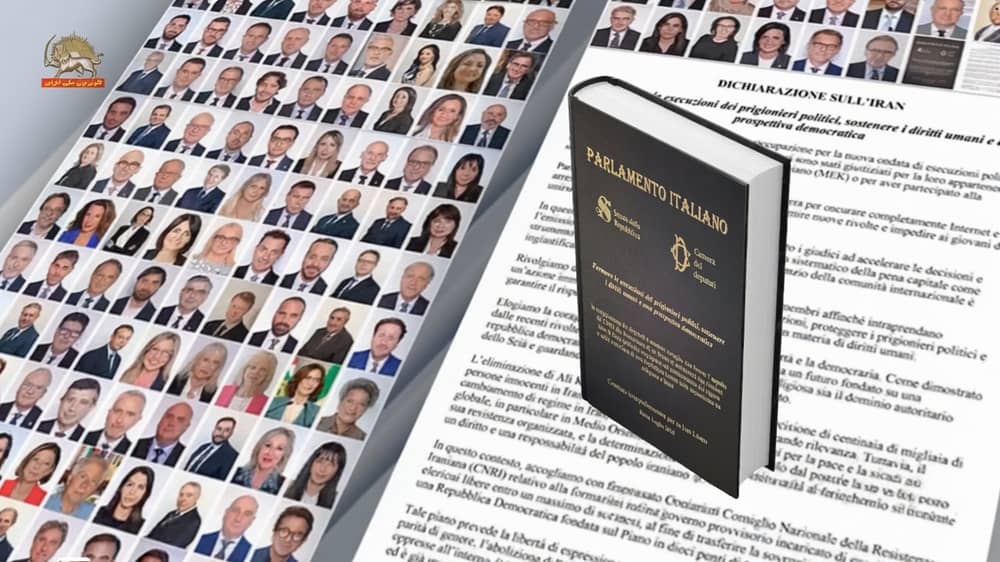
A majority of members of Italy’s Chamber of Deputies and Senate have signed a joint statement condemning the Iranian authorities’ increased use of political executions and expressing support for the National Council of Resistance of Iran’s (NCRI) proposal for a provisional government.
The signatories stated deep concern over recent executions of prisoners linked by Iranian authorities to the People’s Mojahedin Organization of Iran (PMOI/MEK) or to participation in nationwide protests. They noted that the regime’s judiciary chief has called for accelerated implementation of death sentences, describing this as confirmation that capital punishment is being used as a tool of political repression. The lawmakers called the international community’s silence unjustifiable and urged the United Nations and its member states to act immediately to halt the executions and protect political prisoners.
The statement recognized the Iranian people’s protests as evidence of a demand for a democratic republic that rejects both the current religious dictatorship and a return to monarchical rule. It welcomed the NCRI’s initiative to form a provisional government tasked with organizing free elections within six months, based on the Ten-Point Pan advanced by Maryam Rajavi. The Italian parliamentarians described support for this platform and for Mrs. Rajavi’s leadership as a necessary step toward democracy, stability, and regional peace.
Address to the #HumanRights Commission of the Italian Senate
The Iranian people and their Resistance look to Italy—historically a global pioneer in the movement to abolish the death penalty—to lead the way within the European Union in spearheading decisive measures against the… pic.twitter.com/BTzZMLN7IF
— Maryam Rajavi (@Maryam_Rajavi) July 16, 2026
According to the text, the plan centers on free and fair elections, separation of religion and state, gender equality, abolition of the death penalty, protection of minority rights, and a non-nuclear Iran committed to peaceful relations. The compiled signatures were presented in book form to Mrs. Rajavi by Italian legislators, including Deputy Speaker Fabio Rampelli, Senator Marco Scurria, and Senator Giulio Terzi.
The statement forms part of broader European parliamentary activity addressing Iran’s human-rights record and the use of executions against political opponents. The lawmakers emphasized that political change in Iran should be driven by the Iranian people through democratic means rather than foreign military intervention, arguing that a transition grounded in elections, human rights, and the rule of law would contribute to greater stability in Iran and the wider Middle East.