

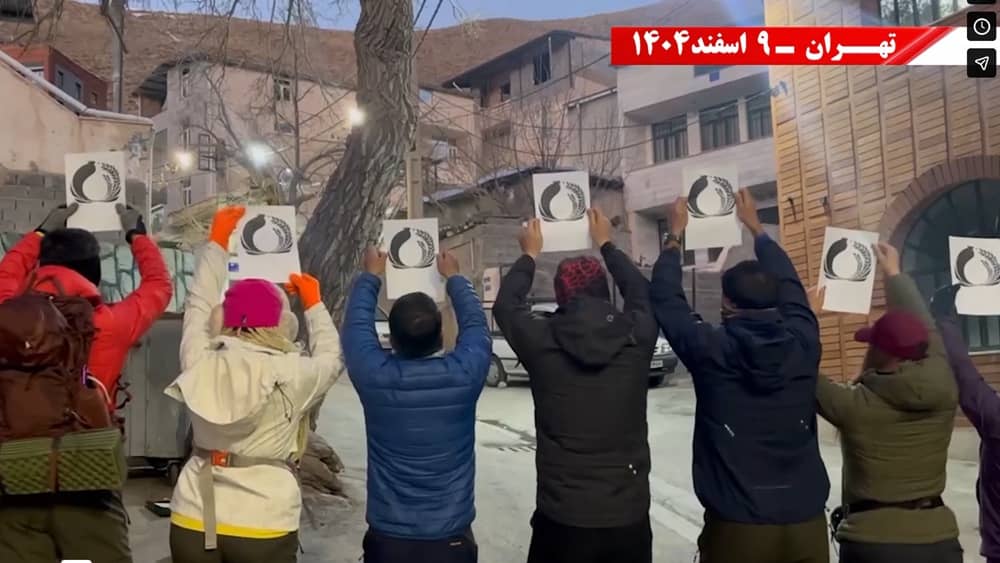
An escalating wave of underground defiance and coordinated anti-regime operations has swept across Iran during the week of July 19–26, 2026, revealing a deepening political crisis for the clerical establishment. Amid ongoing regional war, internal power struggles within the ruling hierarchy following the death of Ali Khamenei and the contested elevation of his son Mojtaba Khamenei, organized activist networks known as MEK Resistance Units have launched widespread public campaigns spanning dozens of major urban centers. Driven by the judicial execution of 26-year-old Resistance Units member Mehdi Khanaki and coinciding with historic political anniversaries, these clandestine actions have openly defied the regime’s campaign of intimidation, exposing the state’s severe domestic isolation and its failure to suppress dissent through mass executions.
July 25, 2026
In a direct challenge to state authority, Resistance Units mobilized across Zahedan to commemorate the 1988 mass executions of political prisoners and the anniversary of Operation Eternal Light. Activists displayed large banners and placards in public spaces, drawing parallels between historical resistance and current anti-regime activity. Slogans prominently displayed across the city affirmed that the spirit of resistance remains vibrant across the nation, directly condemning the Islamic Revolutionary Guard Corps (IRGC) for ongoing violence.
July 24, 2026
Following the state execution of law graduate and MEK member Mehdi Khanaki, nationwide Resistance Units executed coordinated public tributes and anti-regime operations in Tehran, Karaj, Mashhad, Shiraz, Kermanshah, Bandar Abbas, and Ahvaz. In Tehran and Karaj, activists placed large memorial wreaths and posted messages directly addressing the regime’s leadership, warning that state-sanctioned hangings would provoke retaliation. Public spaces in Mashhad were painted with graffiti reading that continuous executions reflect the leadership’s terror of erupting civil unrest. Meanwhile, in Kermanshah, Shiraz, Bandar Abbas, and Ahvaz, activists distributed literature and posted signs calling for an end to capital punishment, demanding the release of all political prisoners, and urging the public to join organized resistance networks.
Echoes of 1952: How PMOI resistance units keep Mossadegh’s uncompromising spirit alive https://t.co/F77mmlY2s6
— People's Mojahedin Organization of Iran (PMOI/MEK) (@Mojahedineng) July 21, 2026
July 22, 2026
The regime executed 26-year-old Mehdi Khanaki at dawn following months of physical and psychological torture in Karaj. Khanaki had been pursued by security forces following his participation in nationwide protests in January 2026 before his arrest in February. His death in Karaj sparked immediate backlash from activist networks across the country. Demonstrators in Tehran engaged in high-risk street actions, displaying placards holding Mojtaba Khamenei personally accountable for the execution and promising a swift response to state violence.
July 21, 2026
Coinciding with the anniversary of the historic July 21, 1952 (30 Tir) uprising, Resistance Units orchestrated a synchronized operational campaign across 16 Iranian cities. Activists conducted visual projections, graffiti campaigns, and public banner displays in Tehran, Mashhad, Tabriz, Shiraz, Karaj, Bandar Abbas, Kermanshah, Qazvin, Gorgan, Amol, Marivan, Tabas, Hamedan, Malayer, Iranshahr, and Minudasht. In Mashhad, high-visibility image projections featured opposition leadership alongside messages calling for uncompromising resistance against both monarchical and clerical rule. In Tehran and Tabriz, street operatives posted handwritten flyers and sprayed slogans across public walls, explicitly calling for the downfall of the absolute clerical dictatorship. Similar actions in Gorgan, Amol, Marivan, Tabas, Hamedan, Malayer, Iranshahr, and Minudasht connected the 1952 anti-colonial struggle for democracy to present-day demands for a democratic republic.
Resistance Units commemorate PMOI martyr Mehdi Khanaki, shatter regime’s campaign of terror https://t.co/AfeIwozYZq
— People's Mojahedin Organization of Iran (PMOI/MEK) (@Mojahedineng) July 25, 2026
The rapid spread and high visibility of these underground operations during the week of July 19–26, 2026, expose a fundamental strategic deadlock within the Iranian regime. For decades, the clerical establishment has relied on capital punishment and systemic terror as its primary instruments to enforce social compliance and neutralize political dissent. However, the immediate nationwide surge in resistance following the execution of Mehdi Khanaki demonstrates that this doctrine of fear has reached a point of diminishing returns. Rather than deterring the populace, state violence is actively accelerating the mobilization of organized youth networks across diverse geographic hubs. Far from projecting strength or internal stability under the unconfirmed authority of Mojtaba Khamenei, the regime’s heavy reliance on the gallows reflects an autocratic system backed into a corner, unable to offer political change or address public grievances, and increasingly vulnerable to organized domestic resistance.