

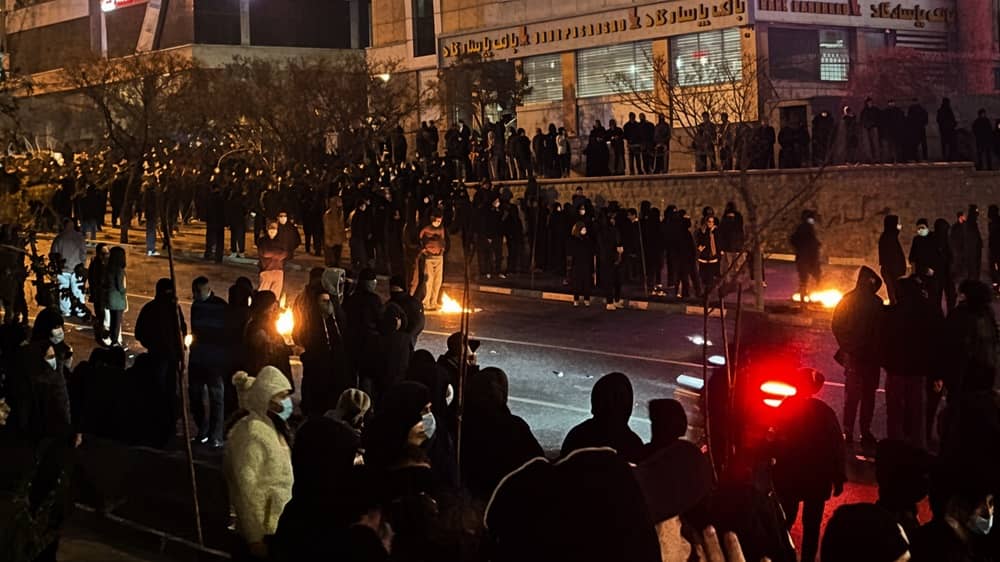
Iran’s economy of humiliation, and the psychology of a society that will soon stop being afraid
The video is thirty seconds long and it was filmed inside an empty shop. A middle-aged man, sweat on his collar, holds the phone at arm’s length and shouts at no one and at everyone: “How am I supposed to keep this wreck standing? It’s ten in the morning — how am I supposed to work? How do I pay the rent on this shop? Last night the power was gone from eight until ten. Today it’s been off since nine and it still hasn’t come back. How do I fill my family’s stomachs? And if we say anything, you tell us it’s war against God.”
That last sentence is the whole country in eleven words. Moharebeh — enmity against God — is the charge the clerical regime hangs people for. The shopkeeper knows it. He filmed himself anyway. This is not the behavior of a frightened population. It is the behavior of a population that has run out of things left to lose, which is a very different and far more dangerous thing.
Western capitals are currently telling themselves a comforting story about Iran. The clerical regime absorbed a war with the United States and Israel and is still standing. It holds a hand on the throat of the Strait of Hormuz and is trading that grip for sanctions relief. In January it killed protesters in the thousands and the streets eventually emptied. Ergo: durable. Ergo: a partner to be managed rather than a system in terminal decline.
That analysis mistakes the absence of a funeral for the presence of health. Regimes are not overthrown by macroeconomic aggregates; they are overthrown by what those aggregates do to the inside of a human being. And what is happening inside Iranians right now is not measured in percentage points. It is measured in a baker throwing away dough.
State-aligned #economist Hossein Raghfar: Iran’s oligarchs are part of the regime. Post-war “privatizations” handed resources to cronies (“trustees”). He warned Pezeshkian & Raisi: change or the Islamic Republic falls. When insiders say this, the system is rotting from within. pic.twitter.com/jgIqo2MCeO
— NCRI-FAC (@iran_policy) August 12, 2026
The arithmetic of one hour without electricity
Here is what an hour of the regime’s “energy imbalance” costs, told by the people who pay it — testimony gathered by Iranian citizen reporters and on social media, outside the regime’s reach this summer.
Ali is a baker in Tehran’s District 10. “Four in the afternoon, right in the middle of the second bake, the power went. Two big sacks of flour were in the mixer and the automatic roller stopped. Lavash dough goes sour if it sits more than forty minutes — it collapses, it won’t stick to the oven wall. We had to empty the whole batch into the waste barrels.” Around 700,000 toman of flour and yeast destroyed, plus the workers’ wages he still owes, plus an automated warning from the state bread-subsidy system because his card-reader transactions no longer match his flour quota. The electricity company’s advice was to buy a generator. The generator costs more than a hundred million toman.
Mahsa runs a salon in the Jahanshahr district of Karaj. “Thursday, six in the evening — three women were under the dryers and one was mid-bleach. When the power goes, the color timing collapses; if it isn’t rinsed in time the hair burns. We washed a client’s head with a phone torch and cold water.” Two regulars walked out of the chair. In one week, she lost close to five million toman in cancelled appointments. The landlord wants the full rent on the first of the month and will not discount a single rial.
Kamran delivers on a motorbike. “People think a bike doesn’t run on electricity, so what’s the problem? But my bread is inside my phone. Half an hour after the neighborhood loses power, the telecom masts go too. The app won’t open, I can’t pull the destination or scan the parcel.” An hour and a half hunting for one address because the map was dead. A gas-powered taxi driver: when the grid drops, the CNG compressors stop, the queues stretch for kilometers, two hours in line for fuel — two hours of blackout equals four or five fares he will never make.
And Farzaneh, a machinist in a garment workshop off Jomhouri Street, describes the mechanism that turns a technical failure into a moral injury. “I’m paid by the piece — I get money for every coat I sew. The workshop loses three hours of power a day. When it goes, we sit behind dead machines. The boss says: you didn’t sew, so those three hours are zero. And then he insists we stay until nine at night to catch up on orders.” She is married; the metro home at that hour is neither easy nor safe. When the women object, the answer is four words long: if you don’t like it, settle up — there are plenty of workers outside.
Notice what none of these stories contain: a villain who can be sued, an insurer, an inspector, a compensation form. In Iran’s small urban economy the relationship between “seconds of electricity” and “money in the house” is direct and unmediated, and no institution absorbs the loss. A steel holding company writes off a billion-toman shock. A baker eats it out of his family’s dinner.
Multiply this across a country where citizens report two to four hours of outages a day, sometimes twice daily, sometimes off-schedule with no warning — where fire brigades in Hamedan logged some fifty call-outs a day for people trapped in dead lifts, where patients at home on oxygen concentrators simply stop receiving oxygen, where a shopkeeper in Delijan filmed 180 kilograms of his own ice cream melting into ruin, where videos circulate of poultry suffocating in the dark of unventilated barns. Then send the bills. Households that had no power for hours a day opened July invoices two and three times higher than June’s — 300,000 toman becoming 800,000 to a million. One farmer’s irrigation-well bill went from under four million toman to roughly 440 million. The Energy Ministry’s response was that tariffs had not risen; people were simply consuming beyond the “pattern.” You were not robbed. You are greedy. And you were greedy in the dark.
That is the specific texture of the humiliation. Not poverty alone — poverty is old and Iranians have endured it — but poverty administered with an insult attached.
2/ A worker breaks down the daily price explosion of basic food, declaring: "This is a protest! I swear to God it’s not a riot. Want to shut my page down? Go ahead. This page belongs to the people!" pic.twitter.com/p7AQGqDb5K
— NCRI-FAC (@iran_policy) August 13, 2026
The table, the tap, the sky
The dining table went first. By the regime’s own Statistical Centre, food inflation ran at triple digits for six consecutive months, reaching 134 percent year-on-year in July; general year-on-year inflation hit the low eighties, with the annual average at a record 62 percent and the official misery index at 71.1. Eight of ten food groups broke the 100-percent barrier. Cooking oil and fats — the base of nearly every Iranian dish — rose 261.5 percent point to point. Dairy 147. Meat 145. Bread, the food of the poor, 117. This is the worst inflation since the Second World War, when foreign armies were physically occupying the country.
The human translation, from Tehran’s markets: a 63-year-old retiree turning packages over one by one, saying his pension covers less than a third of the household’s costs and that “we don’t only complain about high prices, but about their speed, which leaves us no chance to catch our breath.” A mother of three: “Red meat has become a dream, chicken is a guest at our table, and I’ve started counting eggs one by one.” A grocer of forty years: “In my forty years I have never seen a recession like this — not even in the worst sanctions years. I’m just trying not to go bankrupt and lose the shop I inherited from my father.” Another, in the north of the city where the customers are supposed to be rich: “The market has reached clinical death.” An architect married to another professional, both employed in large private firms, does the sum out loud: the poverty line in Tehran now sits around 900 million rials a month, and “we were a high-income family two years ago; today we are the wealthy poor.”
When a society’s professional class starts naming itself with a new phrase — the wealthy poor — the regime has lost the constituency it needs to keep the machine turning.
Then the tap. Iran is in its sixth year of drought, using more than 80 percent of its renewable water in an average year and, in 2025, consuming some 13 billion cubic meters more than nature replaced. The dams that feed Tehran were about 22 percent full going into this summer; the Amir Kabir reservoir fell to 8 percent last autumn and nineteen major dams have run dry. The regime’s own water-industry spokesman admits 35 million people face shortages. Pressure is cut across the capital’s network overnight while officials deny — with the special vehemence reserved for true things — that any rationing schedule exists. Lake Urmia is a salt flat, strangled by more than sixty dams on its feeder rivers and decades of unlicensed wells: an entire regional ecology converted into dust that blows into the lungs of the children of Tabriz.
And then the sky. Fifty degrees Celsius in Khuzestan, Ilam, Bushehr, Hormozgan. Residents in Abadan say the real temperature is higher than announced, and that officials avoid formally logging above 50 because that would legally force offices to close. In the province that generates a large share of the nation’s electricity, people sit in the dark at 50 degrees. A man in Mahshahr, both elderly parents felled by heatstroke: “I have absolutely no idea how we are going to get through this summer.”
6/ Outside the Electricity Department of Astaneh-ye Ashrafiyeh, Gilan. The entire town is blacked out—except the electricity office itself, which still has power. A local barber is giving his client a haircut under the only working lights. “We’re not protesting, we’re not… pic.twitter.com/5BemWmYceB
— NCRI-FAC (@iran_policy) August 13, 2026
The inside of the country
There is a document that tells you the regime knows precisely what it has created. In June, the president’s own social adviser circulated a confidential report, based on a May survey by a domestic polling center, to institutions across the power structure. More than 81 percent of Iranians reported some degree of difficulty obtaining food. Over 50 percent declared themselves hopeless that anything will improve. Some 47.7 percent reported sadness and depression; 45.4 percent constant fear and anxiety. And more than 63 percent reported living with high levels of anger and rage — up twelve percentage points in six months.
Sixty-three percent. There is no historical precedent in comparative polling for a rate like that in a population of 92 million. It is not a mood. It is fuel.
The rest of the evidence points the same way. Roughly one in four Iranians now lives with a diagnosable mental-health condition; psychiatric medication use surged after January’s crackdown and the war. Recorded suicides rose about 70 percent over a decade — and Iranian suicide is understood to be badly undercounted, because it is shameful, so the real curve is steeper. Births fell to about 892,000 last Iranian year, the lowest in seven decades, with marriages down roughly 30 percent in four years. That is not a “demographic pattern.” That is millions of private referendums on the future, each one held quietly in a kitchen, each one voting no.
Consider, too, what the regime did to the last exits. For most of 2026 it cut 92 million people off the internet — more than 2,000 hours of near-total national blackout, the longest in the world’s history — costing an estimated $30–40 million a day and annihilating the small online businesses that had become the survival strategy of the young, of women running home workshops, of unemployed graduates. When those people migrated to the pavements of Tajrish to sell handmade goods or play music for coins, municipal crews arrived with sledgehammers and plainclothes men with radios told a young musician: The time for these antics is over; there will be none of this in the streets anymore.
Follow that logic to its end. The regime destroyed the formal economy, then blocked the digital economy, then bulldozed the informal economy of the pavement. It has methodically closed every route by which a desperate person might survive without confronting it — and then expressed surprise that desperate people confront it.
9/ A man holds up a package of bologna and asks in pure disbelief:
“What do you think this costs? 79,000 tomans! Seriously, what is this? Seventy-nine thousand tomans?” pic.twitter.com/wVnUqA4fsN— NCRI-FAC (@iran_policy) August 13, 2026
Why bullets no longer settle the question
The illusional assumption is that January answered the question. More than 7,000 people were killed in that crackdown, according to independent monitors abroad; two young men were publicly hanged in Isfahan in July; another 20-year-old was executed in August; children have been sentenced to death. By the old arithmetic of terror, a society that absorbs that in January is silent by August.
It is not. Within six months of the bloodiest repression in the regime’s history, the strikes came back. Nurses at a Tehran hospital struck over wages and were beaten, detained, dismissed — and other hospitals kept organizing anyway. Through the summer, retirees from social security, steel, and telecoms rallied simultaneously in Arak, Ahvaz, Tehran, Dezful, Rasht, Shush, Isfahan, Kermanshah. Sugarcane pensioners, farmers, drivers, pharmacists. Residents of small towns like Khomam and Kazerun blocking the road in front of the governor’s office over water and power, singing Ey Iran. Retirees in Shush marching in 50-degree heat with a slogan that should be read very carefully in Washington and Brussels: we no longer want war — and its companion, chanted for years now: our enemy is right here; they lie when they say it’s America.
This is the thing the regime’s survival narrative cannot metabolize. Repression works on politics; it does not work on metabolism. You can imprison a slogan. You cannot imprison the price of cooking oil. A pensioner whose entire pension buys a third of the groceries is not calculating the risk of the baton, because staying home is also fatal, only slower. The food basket for a family of four now eats over 70 percent of the minimum wage, and by the state’s own economic press, if prices keep moving the whole wage will go to food alone. At that line, the deterrent stops functioning: there is nothing left to threaten a person with.
And the mechanism is the one that has ended regimes for two centuries. Inherited poverty is endured; sudden descent detonates — especially when the fall has a name and an address. Iranians are not confused about where the money went. It went to a war their pensioners now publicly refuse; to the networks of officials and armed institutions that own both sides of every shortage; to a subsidized-dollar system that made fortunes for insiders and left oil at 261 percent for everyone else. The regime’s own numbers finish the sentence: the IMF expects the economy to shrink 6.1 percent this year after last year’s contraction; industry is on two blackout days a week; the treasury shrinks as fast as the household.
So no, Iran is not stable. It is pressurized. The clerical regime today has no economic story, no popular constituency, no functioning national grid, no water, a leader whose only credential is a war his own retirees denounce, and a population in which two out of three people report living in rage. What it has is guns, and the memory of January.
But there is a limit written into the species. A man filming himself in an empty shop at ten in the morning, naming the charge that could hang him and shouting anyway, is that limit becoming visible. You can terrorize an opinion. You cannot terrorize an appetite. You can shoot a demonstrator, and the regime has shot thousands. You cannot shoot hunger, and hunger does not get tired, does not go home at night, and does not negotiate.