

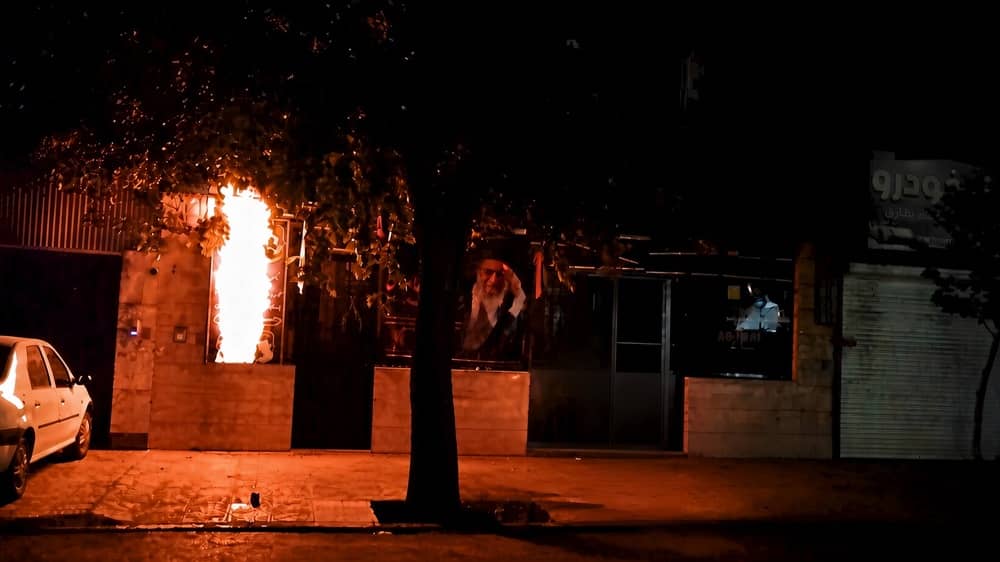
Against a backdrop of profound socio-economic crises and amid an atmosphere of severe repression and political suffocation, an expanding network of Resistance Units affiliated with the People’s Mojahedin Organization of Iran (PMOI/MEK) carried out a coordinated nationwide campaign from August 16 to August 22, 2026. From the southeastern borderlands to the capital’s high-security dungeons, MEK-affiliated Resistance Units mounted targeted strikes against state security infrastructure, incinerated official propaganda, and mobilized widespread defiance against soaring execution rates, exposing the deep structural vulnerabilities of a clerical regime desperately relying on state terror to maintain its grip on power.
August 21, 2026
In Zahedan, the capital of Sistan and Baluchestan province, the Resistance Unites held high-visibility public demonstrations, asserting a firm rejection of both the current clerical autocracy and the former monarchical dictatorship. Displaying banners across prominent public thoroughfares, demonstrators declared that the region remains awake in opposition to both the mullahs and remnants of the ousted Shah, calling unequivocally for a democratic republic grounded in equality and liberty. The messaging directly targeted the executive authority in Tehran, characterizing the presidency under Masoud Pezeshkian as a mere administrative clerk for the Supreme Leader. Activists also addressed the nation’s severe fuel deficit—currently standing at 14 to 15 million liters daily—by proposing a direct solution: stripping 5 million liters of daily gasoline allocations from each of the regime’s four main repressive organs, namely the Islamic Revolutionary Guard Corps (IRGC), the Basij, the Ministry of Intelligence, and the Law Enforcement Forces, which would instantly eliminate the national deficit without burdening citizens with hyperinflationary dual-pricing or strict rationing. The demonstrations highlighted the culmination of the 30th annual telethon for the opposition satellite network Simay Azadi. The day’s proclamations concluded with warnings that religious tyranny, like monarchical rule before it, faces ultimate accountability before the popular tribunals of a risen nation.
In a powerful display, PMOI/MEK Resistance Units carried out 30 daring operations across Iran in support of the 30th national telethon for @en_simayazadi, the real voice of Iran's people. pic.twitter.com/P0xAmgllaR
— People's Mojahedin Organization of Iran (PMOI/MEK) (@Mojahedineng) August 19, 2026
August 18, 2026
Marking the 134th consecutive week of the “No to Executions Tuesdays” campaign, anti-death penalty actions erupted across major urban centers, spanning Tehran, Kashan, Malayer, Kermanshah, Karaj, Isfahan, Eslamshahr, Lahijan, Izeh, Shiraz, Ahvaz, Sabzevar, and Khorramabad. Resistance Units posted flyers, photo displays, and painted wall slogans demanding the immediate revocation of all capital punishment sentences. In Kashan, activists laid a memorial wreath honoring executed MEK member Mohammad (Nima) Massoum Shahi, who was put to death in April 2026. In Shiraz, placards condemned the recent hanging of protester Shahram Sadeghi on August 16. Campaigners in Ahvaz raised demands to halt the impending execution of 25-year-old political prisoner Arghavan Fallahi, who faces the gallows after enduring months of solitary confinement and torture. In Sabzevar, placards called for saving the life of Isa Chari, a 37-year-old laborer and father sentenced to death over political affiliations. Similar demands echoed in Izeh and Lahijan for political prisoners Amir Hassan Akbari and Manouchehr Fallah. In Eslamshahr, activists painted bold graffiti across public walls declaring that youth executions are the regime’s shame and that silence in the face of state murder constitutes treason. Meanwhile, in Khorramabad, displayed messages emphasized that domestic resistance had mobilized 32 countries to formally condemn Tehran’s execution record. Activists in Isfahan declared that capital punishment, rather than instilling fear, has only sharpened the populace’s resolve to achieve systemic change.
Defying the dictatorship: Resistance Units support Simay Azadi telethon with 30 daring operations https://t.co/hwskyQCLBZ
— People's Mojahedin Organization of Iran (PMOI/MEK) (@Mojahedineng) August 16, 2026
August 16, 2026
Opening the operational week, Resistance Units carried out 30 targeted operations against security infrastructure and state propaganda across Aligudarz, Isfahan, Kermanshah, Mashhad, Shiraz, Azna, Birjand, Iranshahr, Khorramabad, Nikshahr, Semirom, Shahriyar, Tehran, and Zahedan. The Resistance Units ignited blazes at IRGC Basij command centers—used primarily for domestic spying and suppression of dissidents—in Isfahan, Kermanshah, Mashhad, and Iranshahr. In Aligudarz, a state building was set ablaze, while operational teams in Shiraz targeted and burned the local headquarters of the regime’s Khomeini Foundation. Across all targeted municipalities, including Azna, Birjand, Khorramabad, Nikshahr, Semirom, Shahriyar, Tehran, and Zahedan, resistance cells systematically set fire to public propaganda banners featuring imagery of regime founder Ruhollah Khomeini, former supreme leader Ali Khamenei, and newly elevated ruler Mojtaba Khamenei. Simultaneously, political prisoners inside Evin Prison in Tehran, Ghezel Hesar Prison, and Central Karaj Prison issued open letters of solidarity. In a message from Evin Prison, detainees explicitly defied the installation of “Khamenei the second,” pledging to transform every cell block into a fortress of resistance. From Ghezel Hesar, political prisoners Loghman Aminpour and Ali Moezzi wrote directly to state executioners, asserting that the surge in executions would only add to the fiery resolve of Iran’s rebellious youth in what they characterized as the final reckoning for the autocratic regime.
August 21—Zahedan, southeast Iran
PMOI/MEK Resistance Units resume weekly anti-regime activities, rejecting all forms of tyranny, including the mullahs' religious fascism and the shah's dictatorship. pic.twitter.com/PiMELsUeqO— People's Mojahedin Organization of Iran (PMOI/MEK) (@Mojahedineng) August 22, 2026
The events of the third week of August 2026 reveal a profound structural fragility beneath the Iranian regime’s aggressive posture. Tehran’s escalating reliance on capital punishment and hereditary succession under Mojtaba Khamenei was designed to project absolute control and intimidate an unsettled populace; instead, it has produced the exact opposite effect. By attempting to govern through systemic violence and resource mismanagement, the clerical leadership has reached an internal deadlock where repression no longer deters action but rather fuels the expansion of organized underground networks. The operational agility demonstrated simultaneously on city streets and within high-security prisons underscores that the regime’s façade of invincibility has fractured. Far from stabilizing the state, Tehran’s strategy of terror has hardened public defiance, forging an unyielding national movement determined to dismantle both past and present forms of autocracy in pursuit of a democratic republic.