

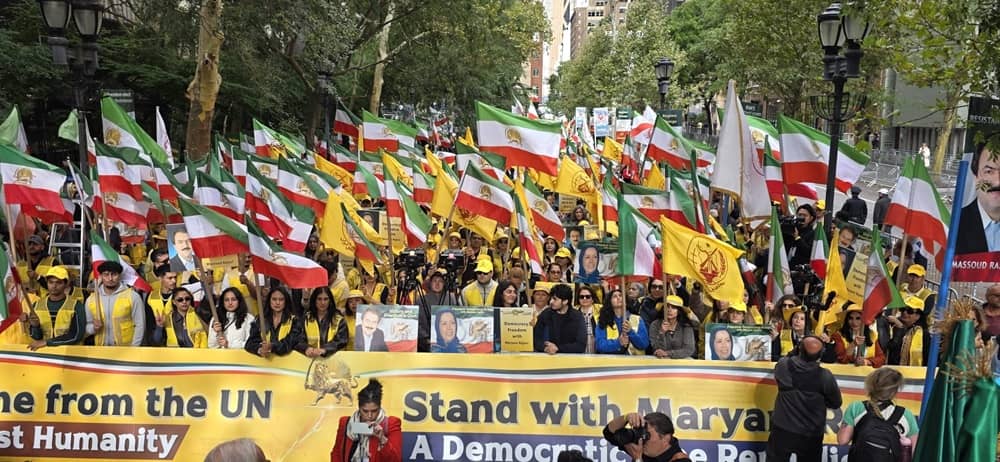
NEW YORK, September 23, 2026 — Iranian-Americans and supporters of the National Council of Resistance of Iran (NCRI) gathered outside United Nations headquarters for a second consecutive day on Wednesday, as the clerical regime’s president Masoud Pezeshkian addressed the UN General Assembly. Former senior American officials, Iranian opposition representatives and young Iranian activists called for international action against political executions, recognition of the Iranian Resistance and a democratic transition led by Iranians themselves. Former New Jersey Senator Robert Torricelli, former New York Mayor Rudy Giuliani and former US Ambassador Marc Ginsberg addressed the demonstration, emphasizing the role of the People’s Mojahedin Organization of Iran (PMOI/MEK), its Resistance Units inside Iran and Maryam Rajavi’s Ten-Point Plan. Speakers also criticized proposals for restoring the former monarchy and argued that political change could not be imposed by foreign governments.
The gathering was part of a two-day demonstration at Dag Hammarskjöld Plaza, organized to coincide with the General Assembly and draw attention to executions and the treatment of political prisoners in Iran. Opening the second day’s proceedings, the moderator said participants had traveled from across the United States and Canada to challenge Tehran’s representation at the UN and express support for the NCRI’s proposed provisional government. She described its stated mandate as organizing free elections within six months and transferring power to elected representatives.
Mrs. Maryam Rajavi, President-elect of the NCRI, sent a message to the rally challenging the Iranian regime’s representation at the United Nations and identifying the struggle between the authorities and the organized Resistance as the central issue determining Iran’s political future.
“The people of Iran want neither war nor dictatorship. They want freedom, a democratic republic, and the right to decide their own future,” Mrs. Rajavi declared.
Day 2 of Rally by freedom-loving Iranians outside the UN General Assembly, New York
The regime that rules Iran does not represent the Iranian people. It is an enemy of the people and responsible for the killing of Iran's young generation. It is also a threat to peace and… pic.twitter.com/EmM6738590
— Maryam Rajavi (@Maryam_Rajavi) September 23, 2026
Mrs. Rajavi said the authorities were intensifying regional tensions to divert attention from domestic unrest, arguing that military confrontation and political repression had become central to their survival strategy.
“But the real battle is between the Iranian people and the organized Resistance, on one side, and the religious dictatorship on the other,” she said.
Mrs. Rajavi devoted particular attention to developments inside Iran, citing economic hardship, public protests and what she described as escalating security measures in anticipation of another uprising. She said the Revolutionary Guards had conducted large military exercises in Tehran and 15 other cities, while Basij personnel had been stationed at gas stations.
“At the same time, Resistance Units have carried out hundreds of anti-repression actions over the past two months,” the NCRI President-elect said. She added that political prisoners had intensified their resistance and were encouraging protests from behind prison walls.
She attributed the authorities’ security mobilization to fears of renewed nationwide unrest and described internal factional disputes as another source of instability. These developments, she argued, had continued despite the military conflict and the government’s extensive use of repression.
Turning to the international response, Mrs. Rajavi presented the developments of the preceding year as evidence supporting the NCRI’s longstanding rejection of both foreign military intervention and continued accommodation with Tehran.
“Over the past year, it has also become clear that war and foreign military intervention are not the solution to Iran’s problem. Neither war nor appeasement is the answer,” she said.
“The solution is the overthrow of this regime by the people of Iran and their organized Resistance.”
Mrs. Rajavi argued that, despite military conflict and intensified repression, the Resistance had continued expanding its network across Iranian cities. She also rejected attempts to restore the previous monarchy, accusing proponents of that approach of relying on foreign intervention rather than domestic democratic change.
Concluding her message, Mrs. Rajavi urged governments to acknowledge the role of Iranian opposition networks and support the NCRI’s proposed transition arrangements.
“Today, we call on the international community to recognize the struggle of the Iranian people and youth against the IRGC to overthrow the regime, and to recognize the Provisional Government for Peace and Freedom proposed by the National Council of Resistance of Iran, based on its Ten-Point Plan,” she said.
Day 2 of Rally by freedom-loving Iranians outside the UN General Assembly, New York
“The time has come to listen to the voice of the people of Iran, who want neither war nor dictatorship.”#FreeIran2026NYRally#UNGA https://t.co/mWNtk1QYnl pic.twitter.com/XdnByfvp1M— Maryam Rajavi (@Maryam_Rajavi) September 23, 2026
Former US Senator Robert Torricelli challenged Pezeshkian’s presence at the General Assembly, accusing the Iranian authorities of responsibility for widespread repression and killings. He called on UN member states to reject Tehran’s claim to represent the Iranian people and argued that recent developments had exposed both the government’s methods and the opposition’s willingness to confront it.
Torricelli highlighted what he described as the growing determination of young Iranians and Resistance Units operating across the country. Referring to their activities in villages, towns and cities, he praised their willingness to organize despite the threat of arrest and execution.
He also criticized Reza Pahlavi’s public defense of his family’s political legacy and questioned his approach to Iran’s ethnic minorities. Rejecting restoration of the monarchy, Senator Torricelli declared: “No to the Mullahs, no to the Kings. We do not want dictatorship of the left or of the right, of religion or of politics.”
Senator Torricelli devoted another part of his address to the residents of Ashraf-3 in Albania, thanking the Albanian people for providing refuge to members of the Iranian opposition. He praised the residents’ continued political activities despite years of displacement and attacks.
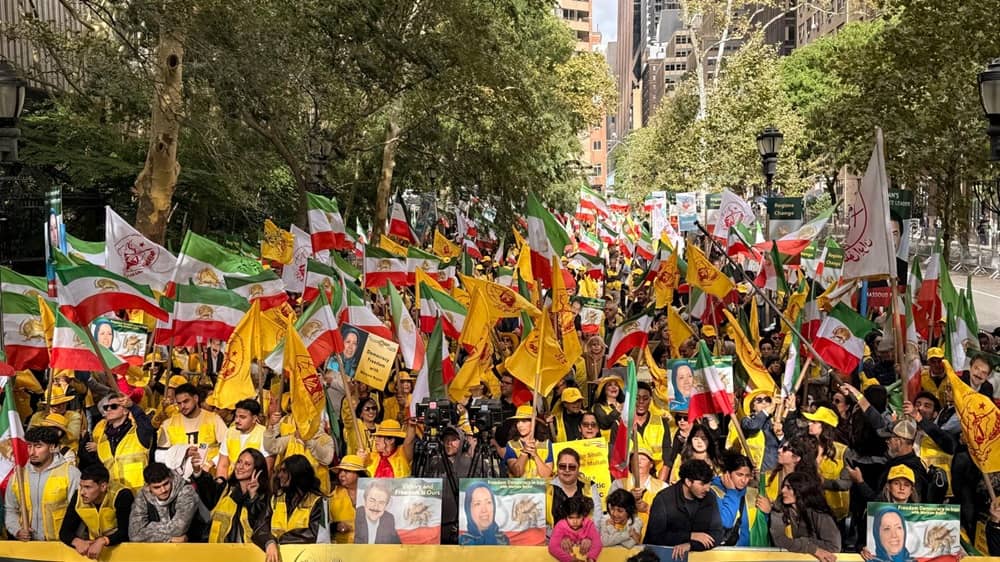
Addressing Iranians inside the country, Senator Torricelli argued that foreign governments could provide support but could not deliver political freedom on their behalf.
“The revolution that is underway is going to be won by children, students, workers, even soldiers who refuse to fire their weapons at their own people. This revolution is not American, it is not European, it is Iranian,” he said.
He urged Iranians, including members of the security forces, to reject participation in repression and called for broader civic resistance. Senator Torricelli concluded by pointing to the NCRI’s political program, saying it offered an alternative based on democratic government, gender equality, religious freedom and a non-nuclear Iran. He credited Mrs. Rajavi with sustaining the opposition movement over many years.
Former Senator Robert Torricelli summarizes it perfectly – give the people the power to choose their own future! pic.twitter.com/OKzJ17DKw4
— OIAC: Organization of Iranian American Communities (@OrgIAC) September 23, 2026
Former US Ambassador to Morocco Marc Ginsberg focused on what he described as the need to translate international expressions of support into concrete American policy.
“We gather with a solemn mission, a vital mission that cannot wait for another war, another crisis, or another president. We cannot wait,” he told the demonstration.
Amb. Ginsberg referred to accounts of imprisoned and tortured Iranians and families whose relatives had been killed during protests, arguing that their experiences demanded a response beyond public condemnation. He said Americans need not support an indefinite foreign war to assist Iranians seeking democratic change.
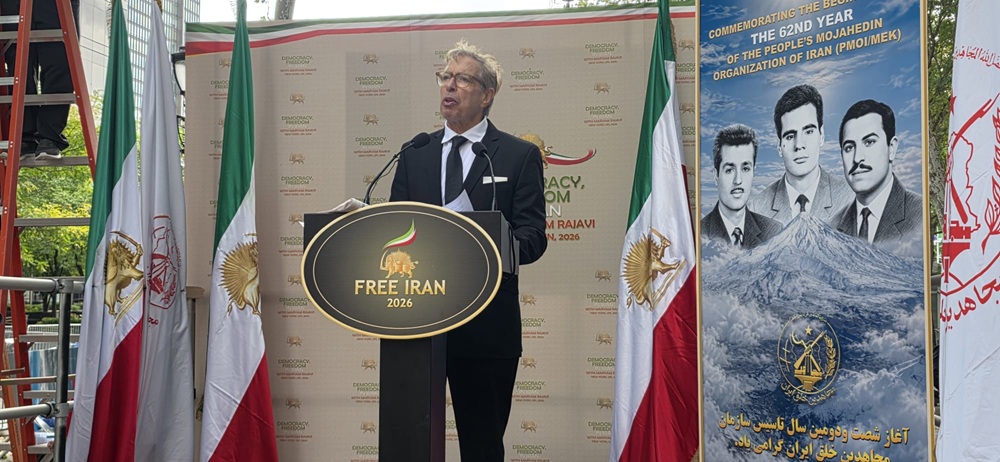
He strongly rejected both hereditary rule and the clerical political system, saying the future should be determined by Iranians rather than a monarch, supreme leader or foreign government. Ginsberg described the NCRI’s transition proposal and Rajavi’s Ten-Point Plan as frameworks for organizing elections, transferring sovereignty to an elected constituent assembly and establishing a new constitutional order.
Amb. Ginsberg called on Congress and the Trump administration to consider greater support for democratic transition efforts, including assistance to the NCRI and its proposed provisional government. He argued that Washington should distinguish between choosing Iran’s political leadership and assisting Iranians in exercising that choice themselves.
“Americans cannot and should not choose the leaders. Only the Iranian opposition and the Iranian people together can accomplish that,” he said.
He also urged greater international attention to the Resistance Units and asked Congress to intensify its engagement with the administration over Iran policy.
Amb. @ambmcg): There is bipartisan support for a free Iran, and Congress must push the administration to act. Only the Iranian opposition and people can choose their leaders, but the US can support a transitional government in exile led by @Maryam_Rajavi and back the…
— NCRI-FAC (@iran_policy) September 23, 2026
Former New York Mayor Rudy Giuliani delivered an extended address concentrating on the PMOI’s organizational history, its activities inside Iran and its proposed role in a political transition.
Mayor Giuliani accused the Iranian authorities of systematically targeting political opponents and argued that repeated repression had failed to eliminate the PMOI. He described the organization as a longstanding opposition movement that had survived decades of persecution while developing a political alternative under Mrs. Rajavi’s leadership.
He referred to the NCRI’s proposed provisional government, emphasizing its commitment to organizing elections within six months of a transition. These arrangements, Mayor Giuliani argued, addressed concerns about what political institutions could replace the existing system.
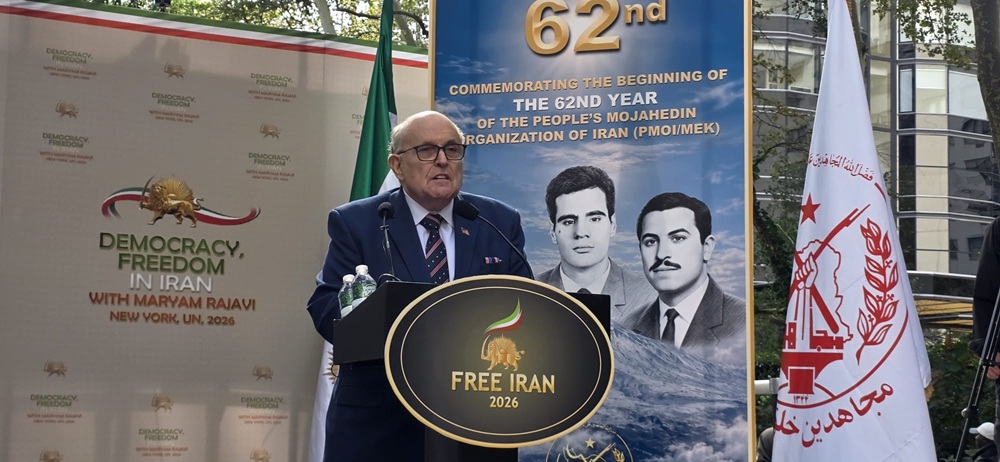
Mayor Giuliani also rejected restoration of the former monarchy. He criticized Reza Pahlavi’s political activities and raised questions about the latter’s stated contacts with personnel associated with the Revolutionary Guards. His broader objection concerned the possibility of replacing one form of authoritarian government with another.
“So, we’re going to go from a theocracy to a crooked monarchy? No, no. If we’re going to go through all this, we’re going to go through it, so we have a representative democracy,” Mayor Giuliani declared.
Turning to the PMOI’s domestic presence, the former New York mayor said its activities extended across all 31 Iranian provinces and described the organization as deeply involved in opposition mobilization.
“The MEK is stronger today than it ever was. It’s represented in all 31 parts of Iran. It’s at the core of these protests,” he said.
Mayor Giuliani also cited statements attributed to Iranian officials acknowledging the PMOI’s organizational activities, presenting them as evidence that the authorities themselves regarded the movement as a significant opponent. He referred to the organization’s history of disclosing information about Iran’s nuclear program and argued that its intelligence-gathering activities demonstrated capabilities extending beyond public demonstrations.
He concluded by calling for international political support for the Iranian opposition rather than deploying foreign ground forces. Mayor Giuliani highlighted Mrs. Rajavi’s Ten-Point Plan, including freedom of expression, gender equality, judicial independence, minority rights and a non-nuclear Iran, as the political program around which the proposed transition had been organized.
“The MEK doesn’t need troops on the ground. They’re not asking for it,” he said, describing the principal requirement as international recognition and support for the opposition’s stated democratic objectives.
🚨 MUST WATCH VIDEO: It is a great honor to join the thousands of Iranians who are raising their voices in opposition of the murderous Regime.
We are gathered outside the United Nations HQ in support of @Maryam_Rajavi’s 10-point-plan for a #FreeIran.#UNGA26 pic.twitter.com/teJgDu6hcJ
— Rudy W. Giuliani (@RudyGiuliani) September 23, 2026
Sona Samsami, the NCRI’s representative in the United States, connected the demonstration to the anniversary of the PMOI’s founding and the recent election of Mahnaz Maimanat as its Secretary-General. She praised the movement’s record of female leadership and emphasized the situation facing political prisoners.
Ms. Samsami said that at least 40 political opponents, including nine PMOI members, had been executed since mid-March, while another 100 prisoners faced execution. These figures were presented by the NCRI representative and were not independently established at the rally.
She rejected both foreign military intervention and accommodation with Tehran, arguing that domestic opposition networks were indispensable to political change.
“Across Iran, the PMOI resistance units are expanding their activities. Courageous young women and men are challenging the machinery of repression, breaking the atmosphere of fear, and keeping the flame of organized resistance alive,” she said.
Ms. Samsami also rejected a restoration of monarchical rule, describing the NCRI and the Resistance Units as the political and organizational components of an alternative transition.
She called for the establishment of an international criminal-justice mechanism to investigate crimes against humanity, Security Council referral of Iran’s human-rights situation to the International Criminal Court, and prosecutions under universal jurisdiction. Ms. Samsami additionally urged governments to recognize the Iranian Resistance and called for Tehran’s representatives to be expelled from the United Nations.
Iranian President Pezeshkian does NOT represent the Iranian people and the murderous regime does NOT deserve a seat in the UN. #StopExecutionsInIran #UNGA81 pic.twitter.com/WG1M0Gq4U7
— OIAC: Organization of Iranian American Communities (@OrgIAC) September 23, 2026
A delegation of Iranian speakers from the United States and Canada brought a generational perspective to the gathering. Recounting the imprisonment and deaths of relatives under both the Shah and the clerical authorities, they described political resistance as an inheritance passed between generations. Their remarks emphasized women’s leadership, the PMOI’s organizational history, the Resistance Units and rejection of both forms of dictatorship. They also urged international recognition of the Iranian people’s right to determine their country’s future, while distinguishing support for domestic political change from foreign military intervention.