

Four-minute read
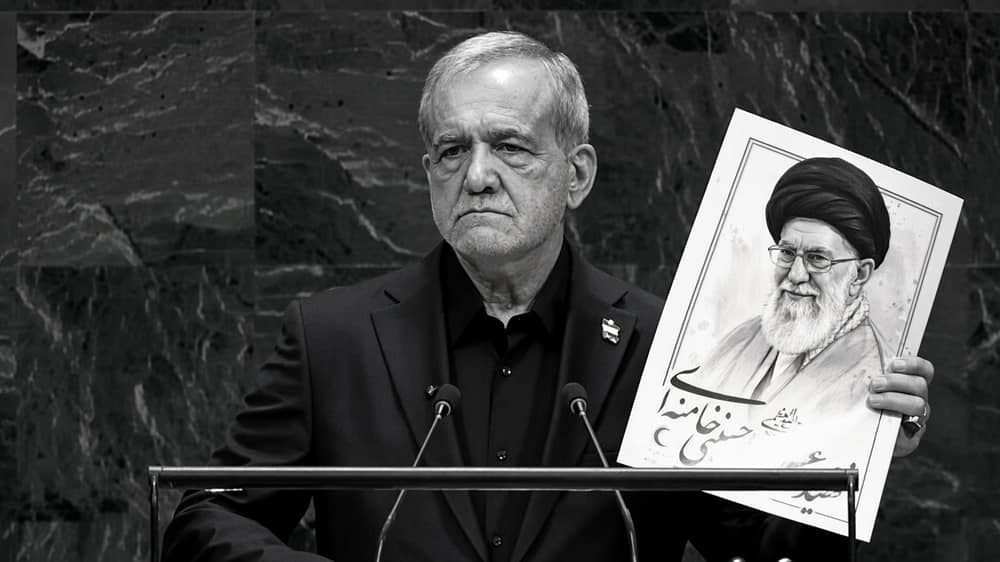
The Iranian regime’s president Masoud Pezeshkian arrived at the United Nations this week with a message of defiance. He accused Washington of a “bullying mentality” and said Iran would not surrender under American pressure, even as his government signaled that negotiations could continue.
It sounded like confidence. It may be closer to desperation.
What is frequently described as the Iranian regime’s “resilience” obscures the more important question: What happens if the regime backs down? For a state confronting war abroad, severe economic deterioration and one of the bloodiest domestic uprisings in its history, surrendering to foreign pressure may appear less like a diplomatic adjustment than an invitation to challenges from below.
An Economy Losing Its Shock Absorbers
The economic backdrop is extraordinary. The International Monetary Fund (IMF) expects Iran’s economy to contract 5.4 percent this year, with consumer-price inflation averaging 68.9 percent. The IMF cautions that even these projections carry unusual uncertainty because of sanctions and geopolitical conditions.
Those numbers matter less as measures of public misery than as indicators of diminishing state room for maneuver. A contracting economy, impaired oil exports, chronic fiscal demands and deteriorating purchasing power leave Tehran fewer resources with which to buy social peace, reward constituencies or absorb another shock.
Yet the regime continues to reject an agreement. That does not necessarily mean economic pressure has failed. It can mean the opposite: the leadership may believe it has reached the point where retreat carries greater political risk than continued economic punishment.
"On the morning after the ceasefire, every exhausted and exasperated mind, long numbed by the #IranWar, will turn instinctively toward the search for real change and the practical means to bring this regime to an end." https://t.co/8Tmh0Sl0Kc
— NCRI-FAC (@iran_policy) April 9, 2026
The Threat Tehran Cannot Bomb Away
The evidence for that calculation lies on Iran’s streets.
According to the National Council of Resistance of Iran, the uprising that began in late December spread with remarkable speed across the country. NCRI reported demonstrations in 107 cities by the eighth day, 180 cities by Jan. 9 and 192 cities by the following night, alongside strikes by bazaar merchants and protests involving students and other sectors of society.
The regime’s own figures are more revealing. An Iranian official told Reuters in January that authorities had verified at least 5,000 deaths, including approximately 500 members of the security forces. Tehran attributed much of the bloodshed to armed rioters and foreign-backed groups.
This is the nightmare against which Tehran must calculate every foreign-policy concession. Bombs can destroy infrastructure. Sanctions can empty accounts. Neither, by itself, removes the men carrying rifles for the regime. A nationwide political breakdown might.
Guns, Gallows and a State Preparing for the Street
Look at what the authorities have chosen to publicize since the uprising.
In March, the Intelligence Ministry announced that it had seized 87 weapons, including Kalashnikov rifles, shoulder-fired weapons and an RPG, while arresting 30 people across several provinces. Weeks later, it announced another operation involving 42 firearms allegedly being brought from Iraqi Kurdistan for distribution inside Iran.
Publicizing weapons caches, alleged cells and supposed foreign connections serves several purposes at once: intimidating would-be opponents, mobilizing loyalists and portraying political unrest as part of a security war rather than as a crisis of legitimacy.
Why the Iranian Regime Chose War and #Economic Siege Over an Ideal Deal
by @HakamianMahmoud https://t.co/Dxg60oscz5— NCRI-FAC (@iran_policy) August 26, 2026
The executions are harder to misread. By Aug. 5, U.N. human-rights chief Volker Türk said Iran had executed at least 56 people on national-security charges since March 19, including 27 people linked to the protests earlier this year. More than 100 others were reported to face similar risks. Iranian authorities defend such prosecutions as necessary for security; the United Nations argues that executions are being used to suppress dissent and instill fear.
An Opposition That Did Not Disappear
There is another problem Tehran must factor into its calculations: from March 4 through Sept. 16, the NCRI publicly reported hundreds of operations in 15 separately announced waves by PMOI-linked Resistance Units, targeting Basij, Revolutionary Guard and other regime facilities.
Separately, a conservative count of publicly reported armed attacks and clashes since late June finds at least 15 incidents involving regime security forces and at least 21 personnel killed: roughly 5 IRGC members, 4 Basij members, 2 border guards, 9 other police/FARAJA personnel and one army conscript. The violence has stretched from Kurdish areas in the west to Sistan and Baluchestan in the southeast.
For Tehran, the danger is not that these forces already constitute one unified insurgency, but that another mass uprising could create conditions in which organized opposition, armed unrest and broader social anger begin to reinforce one another.
The regime, meanwhile, has been organizing its own street.
Why is Iran’s regime obstructing an MOU many see as already favoring Tehran? Because converting the framework into a binding deal would force meaningful concessions on its #nuclear program and regional proxies—moves it views as existential threats to its survival. In an…
— NCRI-FAC (@iran_policy) July 14, 2026
Tasnim last week celebrated 200 consecutive nights of pro-regime gatherings. The language was striking. One commentary called them a 200-night “street exercise” and compared their importance with fighting on the front lines. Another described the gatherings as an antidote to the enemy’s plans. Far from treating loyalist demonstrations merely as expressions of popular support, regime media portray them as an instrument of political warfare.
That tells us something important about the regime’s insecurity. A government certain of society does not ordinarily need to rehearse control of the street for 200 consecutive nights.
Why Retreat May Look More Dangerous Than War
The Iranian regime has a shrinking base of supporters. It still has armed forces, intelligence networks, foreign relationships and institutions capable of imposing enormous violence.
But its behavior suggests that its leadership understands how narrow its real margin of safety has become.
Put the pieces together: a shrinking economy, nationwide unrest, mounting executions, attacks on security forces and a loyalist base mobilized night after night. But Tehran’s deepest fear is another uprising converging with an organized resistance and expanding network of Resistance Units—turning social anger into sustained, coordinated confrontation.
Now place yourself, just analytically, inside such a governing system.
A concession extracted by Washington would not merely change the terms of a nuclear, military or sanctions negotiation. It could communicate something much more dangerous inside Iran: the regime can be forced backward.
When Mojtaba Khamenei forbids the "#IranWar or negotiation” binary, both camps defy him within days. The new Leader’s word is no longer final. The pillar that once capped factional war is fracturing.
Analysis by @MehdiOghbaihttps://t.co/l4x1BQDA5V— NCRI-FAC (@iran_policy) September 1, 2026
That message would be heard not only by protesters. It would be heard by IRGC forces deciding whether to fire, Basij members deciding whether to report for duty, bureaucrats deciding whether the system will survive, regional clients calculating their own futures, and opponents wondering whether the moment had arrived to push harder.
This is why the cornered-cat analogy matters.
The regime may continue accepting staggering economic losses and military punishment not because it is impervious to pain, but because its rulers understand that lowering their guard could be more dangerous than permanent confrontation.
For years, Ali Khamenei warned his followers what retreat meant: “The more you retreat, the more they advance.” In his telling, vulnerability, once exposed, “will never end.”
This was not a doctrine of resilience but one of desperation.
Khamenei followed it to the end. On February 28, 2026, he was killed in the opening U.S.-Israeli strikes, after Tehran had again refused Washington’s central demands.
That logic survives him. The regime accepts enormous losses because it believes retreat could threaten its survival.
Its last insurance policy is not oil, money or allies.
It is the gun in the hands of a loyal security force.
As long as the clerical regime believes those guns can keep an angry society down, foreign pressure may not produce surrender. It may make a cornered regime cling harder to the weapon it trusts most.