
THIS PAGE WILL BE UPDATED WITH THE LATEST NEWS
UPDATE: 7:00 AM CEST
Message to Conference in Berlin: Iran Crisis and Democratic Solution
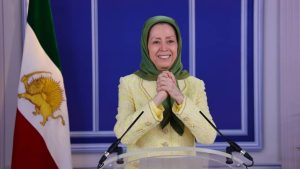
Mrs. Maryam Rajavi’s message: “From its inception, the clerical regime was confronted with two distinct paths. The first path was to rely on the immense energy liberated by the anti-monarchic revolution to advance progress, democracy, and independence for Iran—the very direction desired by the vast majority of the Iranian people. The second path was to suppress this monumental force and turn toward regional intervention, warmongering, and terrorism that, for this regime, represent the flip side of domestic repression and a core component of its survival strategy. Because this regime viewed freedom and democracy as an existential threat to its own survival, it chose the second path. Consequently, the struggle for freedom and human rights is not merely an internal Iranian affair; it is a vital prerequisite for ending the regime’s global warmongering. For forty-seven years, a deep and protracted conflict has unfolded in Iran—one that constitutes the true battle, far eclipsing any external conflict. That is the fundamental war between the Iranian people and religious fascism.”
Iran’s Regime Executes At Least 43 Prisoners In Two Weeks Amid Escalating Human Rights Violations

The Iranian regime has executed at least 43 prisoners between September 30 and October 13, 2026. On September 30 alone, the regime’s judiciary sent 19 prisoners to the gallows, followed by further executions across numerous prisons in the following days.
The latest executions are part of an escalating campaign of repression through which the regime is using capital punishment, arbitrary imprisonment, and judicial persecution to spread fear and suppress dissent amid growing public discontent. The latest wave of executions has spread across numerous prisons in Iran, with prisoners being sent to the gallows in rapid succession.
On September 30 alone, the regime executed 19 prisoners, including four in Tabriz, one in Rafsanjan, one in Gorgan, and two in Sari. Among those executed was a 57-year-old woman. The identities of ten other prisoners executed that day had been disclosed in previous reports.
The executions continued into October. On October 3, a prisoner was executed in Urmia, followed by two more in Shiraz on October 4.
Iran: Political Prisoner Shiva Esmaeli Denied Urgent Lumbar Disc Surgery
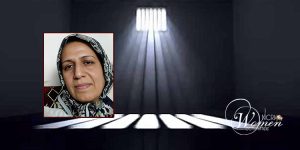
Shiva Esmaeli, a political prisoner held in Evin Prison, continues to be denied urgent surgery for a herniated disc, despite her family’s readiness to cover all medical expenses.
According to a letter issued by the prison infirmary and signed by a physician identified as Dr. Maleki, Evin Prison lacks the necessary medical facilities to perform the required spinal surgery. The document instructs Shiva Esmaeli to inform her family to schedule an appointment with an outside specialist at their own expense for her examination and treatment.
Although Esmaeli’s family has repeatedly offered to pay for all medical care and procedures, the Ministry of Intelligence has blocked the surgery, a prohibition that remains in effect.
Despite these ongoing bureaucratic and security obstacles to her operation, prison authorities and relevant decision-making bodies remain legally and morally responsible for her physical health and medical condition.
This is not the first time Shiva Esmaeli has been deprived of critical care. In September 2026, prison officials similarly blocked her surgery, even though severe pain had impaired her mobility.
Iran Regime Fears Explosive Social Unrest More Than War, Pezeshkian Admits
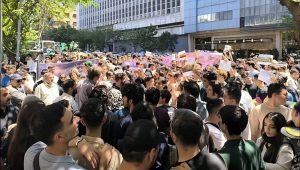
He also acknowledged the government’s responsibility for addressing public grievances, warning that failure to resolve people’s problems would make the authorities culpable.
His remarks point to a central dilemma for Iran’s regime: military confrontation and diplomatic uncertainty are serious challenges, but economic hardship and public anger threaten the foundations of its rule from within.
Iran Records at Least 201 Protest Actions in September 2026 as Economic Grievances Spread
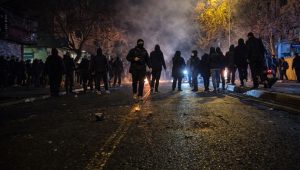
Retirees accounted for the largest share of recorded protest actions, with 79 incidents during the month. Retirees from the Social Security Organization, telecommunications sector, and steel industry protested over inadequate pensions, deteriorating living conditions, healthcare problems, and unpaid entitlements.
Workers ranked second, with 51 protest actions. Their grievances included delayed or unpaid wages, unemployment, job insecurity, unresolved employment status, poor working conditions, inadequate meals, discriminatory treatment of Baluch workers, and company decisions affecting their workplaces.
Iran: Release and Organization of Violent Criminals for Repression

In September and October 2026, official media outlets of the Islamic Republic of Iran launched a massive propaganda campaign announcing the mobilization and military training of 1,000 “Jan-Fada” (Dedicated) National Resistance Battalions. While state propaganda portrays these units as “voluntary public campaigns composed of students, youth, and seminary scholars to defend against foreign threats,” field reports and documentation gathered by human rights organizations reveal a dangerous and hidden reality: “The systemic conditional release of violent criminal convicts from prisons, contingent upon their registration with the Basij and integration into ‘Jan-Fada’ battalions to suppress urban protests.”
This dual strategy allows the state to compensate for severe manpower shortages within its security apparatus while deploying individuals with criminal backgrounds as a violent enforcement arm for street-level repression.
The State’s Propaganda Façade: Official Media Claims
State-run news agencies (Tasnim, ISNA, IRNA, and Mehr), highlighting claims of 31 million participants, promote the structure of the Jan-Fada battalions around the following key axes:
- Organizational Scale and Expansion: Official announcements regarding military training for 1,000 battalions nationwide, alongside 100 public battalions organized in Alborz Province under the “SENMA” structure (Tasnim, Sept 16 & Sept 25, 2026).
- Militarization of Urban Squares: The establishment of bases and temporary “military training hubs” in major public transit squares, including Imam Hossein Square and Haft-e Tir Square in Tehran (Tasnim & ISNA, Oct 3, 2026).
Iran Reportedly Sells Oil to Russia at 35%–42% Discount as New Caspian Route Emerges
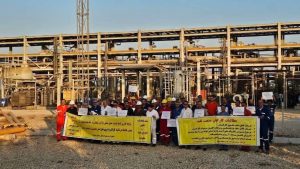
OilPrice reports that Iranian oil is entering Russia’s network and Kazakhstan’s export stream through the Caspian Sea, adding another route to Tehran’s trade with China, trust networks and cryptocurrency as some export channels have been restricted.
A new report published on October 12 says a new route has emerged for Iranian oil sales: crude is transported across the Caspian Sea to Russia, blended with Russian oil and then fed into the “CPC Blend” stream, which is exported to European markets under Kazakh documentation.
OilPrice attributed the claim to an unnamed senior official in the European Union’s energy-security apparatus and said Iranian oil is being transferred to Russia at discounts of 35% to 42%. The outlet said part of the compensation is not paid in cash, but in Russian equipment, including defense systems, missiles and satellite data. These claims have not been independently verified.
UN Special Rapporteur Gina Romero Joins Iranian Prisoners’ Hunger Strike Against Executions
Ms. Gina Romero, the United Nations Special Rapporteur on the rights to freedom of peaceful assembly and of association, joined the “No to Execution Tuesdays” campaign on Tuesday, 13 October 2026. The Colombian expert announced a 24-hour hunger strike in solidarity with political prisoners across Iran who have been staging weekly protests against the death penalty.
It is 3:30 PM on Monday, October 12th in Colombia, which means it’s midnight in Iran and Tuesday, October 13th has just begun. I have just finished my last meal, as my 24-hour hunger strike starts now.
I join #NoToExecutionTuesdays in solidarity with the brave people of Iran. pic.twitter.com/ZEbMqIvzRi— Gina Romero (@Ginitastar) October 12, 2026
Romero stated that the death penalty is being used against people for exercising their rights to freedom of assembly, association, and expression, as well as their political rights. In a video message and thread posted on X, she noted that at least 46 protesters have been executed since March—the highest number of political executions in nearly four decades—following the large-scale protests earlier in 2026. She called for an immediate halt to executions, the quashing of death sentences imposed after unfair trials, and independent monitoring of prisoners at risk, while reiterating that the death penalty should be abolished in all cases.
Iranian Resistance Supporters Run in Paris to Demand End to Executions in Iran
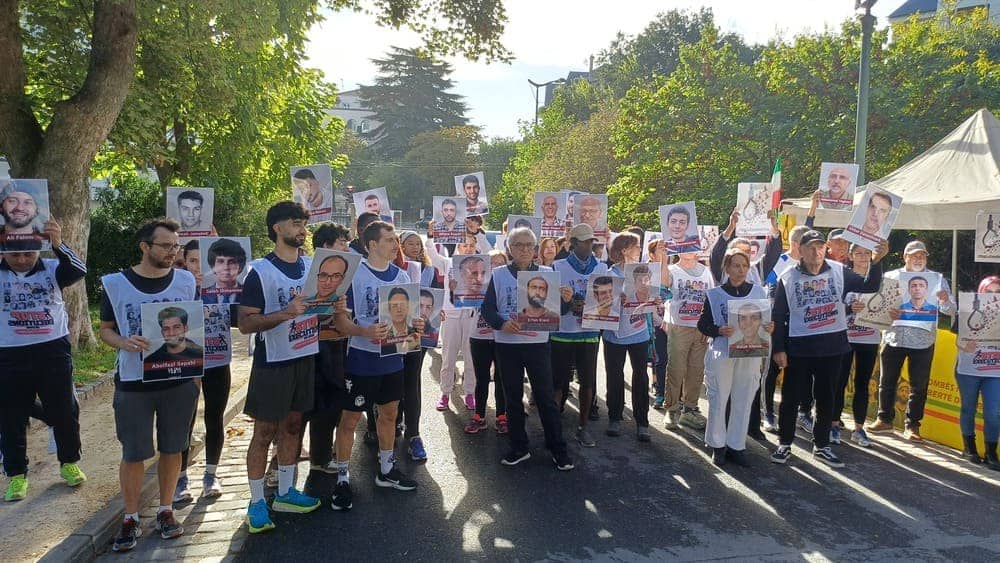
Paris, France – October 10, 2026 – On the World Day Against the Death Penalty, supporters of the Iranian Resistance and human rights advocates took part in a 3.5-kilometer run at Parc Montsouris in Paris to condemn executions in Iran and launch a global call for the abolition of all death sentences in the country.
Wearing vests bearing the slogans “No to Executions” and “Stop Executions in Iran,” participants condemned the Iranian regime’s use of capital punishment as a tool of repression. They called for an immediate end to executions, particularly for political prisoners and protesters arrested during nationwide uprisings.

Organizers said at least 45 political prisoners, including nine supporters of the People’s Mojahedin Organization of Iran (PMOI/MEK), have been executed since the beginning of 2026.
Demonstrators demanded the abolition of the death penalty, the release of all political prisoners, an end to state violence, and the establishment of a democratic republic in Iran. They expressed solidarity with political prisoners and those facing execution, reaffirming their commitment to a democratic future for the Iranian people.