
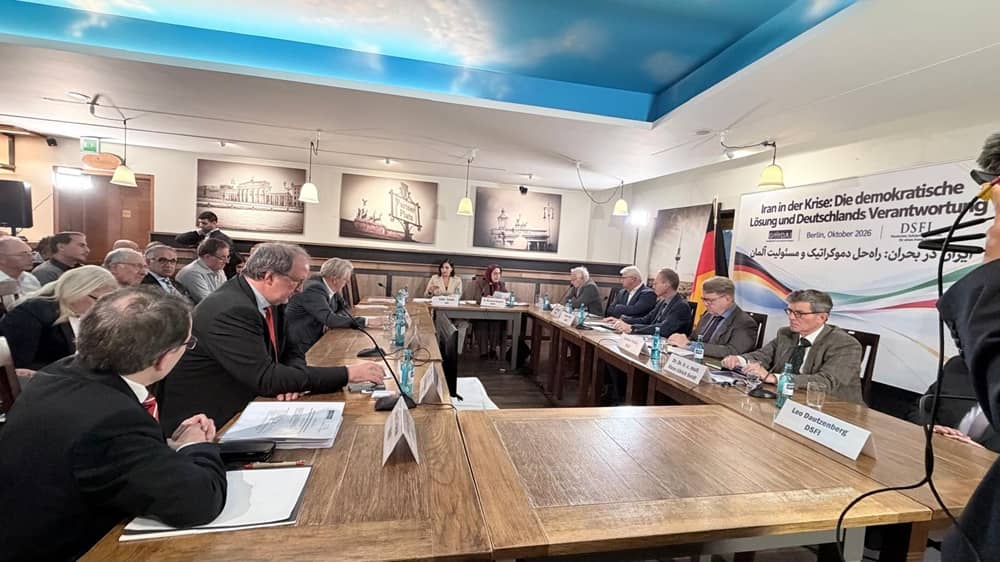
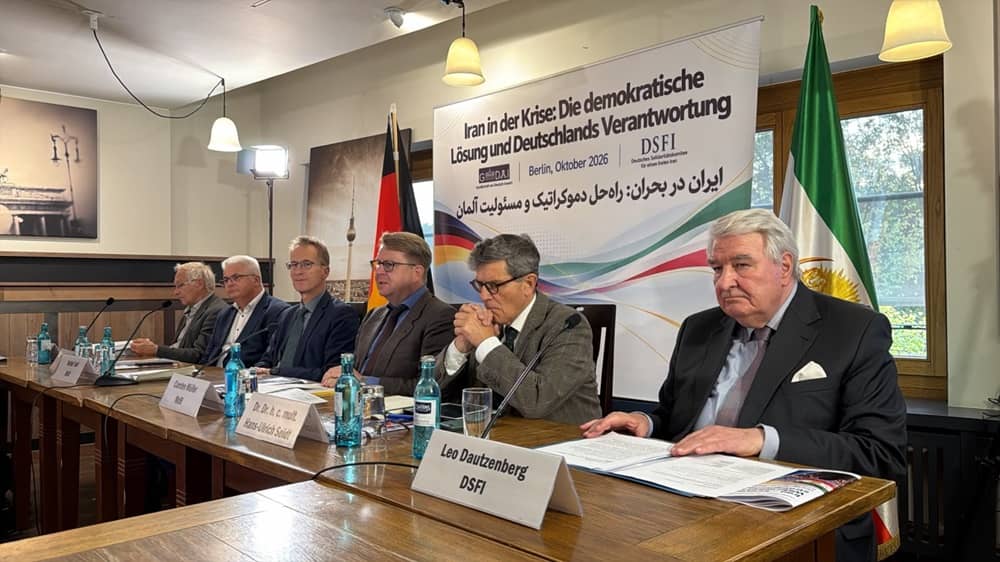
BERLIN, October 14, 2026 — German lawmakers, former parliamentarians, diplomats, political analysts and Iranian activists gathered in Berlin for a conference on Iran’s political crisis, calling for a fundamental change in German and European policy toward Tehran and greater recognition of the organized Iranian Resistance. Speakers highlighted the expansion of Resistance Units inside Iran, the endurance of the People’s Mojahedin Organization of Iran (PMOI/MEK) despite decades of executions and persecution, and the National Council of Resistance of Iran’s proposed democratic transition. The conference also sharply criticized efforts to promote Reza Pahlavi and restoration of the ousted monarchy, warned against campaigns to demonize or marginalize the organized Resistance, and called for stronger action against executions, transnational repression and impunity for crimes against humanity.
By sending a video message, Mrs. Maryam Rajavi, President-elect of the NCRI, addressed the conference as keynote speaker, arguing that neither appeasement nor foreign war could resolve the Iranian crisis and urging Germany to support the Iranian people’s struggle for democratic change.
Mrs. Rajavi told the gathering that the defining conflict over Iran’s future was not the regime’s confrontation with foreign powers but its unresolved struggle against Iranian society.
“For forty-seven years, a deep and protracted conflict has unfolded in Iran—one that constitutes the true battle, far eclipsing any external conflict,” she said. “That is the fundamental war between the Iranian people and religious fascism.”
She said executions had become a principal instrument for suppressing opponents and preventing another nationwide uprising, citing the execution of at least 46 political prisoners since the latest conflict began, including nine PMOI members, as well as new death sentences against alleged supporters of the organization.
Yet Mrs. Rajavi argued that the repression had failed to contain opposition activity. “Public defiance and resistance, led particularly by the younger generation standing up to the Revolutionary Guard Corps, continues to expand,” she said. “Over recent months, Resistance Units have significantly intensified their strikes against regime installations and defiance of their state apparatus.”
Message to Conference in Berlin: Iran crisis & democratic solution
Germany is among the nations fully empowered under the principle of universal jurisdiction to prosecute regime leaders in its own courts for crimes against humanity.
Furthermore, closing the regime’s embassy and… pic.twitter.com/DArK5LuuPp
— Maryam Rajavi (@Maryam_Rajavi) October 14, 2026
The NCRI President-elect framed those developments as a repudiation of the two approaches that, she argued, had dominated Western policy: seeking accommodation with Tehran and attempting to resolve the Iranian crisis through external military force.
“For many years,” she said, European policy had rested on the hope that religious dictatorship could eventually be moderated and on the assumption that Iran’s problems could be addressed while ignoring the population and its organized Resistance.
“Events have proven both assumptions utterly wrong. Appeasement produced war,” Mrs. Rajavi said. “Meanwhile, consecutive uprisings and the expanding network of Resistance and Resistance Units have made one truth clear: the decisive force shaping Iran’s future is the Iranian people and their organized resistance.”
She added: “The core failure of Western policy toward Iran to this day has been the refusal to recognize the Iranian people’s resistance.”
Mrs. Rajavi also rejected attempts to present the former monarchy as an alternative to the clerical system. She described Reza Pahlavi as a “false alternative” that, in her assessment, diverted attention from a democratic movement rooted within Iranian society and served Tehran’s interests by reviving the specter of monarchical restoration. The NCRI, she said, instead advocated a democratic republic based on free elections and separation of religion and state.
Turning directly to Germany, Mrs. Rajavi called for political and judicial action. She urged Berlin to use universal jurisdiction against Iranian officials accused of crimes against humanity, make an end to executions a condition of diplomatic and economic relations with Tehran, and support international investigations and referrals to competent judicial bodies.
“Germany is among the nations fully empowered under the principle of universal jurisdiction to prosecute regime leaders in its own courts for crimes against humanity,” she said.
Mrs. Rajavi also called for closing Tehran’s embassy and expelling operatives of the IRGC and Ministry of Intelligence, before making what she described as the most important demand: “Most crucially, the international community must formally recognize the Iranian people’s fight to overthrow religious fascism and the legitimate struggle of rebellious youth against the criminal IRGC.”
Bundestag member Carsten Müller said Iran had reached a critical turning point, arguing that intensified executions, arrests and repression demonstrated weakness rather than stability. He said the clerical authorities were attempting to portray their survival through recent military confrontation as a victory, while the country’s underlying political crisis had deepened.
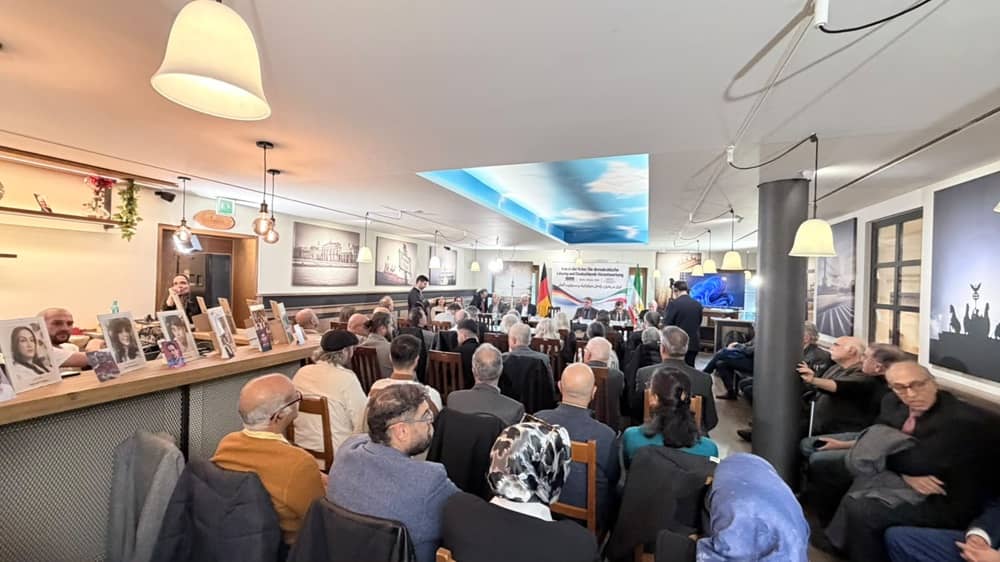
Müller rejected both military intervention from abroad and restoration of the monarchy. He said the Shah’s rule had also been characterized by serious human-rights violations and argued that any credible democratic alternative had to acknowledge and reject that record.
He placed particular emphasis on the organization and endurance of the PMOI. Responding to claims that its strength inside Iran was exaggerated, Müller argued that the scale of Tehran’s repression against the movement suggested the opposite.
“Someone who is irrelevant is not fought as the greatest enemy; they are simply ignored,” he said in substance, noting that some of the harshest repression had been directed against PMOI supporters.
Müller said political change required more than public anger. It required organized structures, continuity and a plan for what followed the existing system. In his assessment, Mrs. Rajavi’s Ten-Point Plan supplied that political framework through secular government, human rights, gender equality, abolition of the death penalty and an end to political persecution.
Bundestag member Detlef Seif discussed Germany’s growing response to Tehran’s activities beyond Iran, including transnational repression and indirect intimidation directed at diaspora members through their families inside Iran. Seif highlighted recent legislative progress in Germany, specifically pointing to the addition of Section 87c to the German Criminal Code (Strafgesetzbuch) in April, which explicitly penalizes transnational repression with up to five years of imprisonment.
He argued for stronger, coordinated European diplomatic measures while evaluating NCRI President-elect Maryam Rajavi’s Ten-Point Plan, noting that its principles mirror Germany’s own constitutional concept of a “free democratic basic order” through the rule of law, democratic government, freedom of religion, minority rights, secularism, and gender equality.
Message to Conference in Berlin: Iran crisis & democratic solution
For forty-seven years, a deep and protracted conflict has unfolded in Iran—one that constitutes the true battle, far eclipsing any external conflict. That is the war between the Iranian people and religious… pic.twitter.com/dUGRs19Xha— Maryam Rajavi (@Maryam_Rajavi) October 14, 2026
Former German ambassador Dr. Hans-Ulrich Seidt presented one of the conference’s most extensive critiques of existing European policy. He said Germany and the EU had traditionally concentrated on individual issues—nuclear capabilities, missiles, regional intervention and human rights—while failing to address the character of the ruling system and the domestic forces capable of changing it.
Amb. Seidt argued that neither engagement nor military intervention had delivered the intended result.
“Neither diplomatic negotiations with the regime nor a war begun by external powers have so far been able to move the regime in Tehran to change its domestic and foreign policy,” he said.
Instead, he said, European strategy should recognize the importance of an organized political force inside Iran.
“Without organized resistance networks, without the existence and decades-long continuity of an opposition structure, without a long-term program for a secular and democratic republic, as well as a concrete plan for a time-limited transitional phase after the end of the regime, political change in Iran is presently hardly conceivable.”
Amb. Seidt specifically identified the NCRI and PMOI as possessing organizational continuity and a political program, arguing that European governments risked ignoring a major strategic factor if they excluded them from their calculations or refused dialogue with them.
Former Bundestag member Leo Dautzenberg emphasized the personal sacrifices sustaining the Resistance over decades. He said that during nearly 30 years of engagement with the Iranian opposition, he had met people who lost relatives, endured prison, persecution and exile, and transformed those experiences into continued commitment.
“I have experienced how much strength, lifetime and personal sacrifice this Resistance costs,” he said.
Dautzenberg argued that dissatisfaction alone could not produce a transition from dictatorship. “Millions can reject a system,” he said, but moving from spontaneous protest to political change required “organization, networking, endurance, political leadership and a clear idea of the day after.”
He also addressed efforts to discredit the organized Resistance, citing findings attributed to North Rhine-Westphalia’s domestic intelligence service concerning Iranian intelligence activity directed at the PMOI and NCRI. He argued that European governments should not allow Tehran to determine which opposition groups Western institutions could engage with.
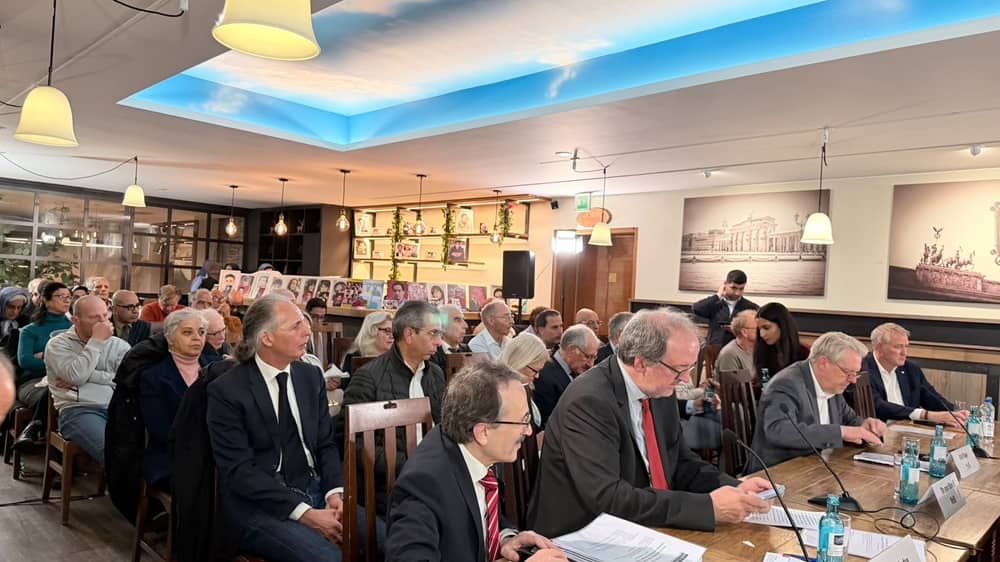
“A balanced policy based on interests requires, alongside dealing with the Iranian government, active, direct and permanent relations with the most important organized opposition,” Dautzenberg said.
Former Bundestag human-rights committee member Martin Patzelt focused on the Friedrich Naumann Foundation’s decision to involve Reza Pahlavi in presenting its 2026 Freedom Prize for the Iranian people. Patzelt said more than 80 former ministers, politicians, academics and cultural figures had signed an open letter criticizing the decision.
He rejected the explanation that Pahlavi’s public visibility provided sufficient legitimacy. “Being well known” was not equivalent to democratic representation, he argued.
Patzelt described the move as politically damaging because Tehran had long sought to present Iranians with a binary choice between clerical rule and restoration of the monarchy.
“Whoever gives prestige to the symbol of the former dictatorship in this way gives a gift to today’s dictatorship,” he said.
He added: “Reza Pahlavi today is not a symbol of unity for the opposition. He is a controversial and divisive figure.” According to Patzelt, strengthening such an alternative weakened republican opposition forces and ultimately benefited Tehran. Iran, he said, needed neither “hereditary monarchy” nor clerical dictatorship, but a democratic political order.
Former Bundestag member Thomas Lutze similarly questioned efforts by European institutions to elevate Pahlavi. He said neither media visibility nor extensive online promotion amounted to democratic legitimacy or evidence of an organized presence inside Iran.
“The criterion must instead be a program, accountability, a measurable organizational structure and an actual base inside Iran,” Lutze said.
He also raised concerns about reports of threats and intimidation by some monarchist supporters against critics and argued that promoting one controversial figure risked marginalizing republicans, ethnic communities, women, religious minorities, human-rights advocates and other opposition currents.
“It is not Europe’s task, and not Germany’s task, to select a leader for Iran,” Lutze said.
Dr. Masumeh Bolourchi, NCRI Representative in Germany, highlighted resistance inside Iran’s prisons as evidence that repression had failed to break political commitment. She pointed to the “No to Execution Tuesdays” campaign, which she said had reached its 142nd week, with prisoners in 66 prisons participating in hunger strikes despite the threat of death sentences.
“The significance of this movement is not only resistance to the death penalty,” Dr. Bolourchi said. “It also shows that even in prison and under the shadow of the gallows, resistance continues and expands.”
She described the prison protests as part of a Resistance that had endured more than four decades of imprisonment, torture and execution and urged recognition of the organized opposition as the practical force for political change.
Sociologist Reza Mousavi examined the role of the Resistance Units from a social and political perspective. He argued that deep economic crisis and public anger had created conditions for renewed revolt but that spontaneous protest alone could not overcome a highly organized repressive apparatus.
“Unorganized people may possess revolutionary energy, but not strategic coherence,” Mousavi said. He described Resistance Units as the link between spontaneous protest and sustained organization, arguing that they helped overcome fear, coordinate scattered opposition activity and transform diffuse social anger into an organized challenge.
He concluded that the Resistance Units and Mrs. Rajavi’s Ten-Point Plan provided what he called the organizational and political “backbone” required to turn public dissatisfaction into a coherent force for democratic transition.
Former political prisoner Mohammad Ali Elahi provided testimony about repression under the Shah, recounting his arrest by SAVAK in 1972 for distributing PMOI literature, prolonged torture, solitary confinement and five years of imprisonment. He also described witnessing security forces fire on demonstrators in Tehran in 1978.
Elahi said the proposal to give Reza Pahlavi a prominent role in accepting a prize in the name of the Iranian people revived memories of those abuses.
“My demand is that the voices of the Shah’s SAVAK victims be heard,” he said, arguing that Iranians should not be forced to choose between “the dictatorship of the mullahs” and “the dictatorship of the Shah.” He called instead for freedom, republican government, popular sovereignty and independence.
Sahar Sanaei, who helped moderate the conference, said many participants had personal or family experience of repression by the clerical authorities and argued that their engagement was driven not by revenge but by a commitment to freedom and accountability. She said European governments had too often accepted Tehran’s framing that there was no viable alternative to the regime, while simultaneously marginalizing the organized Resistance. Sanaei argued that this distorted picture was reinforced by what she described as the artificial elevation of Reza Pahlavi through lobbying, publicity and coordinated online activity, making him appear more representative than his actual base warranted.
She also accused some monarchist circles of directing hostility toward other opposition currents, including leftists, Kurds, Baluchis and PMOI members, warning that “an opposition built on exclusion, threats and denial of others cannot bring freedom or pluralism to tomorrow’s Iran.” Sanaei said such divisions ultimately benefited the clerical authorities and concluded that legitimacy had to come from the Iranian people themselves, expressing support for Maryam Rajavi and the NCRI’s Ten-Point Plan.
Iranian activist Vida Niktalean said she was speaking not only about her own experiences but on behalf of more than 100 Iranians in Germany who, she alleged, had faced insults, threats, digital harassment, disclosure of personal information, cyberattacks or physical violence associated with some monarchist activists.
She urged German authorities to investigate such allegations systematically and protect those targeted. “Whoever demands democracy for Iran must also respect democratic rights here,” she said. “Violence, threats and intimidation must have no place in Germany or Europe.”
Behnam Vafa, a former political prisoner and activist, said he and members of his family had been subjected to insults and threats by Pahlavi supporters and that he had filed several complaints with German police. Vafa said he recognized in those methods the same kind of coercive behavior he had experienced during interrogation and imprisonment in Iran.
He alleged that individuals involved in threatening him had links to circles close to Reza Pahlavi and said some of the incidents remained under police or judicial review. “The aim of these attackers is clear,” he said, arguing that intimidation was intended either to force critics out of the political arena or pressure them into conforming with monarchist slogans. Vafa stressed that such conduct should not be dismissed as ordinary political disagreement and called for threats, insults and attacks to be formally reported and investigated.