
THIS PAGE WILL BE UPDATED WITH THE LATEST NEWS
UPDATE: 10:30 AM CEST
EU Leaders Condemn Iran Over Attacks and Executions

European Union leaders on Friday condemned Iran’s attacks on neighboring countries and any actions that threaten shipping through the Strait of Hormuz. They also warned that Tehran must never be allowed to acquire a nuclear weapon. The statements came in conclusions adopted at the end of a two-day summit in Brussels. Iran was addressed in both the Middle East and Ukraine sections of the document, which also covered soaring energy prices, Russia’s war and other conflicts in the region.
The European Council, made up of the leaders of the EU’s 27 member states, said it “reiterates its strong condemnation of Iran’s attacks against countries in the region and its solidarity with countries affected.”
It called on Iran “and its proxies” to halt such attacks and respect the sovereignty of their neighbors.
The leaders also “strongly condemns any acts that threaten navigation or prevent commercial vessels from entering and exiting the Strait of Hormuz.”
UPDATE: 9:30 AM CEST
Iran’s Resistance Units Respond to Demolition of Impoverished Families’ Homes in Tabriz
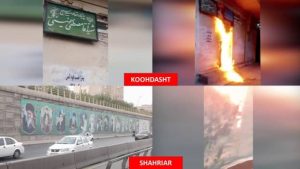
On October 10, PMOI/MEK Resistance Units carried out ten operations across nine Iranian cities in response to the demolition of homes belonging to impoverished families in Tabriz. The operations targeted regime-affiliated facilities, bases of the Islamic Revolutionary Guard Corps (IRGC) Basij, and propaganda symbols associated with the ruling establishment.
The operations took place in Mashhad, Zahedan, Iranshahr, Kuhdasht, Shahriar, Shiraz, Saveh, Isfahan, and Sabzevar, demonstrating a nationwide response to the authorities’ treatment of vulnerable citizens. The campaign carried a message of solidarity with families facing repression: The regime’s abuses against defenseless citizens would not go unanswered.
On October 4, regime authorities demolished residential buildings in Tabriz, leaving impoverished families without shelter.
One resident described how authorities arrived without presenting legal documentation or a demolition order. The resident said that regime agents beat women and children and destroyed a residential building that had stood for six or seven years.
Germany’s Freedom Prize: Iran’s People Deserve Solidarity, Not a Manufactured Leader
Germany’s Friedrich Naumann Foundation for Freedom‘s decision to award its 2026 Freedom Prize to the Iranian people should have been an uncontroversial tribute to extraordinary courage. For years, Iranians have confronted a ruling regime that answers demand for freedom with bullets, prisons, torture, and executions. Honoring that struggle in Frankfurt’s historic Paulskirche on November 7 could have sent an important message of solidarity. Instead, the FDP-affiliated Foundation has created a political controversy of its own making by appointing Reza Pahlavi, son of Iran’s deposed Shah, to receive the prize “in trust” on behalf of the Iranian people.
The contradiction is difficult to miss.
The Foundation’s own announcement emphasizes that it is deliberately awarding the prize to the Iranian people rather than to an individual. Yet it then appoints an individual whose only relevance to Iran is his deposed father, whom Iranians have rejected, to represent them, describes him as an “opposition leader,” and goes so far as to claim that he is probably the principal political identification figure for a majority of Iranians.
No democratic process produced that conclusion. The issue, therefore, is not simply who walks onto the stage in Frankfurt to collect a plaque. The question is whether an institution dedicated to liberal democracy should appoint a political representative for a people struggling to reclaim the right to choose their representatives.
Iran Regime’s Internal Power Struggle Deepens as Factions Clash Over War and Negotiations
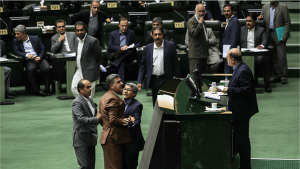
Iran’s regime is experiencing escalating internal conflict as rival factions clash over the war with the United States, diplomatic negotiations, and the government’s handling of domestic affairs. Recent moves against political opponents, calls to impeach Foreign Minister Abbas Araghchi, and threats of summary trials have highlighted the growing difficulty of containing disputes within the regime. The confrontation extends beyond verbal attacks. Following the imprisonment of hard-line cleric Hamid Rasaee after a complaint by Parliament Speaker Mohammad Bagher Ghalibaf, 35 members of the regime’s parliament signed a motion seeking Araghchi’s impeachment. The move underscored the divisions over the foreign minister’s diplomatic activities and the regime’s approach to the United States.
The dispute has also taken a more threatening tone. During nighttime gatherings by regime supporters, demonstrators targeted former President Hassan Rouhani and former Foreign Minister Mohammad Javad Zarif with slogans accusing them of serving foreign interests. Some participants threatened political figures with a fate resembling that of former President Akbar Hashemi Rafsanjani, whose death in a swimming pool in 2017 has remained a subject of public controversy.
One lawmaker defending the prospect of impeaching Araghchi despite the wartime circumstances reportedly declared: “In wartime, we even have summary trials.”
Erfan Ghanei-Fard’s Denials Raise More Questions Than They Answer
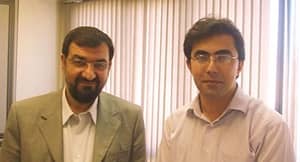
On 15 October 2026, Erfan Ghanei-Fard published an article on The Times of Israel blog platform entitled The MEK’s Dirty War of Lies and Smears, responding to an Iran News Update investigation into his appearance on Voice of America’s Meydan programme that dealt with the trial of Parviz Sabeti, a senior official of the Shah’s notorious secret police, SAVAK.
The original report raised two central issues: Ghanei-Fard’s reported connections with senior officials of the Islamic Republic’s Revolutionary Guards (IRGC), security establishment and former SAVAK officers, and his conduct during the 11 October programme, in which, according to Iran News Update, he repeatedly denounced opposition organizations as terrorists while justifying acts of torture under the Shah or ridiculing allegations that such acts had been carried out at Sabeti’s direction.
Rather than examining the historical evidence behind these questions, Ghanei-Fard devoted much of his response to attacking the People’s Mojahedin Organisation of Iran (PMOI/MEK), Kurdish opposition groups and other political opponents of the monarchy.
These attacks served to divert attention from the central issues and avoid answering the substantive questions raised about his own conduct and connections. Yet such diversionary tactics do nothing to address the substantial body of evidence concerning his meetings, personal relationships and published political assessments — much of which is drawn directly from his own writings.
The central issue is not a single photograph with former IRGC commander and current Secretary for the Supreme National Security Council (SNSC), Mohsen Rezaei. It is Ghanei-Fard’s own account of repeated access to senior figures in the IRGC, the terrorists Quds Force and Iran’s national security apparatus, combined with his remarkably favourable descriptions of some of those individuals.
306 Iranian Associations Protest Reza Pahlavi Award as Naumann Foundation Faces Mounting Criticism

The decision by Germany’s Friedrich Naumann Foundation for Freedom to award its 2026 Freedom Prize for the Iranian people to Reza Pahlavi, son of Iran’s ousted shah, has triggered a widening protest across the Iranian diaspora. In a letter dated October 16, 306 Iranian associations and communities from Europe, the United States, Canada, and Australia condemned the decision, including 70 organizations based in Germany. They argue that presenting the award in the name of the Iranian people contradicts the principles of freedom and democracy the prize is supposed to represent. The controversy has intensified over plans to hold the ceremony at Frankfurt’s Paulskirche, a landmark of German parliamentary democracy and popular sovereignty. Critics argue that honoring Pahlavi at such a venue disregards Iranians who reject both the current religious dictatorship and a return to monarchy.
The latest protest adds to growing opposition from German political figures, former political prisoners, and Iranian republican organizations. On October 1, 82 prominent Germans, including former federal ministers, diplomats, a former chair of the Evangelical Church in Germany, a former Federal Constitutional Court judge, and 15 members of the Bundestag, challenged the decision to award a prize in the Iranian people’s name to what they described as a deeply polarizing figure.
Former political prisoners who suffered under the shah’s dictatorship have also protested. Six survivors of imprisonment and torture by SAVAK, the shah’s secret police, issued a separate letter describing their experiences of repression and executions and warning against diminishing the suffering of the dictatorship’s victims through the award. Another 25 Iranian organizations and political parties representing a broad republican spectrum have joined the opposition.
IRGC Reports Supertanker Explosion in Strait of Hormuz as Brent Nears $110; Former Minister Survives Apparent Assassination Attempt
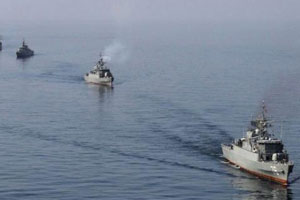
The IRGC says a supertanker carrying more than two million barrels of oil exploded after striking a mine in the Strait of Hormuz; as Brent climbed to around $110, attacks on ships and reports of an assassination attempt on Abbas Akhoundi exposed fresh pressures in Iran’s political landscape.
The Islamic Revolutionary Guard Corps Navy said on Saturday that a supertanker carrying more than two million barrels of crude oil struck a mine while passing through the Strait of Hormuz and suffered a major explosion and fire. The incident came amid an increase in attacks on shipping in the strategic Hormuz waterway, while Brent crude rose to $109.86 a barrel, close to a five-month high.
In Tehran, debate over how to confront the United States, keeping the Strait of Hormuz closed and attacks on shipping has been accompanied by other political tensions. The latest case is the reported failed assassination attempt on Abbas Akhoundi, a former roads and urban development minister, an incident in which reformist figures have warned of the possible involvement of a multi-person group, while a security source has said no evidence has so far been found that the attack was organized or terrorist in nature.
Paris Exhibition Honors Victims of Executions by Iran’s Regime
Paris, October 16, 2026 — Supporters of the People’s Mojahedin Organization of Iran (PMOI/MEK) and the National Council of Resistance of Iran (NCRI) held a photo exhibition in Paris on Friday to commemorate victims of executions carried out by the Iranian regime.
Photographs of the victims were displayed for passersby in the heart of Paris. Their faces, silent but striking, recalled the lives of men and women who sacrificed their lives for freedom and democracy in Iran.

The exhibition featured victims of the 1988 massacre of political prisoners, as well as those executed or killed during Iran’s recent nationwide protests, including the nationwide uprising of 2026.
Their photographs were presented as a testament to the continuing struggle of the Iranian people against repression and for freedom. Organizers highlighted the Iranian regime’s continued use of the death penalty as a tool of political repression and called for an end to executions in Iran.