

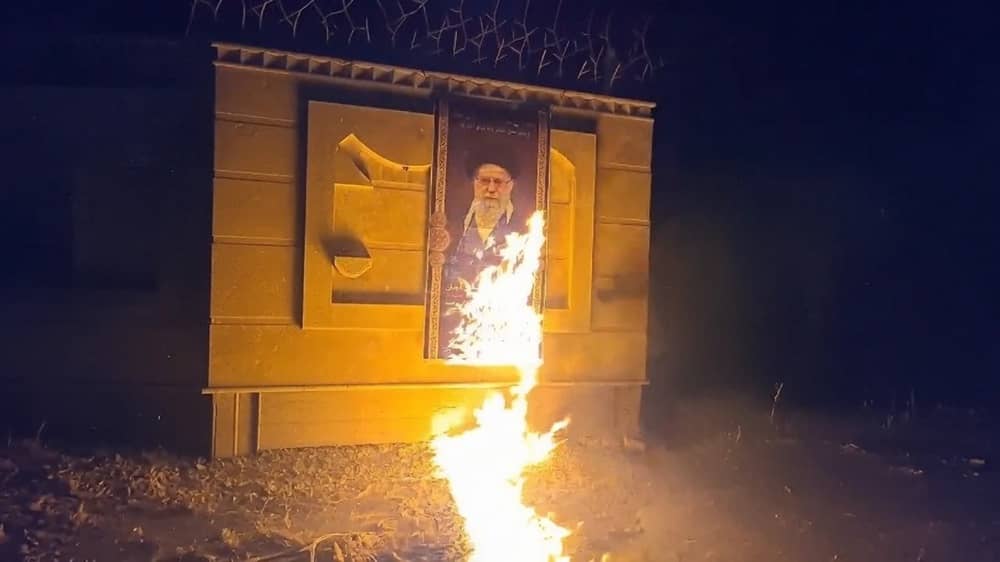
During the week of October 18–24, 2026, a coordinated surge of operational activities across Iran directly targeted the clerical regime’s security apparatus, propaganda infrastructure, and key state authorities. Against the backdrop of an accelerating wave of political executions and severe economic repression, MEK Resistance Units operating in dozens of municipalities executed direct strikes against Islamic Revolutionary Guard Corps (IRGC) targets and paramilitary Basij centers. Concurrently, political prisoners and anti-regime organizers launched widespread public campaigns across major urban corridors, signaling an escalating internal crisis for Tehran.
October 24, 2026
Marking a state visit by the regime’s president Masoud Pezeshkian to Mashhad, Resistance Units staged widespread public protest operations. They saturated public spaces with anti-regime placards and leaflets directly targeting the administration. Displaying slogans such as “Pezeshkian, Mashhad is no place for you, get out,” “Pezeshkian’s record is only the execution of youth and innocent people,” and “the Supreme Leader’s president, accomplice to every crime,” activists voiced fierce opposition to the regime’s surging execution rates. Resistance Units in Mashhad publicly pledged continued resistance against tyranny, reaffirming their commitment to confronting state repression until the regime falls.
PMOI Resistance Units mark anniversary of Maryam Rajavi’s election as NCRI president-elect with nationwide activities https://t.co/2xQ18UX0sH
— People's Mojahedin Organization of Iran (PMOI/MEK) (@Mojahedineng) October 20, 2026
October 23, 2026
In Zahedan, Resistance Units deployed major public banners articulating the leadership positions of the Iranian Resistance. The displays explicitly repudiated both the ruling clerical regime and any potential restoration of monarchical rule, advocating instead for the establishment of a democratic republic based on the separation of church and state. Banners highlighted resistance declarations identifying the regime’s execution of political prisoners as its sole mechanism for retaining control, while explicitly framing monarchy as a false alternative that serves state interests.
Simultaneously, Resistance Units executed twenty coordinated incendiary operations in response to municipal aggression against local populations. In Khorramshahr, following state-ordered demolitions of impoverished residents’ coastal cafes, Resistance Units launched ten retaliatory strikes: in Tabriz, state propaganda banners depicting Supreme Leader Ali Khamenei were set ablaze over a major highway bridge; in Kohgiluyeh, an incendiary device targeted the Imam Sadeq Basij center; in Khash, the IRGC Basij base was struck; in Shahriar, two separate Basij strongholds—the Jalad Soleimani and Anti-Hamzah Seyed ol-Shohada bases—were set on fire; in Kermanshah, an IRGC Basij zone center was torched; in Rask, an IRGC battalion headquarters was engulfed in blazes; in Chabahar, an IRGC Basij headquarters was set ablaze; and in Islamshahr, a specialized intelligence-gathering directional marker for the Basij espionage network was destroyed by fire.
🚨 EXCLUSIVE | 10 PMOI Resistance Unit Operations Across Iran
Exclusive footage received by Simay Azadi shows highlights of 10 operations carried out by PMOI Resistance Units on October 23, reportedly in response to a security forces’ raid on a Tehran produce market that damaged… pic.twitter.com/ff50RSRLDj
— SIMAY AZADI TV (@en_simayazadi) October 24, 2026
Concurrently, ten additional retaliatory strikes were carried out in response to a violent regime raid on a major wholesale vegetable market in Tehran. Resistance units executed an operation against the “Velayat Seminary” center of indoctrination in Tehran, while setting alight a Khomeini Relief Committee facility with Molotov cocktails and torching an IRGC Basij base in the capital. Additional synchronized strikes set fire to an IRGC Basij base in Shahriar, burned state propaganda banners in Tabriz, destroyed propaganda posters in Mashhad, Masjed Soleyman, and Iranshahr, and torched a Basij spy network intelligence sign in Nazarabad (Karaj).
October 22, 2026
Coordinated public actions marked the anniversary of the Iranian Resistance’s transitional presidency platform across more than twenty major cities. In Tehran, Resistance Units deployed colorful photo actions, distributed leaflets, and affixed hand-lettered and printed posters calling for the overthrow of the regime and the establishment of a democratic republic. Similar synchronized demonstrations, banner displays, and slogan-writing operations were reported in Islamshahr, Mashhad, Isfahan, Shiraz, Ahvaz, Sari, Ardabil, Kerman, Bandar Abbas, Kermanshah, Sanandaj, Khorramabad, Bushehr, Hamedan, Arak, Lahijan, Baneh, Bukan, and Javanrud. In Sanandaj and Baneh, displays prominently emphasized the central leadership role of Iranian women in dismantling the clerical dictatorship, while units in Shiraz and Islamshahr reiterated slogans opposing both monarchical and clerical forms of authoritarian rule.
Tehran
"The overthrow of the regime and the establishment of a free Iran is the responsibility of the people of Iran and their Resistance" pic.twitter.com/rfNXelkg08— People's Mojahedin Organization of Iran (PMOI/MEK) (@Mojahedineng) October 21, 2026
October 21, 2026
A second nationwide campaign involved fifty distinct operational actions across urban centers. In Khorramabad, Resistance Units suspended a massive banner from an elevated highway bridge featuring resistance slogans declaring the movement unstoppable. In Tehran, Resistance Units staged multi-person actions with printed placards, affixed posters across municipal infrastructure and transit hubs, and displayed banners outlining plans for a democratic future.
In Tabriz, Resistance Units posted broadsides on brick facades, while units in Mashhad conducted multi-person nocturnal actions with broadcloth banners and printed statements. In Karaj, posters were affixed to roadside structures emphasizing resistance through maximum uprising. In Isfahan, Resistance Units displayed symbols of the National Liberation Army alongside banners calling for an end to dictatorship. Further synchronized public visual actions and banner installations were carried out across Shiraz, Rasht, Sari, Kermanshah, Ghaemshahr, Lahijan, Zahedan, Bandar Anzali, and Firozabad.
🚨 Simay Azadi Exclusive | Resistance Units and Supporters Mark Anniversary of Mrs. Maryam Rajavi’s Election
Exclusive videos received by Simay Azadi show PMOI Resistance Units and supporters of the Iranian Resistance commemorating the anniversary of the election of Mrs. Maryam… pic.twitter.com/G1tMuu7Asx
— SIMAY AZADI TV (@en_simayazadi) October 19, 2026
October 20, 2026
Resistance Units expanded urban projection initiatives in high-density corridors. In Tehran, projections and display installations were executed along Golayel Street. In Shahr-e Qods, major actions took place along Khaibar Street and Imamzadeh Boulevard. In Mashhad, Resistance Units targeted key thoroughfares, including Sazman-e Ab Boulevard, Azizi Boulevard, and Andisheh Boulevard. In Karaj, visual actions were conducted along Kharazmi Boulevard, Golshahr Boulevard, and Eskandari Square, alongside operations in Hashtgerd (Karaj) along Goldasht Street. Additional visual projections and poster actions were executed along Meraj Street in Bandar Abbas and 12th of Bahman Boulevard in Ilam.
October 19, 2026
Anti-execution campaigns intensified nationwide as Resistance Units responded to a spate of death sentences handed down by state courts. In Tehran, activists conducted photo actions and posted broadsides demanding the immediate release of political prisoners, including Amir-Hassan Akbari Monfared, Arghavan Fallahi, and student activist Ehsan Faridi, while calling for an end to the regime’s death penalty apparatus. In Tabriz, printed notices rejecting capital punishment were distributed across municipal sectors.
Resistance Units across Iran rally behind Maryam Rajavi’s vision for a democratic republic https://t.co/FQ4iIzuDS4
— People's Mojahedin Organization of Iran (PMOI/MEK) (@Mojahedineng) October 22, 2026
In Karaj, Resistance Units placed banners declaring that public outcry would outlast state gallows. In Parand, demonstrations targeted the death sentences of Alireza Mardasi and Amir-Hassan Akbari Monfared. In Rasht, public actions condemned capital sentences issued against Zahra Tabari and Manouchehr Fallah. In Rabat Karim, Resistance Units conducted a photo action during which execution ropes were publicly set on fire. Concurrently, extensive anti-execution campaigns united activists across Kermanshah, spanning from Kurdistan to the capital in a call for systemic change.
Additionally, fifty preliminary operational actions were recorded across Tehran, Islamshahr, Mashhad, Isfahan, Shiraz, Ahvaz, Sari, Ardabil, Kerman, Bandar Abbas, Kermanshah, Sanandaj, Khorramabad, Bushehr, Hamedan, Arak, Lahijan, Baneh, Bukan, and Javanrud, laying the groundwork for broader regional mobilization against state repression.
Zahedan Resistance Units reject shah and mullah’s dictatorships, reaffirm commitment to a democratic republic https://t.co/79Oup0Q0q4
— People's Mojahedin Organization of Iran (PMOI/MEK) (@Mojahedineng) October 24, 2026
October 18, 2026
The weekly operational window opened with organized public actions spanning major Iranian urban centers. In Tehran, organized five-person groups conducted placard actions, displayed posters, and affixed broadsides detailing democratic transition plans. In Karaj, posters were installed on trees and municipal benches asserting that state power belongs to the people. In Mashhad, nocturnal group actions were executed with fabric banners, while units in Shiraz staged multi-person actions with broad cloth displays affirming women’s role in political change.
In Bushehr, three-person operational cells deployed custom banners, while poster installations and photo actions were carried out across Rasht, Amol, Hamedan, Kermanshah, Ahvaz, Rafsanjan, Bukan, Kashan, Shahriar, Iranshahr, Bandar Abbas, Isfahan, and Qazvin. In Qazvin, operatives posted printed declarations on public infrastructure framing the resistance movement as an unprecedented historical vanguard against religious tyranny.
🚨 Simay Azadi Exclusive | PMOI Resistance Units Mark Mrs. Maryam Rajavi’s Election Across Iran
Exclusive footage received by Simay Azadi shows PMOI Resistance Units and supporters of the Iranian Resistance marking the anniversary of Mrs. Maryam Rajavi’s election as… https://t.co/7Dj2gYkrM6 pic.twitter.com/XBkPbSFHvf
— SIMAY AZADI TV (@en_simayazadi) October 23, 2026
The dramatic expansion of synchronized underground operations, direct incendiary strikes on paramilitary facilities, and widespread anti-execution mobilizations across Iran highlight a regime confronting an unprecedented crisis of domestic legitimacy. Tehran’s reliance on escalating executions, public intimidation, and economic extortion has fundamentally failed to suppress internal dissent; instead, it has galvanized a disciplined, highly organized resistance capable of operating simultaneously across dozens of municipalities. By directly targeting the regime’s security apparatus and rejecting both clerical tyranny and monarchical restoration, these operational units expose the state’s internal deadlock. Despite the regime’s persistent attempts to project an image of absolute stability and invincibility, the growing scale and audacity of these operations demonstrate that state terror is actively accelerating the erosion of its control.