
THIS PAGE WILL BE UPDATED WITH THE LATEST NEWS
UPDATE: 7:30 AM CET
Iran Regime’s Factions Turn on Each Other as Accusations of Infiltration Deepen the Crisis

The intensifying confrontation between rival factions of Iran’s regime is revealing more than a dispute over foreign policy. It is exposing a system increasingly struggling to contain its internal contradictions, as accusations of foreign infiltration, complicity in external aggression, and deliberate efforts to restart war become weapons in the struggle for power.
For years, the factions governing Iran have shared responsibility for a system built on domestic repression, regional intervention, and confrontation with its adversaries. Now, policies once defended as essential to the regime’s survival are becoming ammunition for one faction to discredit another.
This escalation raises a fundamental question: What does the deepening conflict at the top of power mean for the Iranian people?
The answer is not that factional infighting will automatically bring freedom. Rather, the public exposure of these divisions can weaken the ruling establishment’s ability to project unity, shift the political atmosphere, and create opportunities for society to press its own demands.
Iran: Defiant Youth Protest Pezeshkian’s Visit to Mashhad, Condemn Executions and Repression
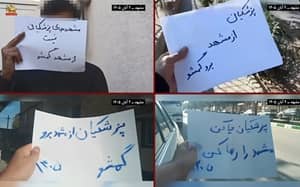
Young protesters in Mashhad used leaflets and photo messages to denounce Iranian regime President Masoud Pezeshkian during his visit to the city on Saturday, November 2, 2026, declaring that he was unwelcome and condemning the wave of executions and repression across Iran.
The protest actions delivered a direct challenge to Pezeshkian’s presence in the northeastern city, with slogans rejecting his visit and holding his administration responsible for the regime’s treatment of young people and ordinary citizens. The messages reflected opposition to executions and state repression, placing the president’s visit against the backdrop of Iran’s escalating use of capital punishment.
One leaflet carried the blunt slogan: “Pezeshkian, Mashhad is no place for you. Get lost!” Another declared: “Pezeshkian, have some shame and leave Mashhad alone.” A third message stated: “The people of Mashhad despise you. Get lost!”
The language left little room for ambiguity. Rather than treating the visit as a routine presidential engagement, the protesters used it to challenge Pezeshkian’s legitimacy and confront him with public anger over the regime’s policies.
Belgian Foreign Minister Maxime Prévot Rejects Demand to Recognize Reza Pahlavi as Iran’s Legitimate Representative

Belgium’s Deputy Prime Minister and Minister of Foreign Affairs, European Affairs and Development Cooperation, Maxime Prévot, has rejected calls for the Belgian government to recognize Reza Pahlavi as the legitimate representative of the Iranian people and the unifying leader of Iran’s democratic opposition. In a public response on X to Melissa Amirkhizy, a municipal councillor in Ganshoren and vice-president of Belgium’s Reformist Movement (MR), Prévot stressed that the choice of Iran’s future leadership belongs exclusively to Iranians.
“You have chosen to take Reza Pahlavi’s side, and I have no business passing judgment on your choice. But precisely in the name of democracy, deciding who should lead Iran is a choice that must belong solely to the Iranians,” Prévot wrote.
His response directly addressed a request for Belgium to grant Pahlavi political recognition as the legitimate representative of the Iranian people and the unifying leader of the democratic opposition. Prévot made clear that the Belgian government would not endorse that demand, emphasizing that other individuals and political movements also claim to represent Iran’s opposition.
Iranian Associations Challenge Belgian Defense Minister’s Meeting With Reza Pahlavi After Parliament Invitation Canceled
Forty-seven Iranian associations in Belgium, the Netherlands, Luxembourg, and France had addressed a letter to Belgium’s prime minister, foreign minister, and the presidents of the Senate and Parliament, protesting the invitation extended to Reza Pahlavi, the son of Iran’s deposed shah, and his meeting with Belgium’s defense minister.
The letter was sent before the Belgian Parliament canceled its invitation to Pahlavi. However, the cancellation did not resolve the associations’ concerns over the defense minister’s meeting with him, which they considered an affront to the Iranian people’s struggle against dictatorship and for democracy and human rights.
The signatories stressed that the controversy extends beyond Reza Pahlavi’s family background. They argued that his continued defense of the former monarchy’s record, including the crimes committed by the shah’s secret police, SAVAK, raises fundamental questions about the political system he represents and the future he envisions for Iran.
2,271 Trucks Stuck Behind the Dogharoun Border Crossing, Iran’s Exports Bottlenecked by Customs
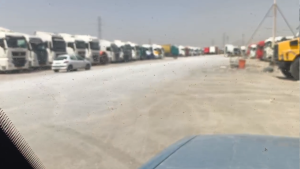
The suspension of some exports has raised a fresh alarm about Iran’s foreign trade. The stranding of 2,271 trucks at the border has heightened these concerns. Transport industry representatives report slow customs procedures, inadequate infrastructure, and congestion caused by transit trucks.
Recent reports indicate that 2,271 trucks are waiting behind the Dogharoun border crossing to enter Afghanistan. Ehsan Malekzadeh, chairman of the board of the Iranian Association of International Transport Companies, announced this figure. He says truck waiting times at this crossing are exceptionally long. The situation shows that border delays remain one of the most significant obstacles to exports and the transit of goods through Iran.
Iran and Afghanistan trade in three areas: exports, imports, and transit. Shared border crossings between the two countries, including the Milak crossing, play an important role in these exchanges. Petroleum and gas derivatives account for a substantial portion of Iran’s exports to Afghanistan. By contrast, the volume of imports from Afghanistan is relatively low. As a result, the main pressure is concentrated on routes used to move goods out of Iran.
Iran’s Steel Giant in Crisis: Isfahan Steel Company Is Losing Money Even on Production
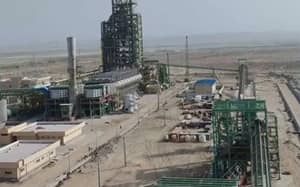
An examination of the financial statements and management report of Iran’s largest steelmaker shows that its net loss reached 93 trillion rials (approximately $15 million) over six months. These figures sound a serious alarm for this industrial giant. The problems are not limited to unfavorable conditions in the steel market. The report also raises concerns about the cost structure, production efficiency, and liquidity. These figures suggest that Isfahan Steel Company’s problems are not merely a temporary crisis.
Production has failed to reach even half of the targets in some key areas. The production targets for crude steel and finished billets were both met at a rate of 54%. Molten iron production reached 58% of the target. The figure was 29% for commercial billets and just 21% for rails. The largest gap between targets and actual performance was in rail production, which achieved only about one-fifth of its target.
Crude steel production has fallen by approximately 42% compared with the previous year. The central question is why a company with such extensive capacity has fallen so far behind its targets in its main production areas. The steel industry’s difficult conditions, energy restrictions, and problems securing raw materials are real. However, the financial data also point to other contributing factors. Reduced production leaves the company’s substantial capacity underutilized. Under these circumstances, fixed costs weigh more heavily on each unit of output.
Iran: The Role of Friday Prayer Leaders in Suppressing and Violating Civil and Human Rights
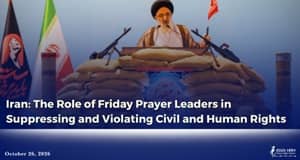
In the political architecture of the Islamic Republic of Iran, Friday prayer leaders serve as direct representatives of the Supreme Leader in various provinces and cities. Their position is defined such that the Friday prayer podium is recognized not as an independent space for worship, but as a “headquarters” (Ghararghah) and a critical pillar for political and security guidance of the country. An examination of the stances taken by Seyyed Mohammad-Mehdi Hosseini Hamedani as Karaj’s Friday Prayer Leader illustrates how public pulpits and state budgets are utilized to disseminate hate speech, curtail fundamental freedoms, and demand state-sponsored crackdowns on civic activists and dissidents.
Section 1: The “Headquarters” Doctrine and Militarization of the Cultural Sphere in Cognitive Warfare
In defining the function of the Friday prayer institution, Hosseini Hamedani strips it of any civil-religious identity, endowing it with a strictly security-political purpose. Referencing directives from the Supreme Leader, he emphasizes that Friday prayers “carry out an essential part of the Supreme Leader’s office operations.”
- Within this discourse, mosques are depicted as “frontline trenches” and the Friday prayer as a “headquarters” for designing, organizing, and directing macro-level social activities.
- By raising the concept of “cognitive warfare and the war of wills,” he claims that the enemy seeks to alter societal beliefs and consequently change public behavior, asserting that the Friday prayer leader’s duty is to confront opposing currents.
After 27 Ship Attacks in October, Iranian Media Debate Hormuz Pressure and Talks

As the highest number of attacks on commercial ships since the war began was recorded in the Strait of Hormuz, debate has intensified in Tehran over whether maritime pressure should continue until Iran’s conditions are met or be turned into leverage to open a path toward an agreement.
While the Strait of Hormuz has seen 27 attacks on commercial ships in October, and USNI News says Iran was responsible for the majority of them, two views remain prominent in Tehran over how this leverage should be used: continuing maritime pressure until the Islamic Republic’s conditions are met, or turning the position created in Hormuz into backing for an agreement and a means of preventing a longer war.
The debate is taking place as Iranian officials, according to reports in domestic media, have tied the full reopening of the strait and a return to negotiations to the fulfillment of seven conditions, while Russia, European countries and regional governments have also stepped up efforts to establish new diplomatic channels.
PMOI Supporters in Heidelberg Protest Iran’s Executions and Defend Political Prisoners
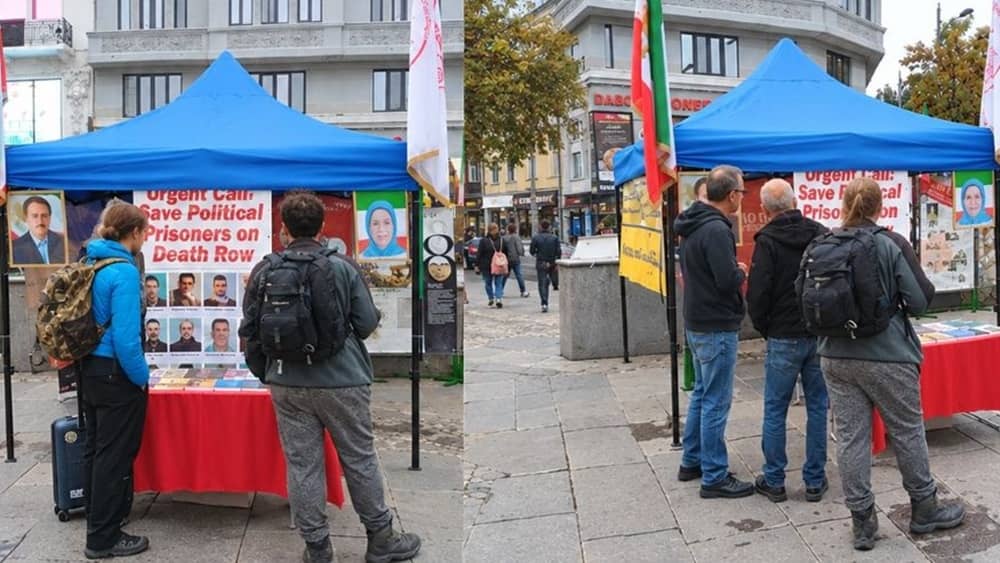
Heidelberg, Germany – October 24, 2026 – Supporters of the People’s Mojahedin Organization of Iran (PMOI/MEK) held a book table and photo exhibition in Heidelberg, condemning the Iranian regime’s ongoing use of the death penalty and drawing attention to political prisoners and protesters at risk of execution.

Participants urged the international community to take immediate and decisive action to save political prisoners and protesters arrested during recent protests who face execution. They called for swift measures to prevent further executions and effective international pressure on the Iranian regime to end its use of capital punishment as a tool of repression.
PMOI Supporters Rally in Stockholm Against Executions and All Forms of Dictatorship, Back Resistance Units in Iran
Stockholm, Sweden — October 24, 2026: Supporters of the People’s Mojahedin Organization of Iran (PMOI/MEK)
held a rally outside the Swedish Parliament in Stockholm. They protested human rights violations in Iran and called for urgent international action to stop executions.
The protesters also urged the international community to prevent death sentences against political prisoners from being carried out.

The demonstrators rejected all forms of dictatorship, both monarchical and theocratic. They opposed the rule of Iran’s former Shah as well as the current clerical regime.
They called for a democratic republic in Iran. They also expressed support for the National Council of Resistance of Iran (NCRI), which they described as a democratic alternative to the current system.
In addition, the participants voiced support for the struggle of the MEK’s Resistance Units inside Iran.
Bucharest Photo Exhibition Highlights Executions and Human Rights Violations in Iran
Bucharest, Romania – October 24, 2026 – Supporters of the People’s Mojahedin Organization of Iran (PMOI/MEK) organized a photo exhibition in Bucharest to draw attention to human rights violations in Iran and urge the international community to take immediate action to stop executions and prevent the enforcement of death sentences against political prisoners.
The exhibition drew attention to the ongoing detention of protesters arrested during Iran’s January 2026 uprising, as well as the executions of political prisoners and the imminent threat of execution facing others. Participants stressed the urgent need for international intervention to prevent further executions.

The event called for the complete abolition of the death penalty in Iran and the immediate release of all political prisoners and detainees, particularly those at imminent risk of execution. Organizers also urged the international community to take effective action and called for senior Iranian regime officials to be held accountable before an international tribunal for crimes against humanity.