
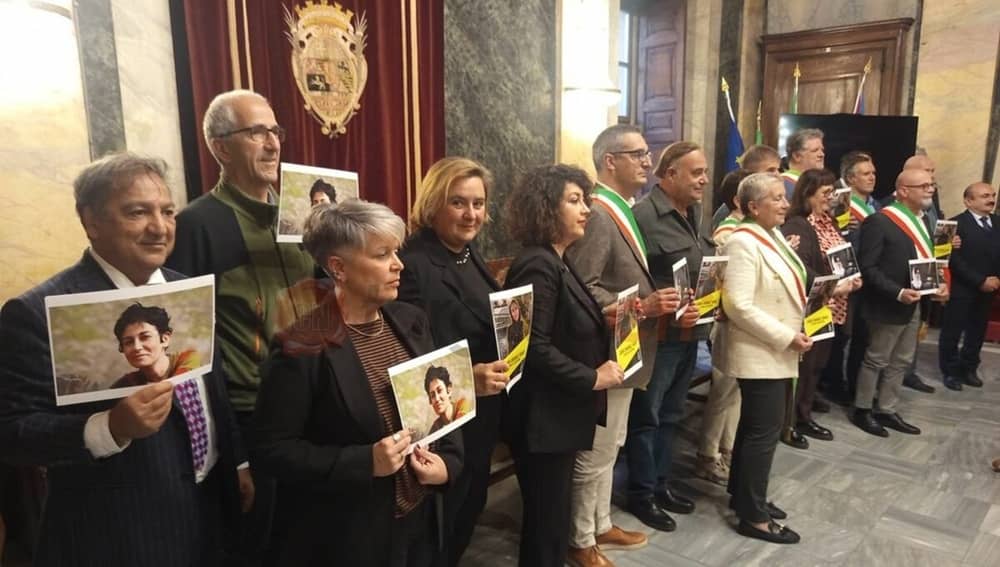
CUNEO, Italy, October 23, 2026 — Italian elected officials, former lawmakers, representatives of the National Association of Italian Partisans (ANPI), human-rights advocates and members of the Iranian community gathered at Cuneo City Hall for a conference titled “No to Executions, Yes to Resistance,” condemning the escalating use of capital punishment in Iran and expressing support for an Iranian-led democratic transition. Speakers drew parallels between Italy’s anti-fascist Resistance and the struggle against dictatorship in Iran, while highlighting political prisoners, women, young people and the organized Resistance inside the country.
Mrs. Maryam Rajavi, President-elect of the National Council of Resistance of Iran (NCRI), sent a video message to the conference, calling the growing use of executions a sign of the clerical authorities’ vulnerability rather than strength. The gathering also rejected both foreign military intervention and a restoration of the former monarchy, with speakers arguing that Iran’s future should be determined through popular sovereignty and an organized domestic movement for democratic change.
Mrs. Rajavi recalled Cuneo’s longstanding relationship with the Iranian Resistance, including its decision in 2008 to establish a sister-city relationship with Camp Ashraf, then home to thousands of PMOI members in Iraq.
“Today, Cuneo stands with the people of Ashraf and with the Resistance Units,” she said. “It stands with the protesters in Iran, whose blood has covered the streets, and Cuneo stands with the long line of people sentenced to death.”
Mrs. Rajavi said executions of political prisoners had accelerated since the latest war, including the execution of nine members of the People’s Mojahedin Organization of Iran (PMOI/MEK), while many other detainees had received death sentences or faced trials that could lead to execution. She cited the case of 25-year-old political prisoner Arghavan Fallahi, who she said had been sentenced to death primarily over support for the PMOI after months of torture.

The NCRI President-elect argued that the escalating repression revealed the authorities’ fear of society.
“If this regime had any stability, it would not resort to these executions,” she said. “However, these atrocities will not save them from being overthrown. Nor can they terrorize Iranian society, especially the brave youth. They cannot discourage the people who are fighting for a democratic republic. They cannot crush the flames of resistance.”
She placed particular emphasis on the Resistance Units operating inside Iran. “Today, more than ever, Resistance Units are striking against the centers of repression. Rebellious youth have risen to confront the Revolutionary Guard Corps. Workers, students, nurses, and retirees are expanding their protests,” Mrs. Rajavi said.
Despite decades of killings, imprisonment and successive crackdowns, she argued, “an organized resistance continues to advance inside the cities of Iran.” Mrs. Rajavi said the goal was a future in which there was room for “neither religious nor monarchical dictatorship.”
Turning to European policy, Mrs. Rajavi described the clerical system as weaker than ever and accused proponents of appeasement of accepting Tehran’s portrayal of itself as durable and without an alternative.
“In truth, there is only one solution to the disasters this regime causes for Iran, the region, and the world—and that is its overthrow by the people of Iran and their organized resistance,” she said.
Mrs. Rajavi called on the Italian government to make relations with Tehran conditional on stopping executions and urged Italy and the international community to recognize both the Iranian people’s struggle for political change and the struggle of rebellious youth against the IRGC.
Message to the Conference at the City Hall of Cuneo, Italy
If the clerical regime in Iran had any stability, it would not resort to executions.
It is time for Italy and the entire world to recognize the Iranian people's struggle to overthrow the regime, as well as the fight of… pic.twitter.com/vDtV98Ld8L— Maryam Rajavi (@Maryam_Rajavi) October 23, 2026
Cuneo Mayor Patrizia Manassero, a former member of the Italian Senate, welcomed participants by emphasizing the city’s historic identification with resistance to dictatorship. She said the values of resistance, freedom and democracy were deeply rooted in the history of Cuneo and other municipalities represented at the conference, recalling Italy’s struggle against Nazi-Fascist dictatorship.
Manassero also recalled Cuneo’s decision in 2008 to recognize Camp Ashraf as a sister city, describing it as an expression of solidarity with Iranian Resistance members who had been forced from their country. “We continue to stand alongside this expression of your Resistance,” she said, referring to the movement represented at the conference.
Despite the distance separating Italy from Iran, Manassero said, local institutions could not remain indifferent to protesters facing imprisonment and execution. “We must nevertheless persist and stand beside you, hoping that the light of freedom can be seen as soon as possible,” she said.
Former Italian Senator Roberto Rampi, who also served in the Chamber of Deputies and as a member of the Italian delegation to the Parliamentary Assembly of the Council of Europe, drew a direct parallel between Italy’s partisan tradition and Iranians who had sustained political resistance over decades.
Rampi said Cuneo was particularly suited to host such a discussion because of its history as “the land of the Resistance.” He noted that some Iranians were resisting inside the country while others in exile had continued their struggle for more than four decades.
He also stressed the historical rejection of the Shah’s dictatorship, arguing that Iranians fighting today were part of a political tradition that had opposed monarchy before confronting clerical rule.
Italia – Cuneo: Il 23 ottobre, nel Salone d’Onore del Comune di Cuneo, si è svolta la conferenza «No alle esecuzioni, sì alla Resistenza», durante la quale è stato trasmesso un messaggio di Maryam Rajavi, presidente eletta del Consiglio Nazionale della Resistenza Iraniana.… pic.twitter.com/WqbregreZN
— mahmoud hakamian (@HakamianMahmoud) October 27, 2026
Senator Rampi strongly rejected foreign military intervention as the answer to the Iranian crisis. He said the NCRI and Iranian Resistance had consistently opposed externally imposed war because it would be counterproductive, and he described recent military intervention as disastrous both in human and political terms.
At the same time, he warned against allowing opposition to war to obscure the character of Tehran’s rule. Senator Rampi argued that neither hostility toward Western military policies nor geopolitical confrontation should turn the clerical authorities into an acceptable political ally.
Instead, he emphasized the Resistance’s endurance and organization.
“We can learn a great lesson from the Iranian Resistance,” Senator Rampi said. “They are friends whom we certainly must support, but from whom we also have much to learn, because for 40 years they have continued to struggle in an organized way, with perseverance and resistance.”
He pointed particularly to women’s extensive representation in the Resistance’s leadership as a practical demonstration that religious belief could coexist with commitment to a secular democratic state and full equality for women.
Lanzo Ruggiero, Vice President of ANPI in Cuneo, reaffirmed what he described as the organization’s longstanding support for the NCRI.
Ruggiero said ANPI’s commitment since 1945 had included maintaining solidarity between Italy’s partisan tradition and freedom movements in other countries.
“The ANPI of Cuneo could not and cannot do anything other than give its full support to the National Council of Resistance of Iran,” he said. “It gave that support in the past, confirms it today and will support it tomorrow as well.”
Message to the Conference at the City Hall of Cuneo, Italy
The mullahs have committed countless crimes to stay in power; from the massacre of 30,000 political prisoners in 1988 to the repeated slaughter of protesters during recent uprisings.
These very crimes are certain proof… pic.twitter.com/KWbIKpN65o— Maryam Rajavi (@Maryam_Rajavi) October 23, 2026
He endorsed Mrs. Rajavi’s Ten-Point Plan, saying its commitments to democratic government, popular sovereignty, universal suffrage, pluralism, secularism, justice and peace were compatible with the principles of Italy’s anti-fascist Constitution.
Ruggiero also focused on executions, describing capital punishment in Iran as an instrument to instill fear, repress dissent and target those considered hostile to the authorities. ANPI, he said, would continue raising the cases of detainees threatened with execution and urging the Italian government, European institutions and the international community to respond.
Drawing again on Italy’s own experience, he concluded that the responsibility of later generations was to preserve the legacy of those who defeated fascism. “From the lesson of our partisan brothers, we hope that the Iranian Resistance will restore democracy and civilization to its people,” he said.
Cuneo City Council member Claudia Carli, who opened the conference, said the city had repeatedly taken bipartisan positions on Iran, including unanimous council action in 2022 and 2024 condemning repression, executions and serious human-rights violations.
Carli said the worsening situation made renewed attention necessary rather than ceremonial. She described executions without genuine due process as a means of frightening society and preventing organized uprisings.
Before introducing the speakers, she summarized the Ten-Point Plan advocated by the Iranian Resistance: a democratic republic, freedom of expression and association, human rights and abolition of capital punishment, separation of religion and state, full gender equality, an independent judiciary, minority rights, economic justice, environmental protection and a non-nuclear Iran. The conference, she said, was intended to reinforce those principles.
Mahmoud Hakamian, a member of the NCRI Foreign Affairs Committee, said executions should be viewed alongside continuing resistance in prisons, among women and young people, and during popular protests. He cited figures indicating that 1,186 executions had taken place since the beginning of 2026 and said nearly 50 political prisoners had been executed since the start of the latest war, nine of them PMOI members.
He argued that international policy should go beyond condemnation and recognize the Iranian population’s right to political change.
“In this context, the existence of a democratic and organized alternative assumes decisive importance,” Hakamian said, describing a Resistance present both abroad and “inside the country through the Resistance Units of the People’s Mojahedin.”
Hakamian rejected both continuation of the existing system and restoration of the former monarchy.
“The future of Iran must be neither the continuation of the religious dictatorship nor the return of the monarchical dictatorship of the past,” he said. “Political legitimacy must be founded on one principle alone: the free vote of the Iranian people.”
"No alle esecuzioni, sì alla resistenza": Cuneo con il popolo iraniano [FOTO e VIDEO] – https://t.co/jQgMBBQe7a https://t.co/swhIsjsLP0
— Abdi Salimi (@salimi_abdi) October 24, 2026
He also criticized some monarchist groups and supporters of Reza Pahlavi for directing political energy against other opposition movements rather than against Tehran.
Hakamian concluded with a succinct formulation of the gathering’s political message: “No to executions, no to dictatorship, whether religious or monarchical, no to a return to the past; yes to freedom, popular sovereignty and a democratic and free Iran.”
Elham Nikzat, representing Democratic Iranian Women in northern Italy, focused on political prisoners and the “No to Execution Tuesdays” campaign. Speaking as an Iranian woman and mother of two, she said she wanted above all to give voice to those inside Iranian prisons who risked being permanently silenced.
Nikzat said the campaign, begun in January 2024, had reached its 143rd consecutive week by October 20 and, according to its organizers, included prisoners in 66 prisons. Each Tuesday, participating detainees refuse food in protest against capital punishment.
“Think of the courage of these people,” she said. “They are deprived of their freedom, some risk their own lives, yet they continue to fight for the right to life of others.”
She cited international solidarity with the campaign, including actions by UN special rapporteurs Gina Romero and Mai Sato, and connected opposition to executions with women’s equality.
“There can be no real democracy without equality between women and men, and there can be no real justice without respect for the right to life,” Nikzat said.
She called on Italian and European institutions to seek an immediate moratorium on executions, the release of political prisoners detained for peacefully exercising their rights and accountability for serious human-rights violations. She also rejected both religious and hereditary dictatorship, insisting that Iran’s future must be determined by its own people.
Finally, Dr. Khosrow Nikzat, president of the Association of Iranian Doctors and Pharmacists Residing in Italy, addressed the political question underlying the conference: what force could actually bring change to Iran.
Dr. Nikzat rejected the assumption that external bombing would overthrow the clerical system. Whatever the military consequences of foreign attacks, he argued, they had not produced democratic political transformation. Nor, he said, had four decades of accommodation and dialogue delivered the hoped-for change in Tehran’s conduct.
The decisive factor, he argued, was the Iranian population itself—but popular discontent had to acquire organization.
“Only and exclusively the Iranian people can change things, and only and exclusively an organized uprising can change things,” Dr. Nikzat said. “We have seen throughout all these years how unorganized uprisings end.”
For that reason, he said, “an organization such as the Iranian Resistance, which is capable of channeling the uprisings in the right direction, is indispensable and therefore must be supported.”