
Three-minute read
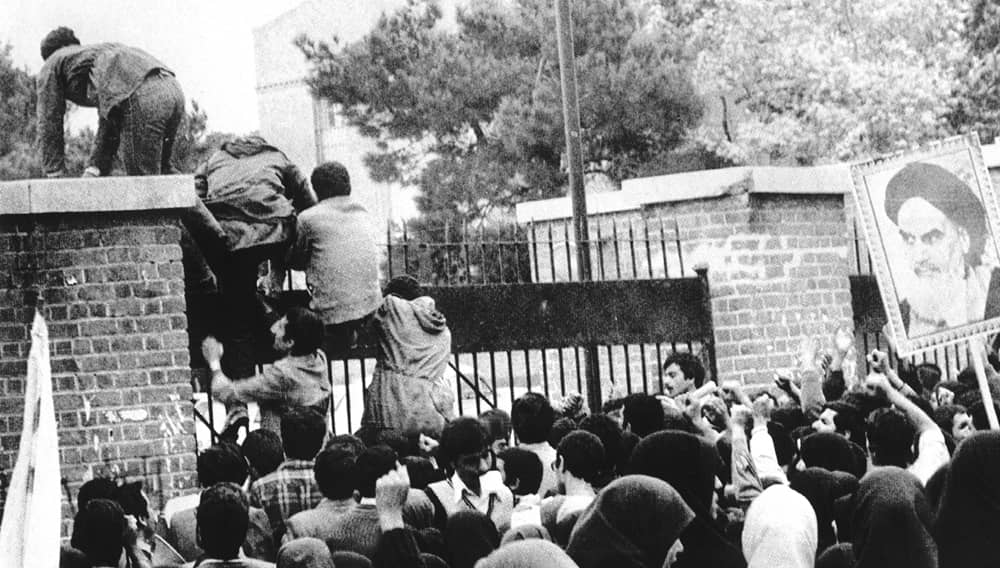
Every November 4, the clerical dictatorship reenacts its founding mythology: pro-regime students storming the U.S. Embassy in 1979, Khomeini confronting the “Great Satan,” and a supposedly unified nation beginning an uncompromising struggle against America.
Mojtaba Khamenei returned to that script this week. He divided the world between a “Front of Truth” and a “Front of Falsehood,” inserted the People’s Mojahedin Organization of Iran (PMOI/MEK) into his catalogue of American conspiracies, and declared that “unity, solidarity and social cohesion” must govern Iranian society.
The message was not merely about Washington.
It was about Iran.
How Khomeini Turned America into a Domestic Weapon
The official story conveniently omits what happened before the embassy seizure.
Declassified U.S. cables show that Washington opened a direct channel to Khomeini’s entourage in Paris on January 15, 1979, while simultaneously encouraging discussions between Iran’s military leadership and Khomeini’s representatives.
Meet the hostage-takers who now run #Iran's government
Read more: #NCRI Special Report – US Embassy Hostage Takers Now Hold Top Positions in Iran's Regime: https://t.co/Ew3ZI9GzFj#NoImpunity4Mullahs pic.twitter.com/4xRSB4jzWb
— NCRI-FAC (@iran_policy) November 4, 2019
On January 27, Khomeini himself sent Washington a private message saying his proposed Islamic Republic bore no “particular animosity” toward Americans and promising that his leadership could restore stability.
Whatever one concludes about American policy during the revolution, those records demolish the simplistic mythology that Khomeini’s movement came to power through an uninterrupted confrontation with Washington.
The political usefulness of anti-Americanism came afterward.
When militants seized the embassy on November 4, Prime Minister Mehdi Bazargan opposed them and resigned within days. Encyclopaedia Iranica records that material taken from the embassy was selectively used to portray political opponents as American collaborators and that Khomeini exploited the crisis to marginalize liberal and secular rivals while consolidating the new theocratic order.
It was an extraordinarily effective trap: accept Khomeini’s radical course—or risk being branded Washington’s agent.
Iranian statecraft has been recycling that device ever since.
Why Mojtaba Needs the Same Formula
Mojtaba Khamenei’s invocation of November 4 comes at a moment when the state faces something much more dangerous than American rhetoric: a deeply discontented society at home.
Protests continue among retirees, workers, students and other social groups. On November 2 alone, reports from inside Iran showed demonstrations by telecommunications retirees across numerous cities, alongside other protests and strikes; demonstrators included the striking slogan: “Our enemy is right here; they lie that it is America.”
In negotiations, weak concessions beget strong demands. When dealing with the most active state sponsor of #terrorism, weakness begets more #hostage-taking and the spread of terror. https://t.co/ieaaOkZb6y
— NCRI-FAC (@iran_policy) April 26, 2023
The response has been escalating repression.
Amnesty International reported on October 16 that authorities had arbitrarily executed at least 34 people arrested in connection with the January uprising after grossly unfair, torture-tainted trials, while at least 20 others had had death sentences upheld.
The NCRI’s more recent tally illustrates the wider scale. By late October, it reported 1,186 executions since the beginning of 2026, including nearly 50 political prisoners executed since the outbreak of the latest war, nine of them PMOI members. The toll has continued to rise.
The regime is simultaneously keeping its own constituency permanently mobilized. The Basij publicly celebrated 200 consecutive nights of pro-government street deployments in September and announced that they would continue for as long as the interests of the system required.
That is not the behavior of a confident state.
What Tehran Remembers About Organized Resistance
Recent remarks from regime veterans expose another layer of concern.
Ahmad Alamolhoda, Khamenei’s representative in Mashhad, recently recalled that during the early confrontation with the MEK, its operations had become so extensive that security officials were losing morale and sought Khomeini’s intervention to stiffen their resolve.
Another state-television discussion acknowledged the MEK’s historic disclosure of secret nuclear activities and complained about the opposition’s access to information from inside the establishment.
What to Make of Recent Remarks from Former #IRGC Commander on #US Embassy Hostage Takinghttps://t.co/GHHejwBU6x
— NCRI-FAC (@iran_policy) August 23, 2023
Those admissions illuminate the regime’s strategic fear.
Mass anger by itself can be suppressed. An underground organization by itself can be hunted.
What becomes potentially explosive is their convergence: a society repeatedly entering the streets alongside an experienced Resistance network capable of organization, continuity and sustained operations.
The MEK Resistance Units carried out 90 actions across Tehran and 24 other cities on November 2, including attacks on Basij and IRGC facilities and anti-regime graffiti.
But Tehran’s own rhetoric supplies the larger evidence.
Forty-seven years ago, Khomeini used America to divide a revolution, destroy political rivals and consolidate clerical rule.
Today his successor again speaks obsessively of America, the MEK and “social cohesion” while protesters fill the streets, executions accelerate and the state keeps its loyalists permanently mobilized.
The propaganda points outward. The fear driving it is inside Iran.