
Three-minute read
Telecommunications retirees demonstrated across Iran on Monday, November 16, joining protests by shopkeepers, students and housing applicants as worsening economic conditions fuel public anger. The demonstrations coincided with mounting controversy over gasoline restrictions, with lawmakers openly warning that further pressure on motorists could trigger social unrest.
Retirees and Workers Protest Across Iran
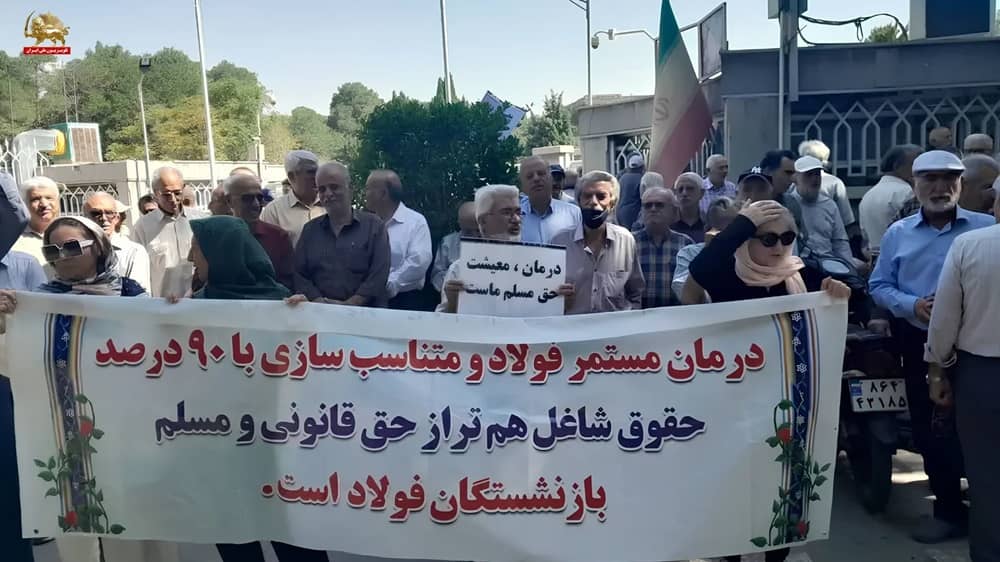
Telecommunications retirees gathered in Kurdistan, Kermanshah, Hamedan, Borujerd, Ilam and Tehran, protesting unpaid benefits, pension discrimination and the management of their retirement funds.
Demonstrators accused institutions affiliated with the Islamic Revolutionary Guard Corps and the Execution of Imam Khomeini’s Order of appropriating their entitlements. In Borujerd, protesters chanted, “We built telecommunications; the IRGC took it, and we lost.”
Additional protests were reported among shopkeepers in Sanandaj, university students in Yazd over poor food, and National Housing Movement applicants in Neyshabur.
Iran, Nov. 13: Fuel-card restrictions expand toward nationwide implementation. Cement workers report up to seven months of unpaid wages, bakeries face flour cuts, #women remain denied motorcycle licences, and Tehran officials acknowledge losing up to 45% of trees in a major…
— NCRI-FAC (@iran_policy) November 13, 2026
Separately, ILNA reported on November 16 that municipal workers in Ilam had protested the previous day over nearly two months of unpaid wages, missing insurance contributions and continued reliance on intermediary contractors.
Gasoline Restrictions Expose Fears of an Uprising
Reports from several cities described prolonged gasoline queues, disrupted filling stations and growing frustration over access to fuel.
Citizen accounts documented motorists waiting for hours in Mamasani, Iranshahr, Fasa and Dehloran. Earlier footage showed protests near filling stations in Bandar Abbas and Kazerun.
The political sensitivity of the issue was exposed by lawmakers’ unusually explicit warnings. During Sunday’s parliamentary session, MP Aliabadi declared: “Don’t play with gasoline. By God, this gasoline will set the country on fire.”
On Monday, MP Gholamhossein Zarei called for suspending the withdrawal of emergency fuel cards, warning of social consequences.
"#Women make up approx. 64% of university applicants, yet barely one in seven participates in Iran’s labor market. The contradiction is not merely social discrimination. It is the destruction of human capital on a national scale," writes @SaforaSM https://t.co/fg7WBiayQ3
— NCRI-FAC (@iran_policy) November 14, 2026
More significantly, a November 16 report exposed contradictory official gasoline figures. The Audit Court cited daily production of 131.5 million liters against consumption of 128.5 million, while parliamentary energy-committee figures put production closer to 115 million liters.
The discrepancy raises questions about the justification for increasingly restrictive fuel policies. Subsidized personal-card quotas have not been universally abolished.
Factional Conflict Reaches State Broadcasting and Judiciary
Factional disputes intensified over the regime’s approach to negotiations and control of political institutions.
In an interview published by Ham-Mihan, Ebrahim Rasouli, political adviser to Parliament Speaker Mohammad Bagher Ghalibaf, attacked Saeed Jalili and allied hardliners for opposing the Islamabad understanding and exploiting their political setbacks.
He also challenged the leadership of state broadcaster IRIB, accusing it of promoting factional confrontation and asserting that dissatisfaction with its management extended across political camps.
"The Iranian regime’s internal disputes are no longer confined to familiar factional sniping. They are spreading across the institutions that matter most to the survival of the ruling system: the intelligence apparatus, state broadcasting, the #nuclear and war files, and the…
— NCRI-FAC (@iran_policy) November 12, 2026
In a separate editorial, the hardline newspaper Kayhan attacked Mohsen Hashemi’s arguments for political cohesion and de-escalation. It went further, demanding judicial action against figures and regime insiders it accused of encouraging concessions and weakening the establishment.
The exchanges reveal competing strategies for preserving the regime, with rival factions increasingly questioning one another’s loyalty and legitimacy.
Economic Crisis Forces Families to Buy Food on Credit
In a report published Sunday, Donya-ye Eqtesad described how installment purchases have spread from expensive consumer goods to food, hygiene products and everyday necessities.
With Central Bank inflation reported at 83.5%, the newspaper said households were increasingly spending future income to survive. Installment-order values rose 103% in 2025, while the number of users with purchasing credit exceeded 10.5 million.
"A society can endure for years without accepting the conditions imposed on it—but when accumulated anger finally breaks through, the result may be sudden, nationwide and far harder to contain," @MansoreGolestan writes.https://t.co/BYM0Pzydhe
— NCRI-FAC (@iran_policy) November 15, 2026
Economic researcher Samaneh Golab warned that hardship had become more severe than during January’s protests, describing public discontent as “fire beneath the ashes.”
Another disclosure revealed that monthly diabetes-treatment expenses had risen from approximately 1.2 million to 6.9 million tomans in a year. Essential insulin-pen needles and blood-glucose test strips have also become substantially more expensive.
Repression and Security Incidents
Human-rights sources reported that authorities had rejected teacher Kokab Badaghi Paga’s request for retrial, while separate cases involved prison sentences against a Bahá’í woman and a former protest detainee. These decisions were reported on November 15.
Meanwhile, Mehr reported the killing of Najim Shahbakhsh, a local Basij member, by unidentified gunmen in the Kourin area of Zahedan on November 15. The attackers’ identities and motives remain unknown.
"The logic of Tehran’s political #economy: protect the institutions that defend the ruling order, preserve the regional and military projects the state considers strategic, and make households absorb a greater share of the cost of economic failure," writes @shahriarkia…
— NCRI-FAC (@iran_policy) November 16, 2026
Tehran’s Pollution Crisis Continues
Tehran’s air-quality index reached 193 on November 15, placing it in the unhealthy category and second in a contemporary international city ranking.
The renewed pollution crisis follows domestic findings that only a small fraction of Iran’s Clean Air Law obligations has been implemented, reflecting years of failure to address major pollution sources.
The regime’s growing difficulty is not simply the accumulation of economic grievances, but the political consequences of its inability to contain them. Even lawmakers within the establishment now openly warn that another gasoline shock could ignite unrest, while domestic economic researchers describe public dissatisfaction as a fire waiting to erupt.
The simultaneous escalation of factional disputes compounds that danger. Rather than projecting the cohesion needed to confront an increasingly discontented population, rival power centers are openly challenging each other’s authority and legitimacy. The leadership faces mounting pressure from below precisely as its own institutions struggle to maintain unity from above.