

Four-minute read
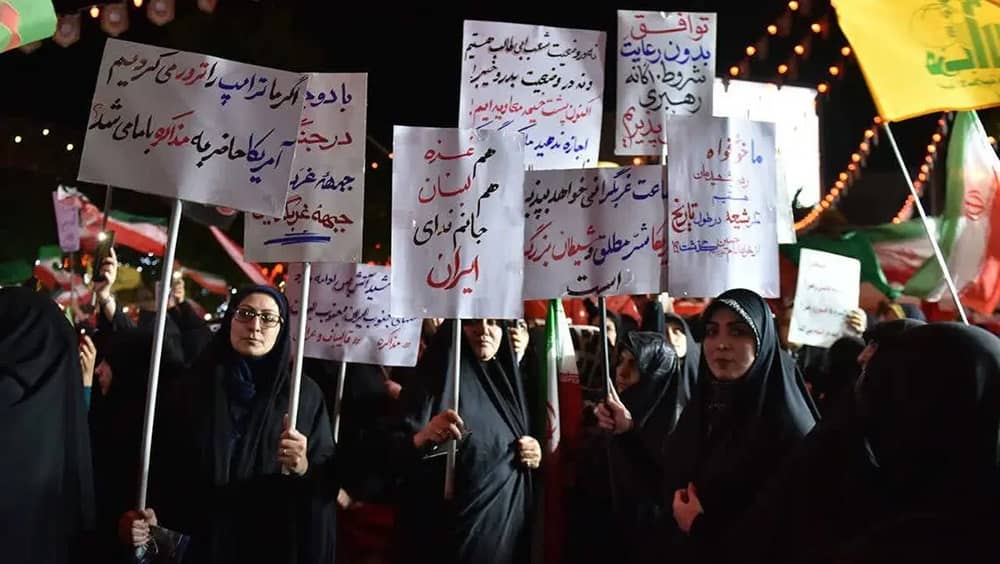
For more than 260 consecutive nights, the Iranian regime has maintained a conspicuous presence in the streets and squares of major cities. What once occurred primarily on official anniversaries and orchestrated political occasions has become a routine deployment of loyalists, Basij networks, and regime-affiliated organizations. Behind the flags, religious ceremonies, and carefully staged displays lies a strategy with multiple audiences but one overriding objective: preventing the Iranian people from reclaiming the streets.
The regime itself has provided revealing evidence of this strategy.
On September 15, Judiciary Chief Gholam-Hossein Mohseni-Ejei celebrated the 200-night mobilization, declaring that supporters had “seized the squares and streets” across the country. He called their presence a “200-night street exercise” and claimed it had “destroyed the enemy’s calculations.”
Two days later, the Basij organization announced that its supporters would remain in the streets “for as long as necessary and the interests of the regime require.”
The determining factor is not a national holiday, a spontaneous public demand, or even the continuation of hostilities. It is the regime’s calculation of what its survival requires.
Fuel shortages spark unrest, retirees and workers protest across multiple cities, and parliament advances penalties against cooperation with Persian-language media. The intelligence-minister dispute persists as lawmakers warn of worsening #inflation. Twelve oil workers die in a…
— NCRI-FAC (@iran_policy) November 16, 2026
The Principal Enemy Is at Home
The most important audience is the Iranian population.
From the nationwide uprisings of 2017–2018 and 2019 to the 2022 revolt and the bloody uprising of January 2026, repeated confrontations have demonstrated the depth of popular rejection of clerical rule.
The regime knows what happens when public anger acquires a collective presence. During the January uprising, security forces perpetrated mass killings. State television subsequently broadcast images of rows of body bags, providing a terrifying visual reminder of the crackdown.
But mass killing did not eliminate the underlying causes of revolt.
On November 16, Reuters reported that senior Iranian and security officials feared worsening economic hardship and winter energy shortages could fuel renewed unrest. One senior official likened public discontent to a fire smoldering beneath ashes.
The regime also faces organized opposition. The People’s Mojahedin Organization of Iran (PMOI/MEK) has developed Resistance Units that reported 4,092 anti-repression operations and 13,133 other activities across Iran’s 31 provinces in 2025. In July, IRGC spokesman Hossein Mohebbi warned of renewed organization by the PMOI and other opponents, fearing another uprising resembling January’s.
This is the strategic logic behind the permanent street presence: occupy potential gathering points, maintain a ready-made apparatus of intimidation, and prevent widespread anger from developing into an organized uprising.
Must-Read enlightening analysis of the impact of the MEK @ResistanceUnits inside Iran: "The Illusion of the External Enemy: How Domestic Agency is Redefining Iran's Future"https://t.co/59ZIkRUIwn@realDonaldTrump @SecRubio @mattgaetz @jaketapper
— Ali Safavi (@amsafavi) July 13, 2026
Reassuring an Exhausted Apparatus
The second audience consists of the regime’s own forces.
Military losses, regional setbacks, economic deterioration, and widespread public hostility have placed the ruling establishment under extraordinary pressure. For security personnel, Basij members, and allied networks, the question is not merely whether the regime can fight, but whether it can survive.
Nightly mobilization seeks to answer that question through repetition: the leadership remains, the command structure functions, and the regime still controls public space.
The Basij’s September statement explicitly claimed that street gatherings had strengthened the morale of officials and the country’s security forces. This is more than propaganda. It is a mechanism for preserving cohesion, testing mobilization capacity, and sustaining confidence among those whose loyalty is essential to the regime’s survival.
Mojtaba #Khamenei inherited a regime engulfed in crises his father long delayed confronting. With less authority, questioned health, and rising factional infighting, he faces the same unresolved strategic choices. His statement on the MOU—revealing he held a different view but…
— NCRI-FAC (@iran_policy) July 14, 2026
A Weapon Against Dissent Within the Regime
The third audience is the ruling establishment itself.
Street gatherings have increasingly served as instruments of factional intimidation. During disputes over negotiations with Washington, hardline demonstrators chanted “Death to compromisers” and directed threats and abuse toward Foreign Minister Abbas Araghchi and Parliament Speaker Mohammad Bagher Ghalibaf.
The danger became sufficiently pronounced that Nour News, affiliated with the Supreme National Security Council, warned that inflammatory slogans against current and former officials represented a troubling political development.
The implication is clear: any faction contemplating accommodation with the West must reckon not only with institutional opposition but also with mobilized hardliners capable of turning the streets against it.
Urgent: Protests & uprising in Abdanan, western Iran. Crowds chant “Death to the Dictator.”
A clip claiming “Pahlavi Will Return” / “Long Live the King” is fake (audio edited). People are rising against the dictatorship. Some are trying to usurp it. Original video below.… pic.twitter.com/oHPUpUFXN8
— Shahin Gobadi (@gobadi) November 17, 2026
A Message Beyond Iran’s Borders
The fourth audience is foreign. Following devastating military strikes and strategic setbacks, Tehran wants Washington, Israel, and other adversaries to believe that its domestic foundations remain intact and that any effort to overthrow it would encounter domestic resistance.
In October, the regime expanded its Jan-Fada military training campaign, opening public training centers and organizing so-called “new battalions.” Basij officials explained that volunteers were being prepared to enter the operational cycle, while the army assigned training facilities to the initiative.
But this spectacle should not be mistaken for genuine popular support, much less a willingness to fight and die for the regime. Many of those drawn to these gatherings by free meals and material assistance are themselves victims of the poverty and economic devastation the ruling establishment has inflicted on Iran. Investigations have documented food distribution financed through pressure on local businesses, while an Interior Ministry security official acknowledged the operation of 115 Iraqi-run service stations at regime gatherings.
Mojtaba Khamenei calls Iran the world’s “fourth superpower”—even No. 1 by “divine calculations.” Yet #IranProtests persist across the country, the rial is at record lows, inflation is called a security threat, critics are jailed, social restrictions tighten, factional battles…
— NCRI-FAC (@iran_policy) September 29, 2026
The Paradox of Permanent Mobilization
Yet the strategy exposes a fundamental contradiction.
A state confident of its stability does not need to demonstrate its control of public squares every night. Nor can permanent mobilization indefinitely compensate for collapsing purchasing power, political alienation, and the exhaustion of its own forces.
The regime can occupy intersections, deploy militias, and fill squares with loyalists. But occupying public space is not the same as commanding public allegiance.
The street has become the decisive battlefield because it is where the regime’s machinery of repression confronts the Iranian people’s determination for change. Tehran’s relentless effort to hold it reveals not the disappearance of the threat of uprising, but how deeply that threat governs the regime’s strategy of survival.