
THIS PAGE WILL BE UPDATED WITH THE LATEST NEWS
UPDATE: 7:30 AM CET
Anti-Regime Protests Erupt in Abdanan After Tragic Bus Accident
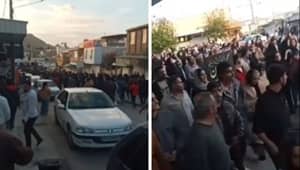
On Tuesday, November 17, 2026, the city of Abdanan in Ilam province returned to the forefront of popular confrontation in Iran as residents staged mass protest rallies condemning the incompetence and systemic corruption of state officials following a catastrophic bus rollover that killed 13 young oil company workers and injured scores of others.
Simultaneously, the aviation sector witnessed a second protest rally within a single month by retirees of Iran Air (“Homa”) defending their healthcare, insurance, and livelihood entitlements.
The tragic deaths of 13 young oil workers in Abdanan rapidly transformed from a deadly road accident into a citywide movement of outrage and solidarity. Residents took to the streets to hold regime officials directly accountable for the carnage, emphasizing that these young men were not victims of an unavoidable accident, but casualties of systemic neglect, official incompetence, and dilapidated transport infrastructure in a province sitting atop vast oil and gas reserves.
The mass solidarity across Abdanan demonstrated that the loss of 13 young men in the prime of their lives is not merely a private grief borne by their bereaved families, but a collective wound shared by the entire city. Standing shoulder to shoulder, residents raised a defiant message against the ruling authorities: “The lives of our youth are an inviolable public right; no other mother must be left mourning because of the irresponsibility and corruption of officials.”
Sara Mousighi at Risk in Qarchak Prison

Sara Mousighi, a 42-year-old political prisoner held in Qarchak Prison, is facing a deteriorating physical and psychological condition after reported sexual torture, physical abuse, and months of denial of medical treatment.
An architect and mountaineer, Sara Mousighi has been imprisoned since May 2026. Her case once again highlights the situation of women political prisoners in Iran, who are often subjected to abuse, medical neglect, and systematic pressure inside the prisons of the misogynistic clerical regime.
During detention and interrogation, Sara Mousighi was reportedly subjected to physical violence and sexual abuse, leaving her with internal injuries as well as serious damage to her back, arm, and shoulder.
Despite her urgent need for medical care, prison authorities reportedly prevented her transfer to medical facilities and forensic specialists for several months. Reports indicate that the delay was intended to allow evidence of torture and sexual abuse to disappear.
The physical and psychological consequences of torture and medical neglect have become so severe that Sara Mousighi has reportedly warned prison authorities about the possibility of harming herself in protest of continued denial of treatment.
Buying Bread on Credit: How Iran’s Economic Crisis Is Pushing Families Into Debt Just to Survive
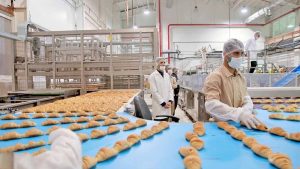
A society in which people must borrow money to buy bread and basic food is confronting more than an inflation crisis. It is experiencing the erosion of basic economic security. Across Iran, the expansion of installment purchases for groceries, food, and even hygiene products reveals how far the cost-of-living crisis has penetrated household budgets. For millions of families, credit is no longer a means of financing major purchases or improving their standard of living. It has become a way to get through the month. State media have reported that the Central Bank’s inflation figure has reached 83.5 percent, while the value of installment purchases increased by 103 percent in the Iranian year 1404 (March 2025–March 2026). The number of users with access to purchasing credit has also exceeded 10.5 million.
These figures should not be interpreted simply as evidence of growth in the consumer-credit market. They reveal a fundamental deterioration in purchasing power. When households cannot cover the cost of ordinary necessities with their current incomes, they are forced to transfer today’s expenses into tomorrow’s debts. Money that has not yet been earned is already committed to food that has already been consumed.
Pahlavi Urged Foreign Powers to Bomb Iran. Who Chose Him to Speak for Iranians?
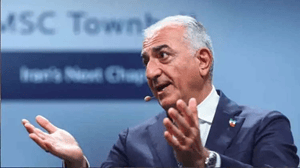
Reza Pahlavi’s November 7, 2026, speech in Frankfurt presented a carefully framed account of his position on military intervention in Iran. Accepting the Friedrich Naumann Foundation’s Freedom Prize, he said he had long opposed both appeasement and war, advocating instead a “third path” of maximum pressure on Iran’s regime and maximum support for the Iranian people. He added that only after the January 2026 killings did he and his associates reluctantly conclude that military pressure on the regime’s repressive apparatus might be necessary.
But Pahlavi’s earlier public statements tell a different story. His remarks during and after the June 2025 conflict, followed by his statements in March and May 2026, raise a straightforward question: how does his claim to have opposed war until January 2026 fit with his earlier description of military action as an opportunity for regime change and his subsequent appeals to continue the campaign?
The issue is not whether Iran’s regime should be held accountable for its repression, or whether the Iranian people have the right to determine their future. The debate is over whether political change in Iran should be brought about by Iranians themselves or through a war waged by foreign powers. Where does Reza Pahlavi stand on that question? Does his approach uphold the principle of national self-determination, or does it depend on such a war to bring about change?
Iran: Retirees, Workers, Truck Drivers, and Students Take to the Streets In New Wave of Protests
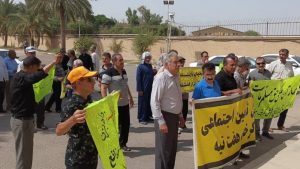
Protests by various segments of the population continued in dozens of locations across Iran on Sunday and Monday, November 16 and 17. Retirees, municipal workers, truck drivers, shopkeepers, students, and applicants for the government’s National Housing Plan staged gatherings and marches in different cities to protest poverty, rising prices, meager wages, livelihood difficulties, and officials’ disregard for their demands.
Over the past two days, a new wave of protests in Iran has involved a broad range of social groups. Reports indicate that Social Security and steel-industry retirees gathered in Tehran, Ahvaz, Isfahan, Kermanshah, Shush, and Rasht on Sunday, while protests by telecommunications retirees continued on Monday in Kurdistan, Kermanshah, Hamedan, Borujerd, Ilam, and Tehran.
On Sunday, November 15, steel-industry retirees in Isfahan gathered outside the provincial governor’s office, chanting, “High prices and inflation are a scourge on the people,” and protesting their living conditions and the failure to fulfill commitments to adjust their pensions.
In Ahvaz, Social Security retirees and pensioners also gathered outside the organization’s provincial headquarters. Emphasizing the need for adequate livelihoods and healthcare services, protesters chanted, “Livelihood, dignity, and free healthcare are our inalienable rights.”
Iran’s Economy: War Is Not the Main Cause of Currency Price Hikes and the Economic Crisis
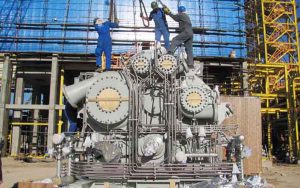
In the face of rising prices, including currency price hikes, the devaluation of the national currency, and the collapse of household purchasing power, Iran’s regime has consistently sought to attribute much of the responsibility to sanctions, foreign threats, and wartime conditions. There is no doubt that war and trade restrictions can affect the economy. However, the fundamental issue is that Iran’s economic crisis existed even before the war, and its roots lie in years of misguided policymaking, economic instability, budget deficits, and ineffective management. Remarks by Hossein Raghfar, a regime-affiliated economist and faculty member at Alzahra University, about the roots of currency price hikes and rising prices have once again raised the issue of the Iranian regime’s policymakers being held accountable for the economic hardship facing the population.
Raghfar says: “Currency price hikes have little to do with the war and the people’s resistance. It is clear that the war has a limited impact on rising prices, but all the price hikes and increases are the result of shock therapy and the government’s misguided policies.”
According to the World Bank’s October 2026 report, Iran’s economy was already facing deep-rooted structural problems before the outbreak of war, including decades of mismanagement, insufficient investment, macroeconomic instability, chronic inflation, devaluation of the national currency, corruption, and the plundering of resources by mafia networks affiliated with powerful institutions. The World Bank also emphasizes that the war has exacerbated these pre-existing vulnerabilities.
Iran Moves to Rewrite Hormuz Shipping Rules as Parliament Advances Control Plan

Iran’s parliament is preparing to consider legislation that could establish a new framework for managing the Strait of Hormuz, as Tehran seeks a more permanent role in regulating shipping through the strategic waterway following months of military confrontation with the United States.
The parliamentary National Security and Foreign Policy Commission has completed its review of the proposal, according to its spokesperson, Hassan Qashqavi, who said Iran and Oman had also reached an understanding concerning a navigational corridor.
The initiative comes as Tehran maintains conditions for reopening the strait and continues to dispute the terms of negotiations with Washington.
It raises a question extending beyond the immediate confrontation: who will determine the rules governing international shipping through Hormuz once the conflict subsides?
According to a November 16 report by Tasnim, the legislation, formally titled the Strategic Action Plan for Ensuring Security and Sustainable Development of the Strait of Hormuz and Persian Gulf, has expanded from an initial 14 articles to 16 following parliamentary revisions.
Toronto Rally Marks 2019 Iran Uprising Anniversary, Honors Fallen Protesters
Toronto, Canada – November 15, 2026: Supporters of the People’s Mojahedin Organization of Iran (PMOI/MEK) gathered at Queen’s Park in Toronto for a rally marking the seventh anniversary of the nationwide November 2019 uprising in Iran. The event paid tribute to those who lost their lives during the protests and reaffirmed calls for freedom, human rights, dignity, and justice in Iran.

Participants remembered the more than 1,500 protesters who were killed during the November 2019 uprising while courageously demanding freedom and fundamental rights. Although their voices may have been silenced, the speakers and attendees said, their aspirations continue to inspire the struggle for a free and democratic Iran.
The rally also condemned the Iranian authorities’ continued use of the death penalty and drew attention to the cases of political prisoners and protesters reportedly at risk of execution. Demonstrators called for an end to executions and for respect for the rights and dignity of all political prisoners in Iran.
Bern Rally Marks November 2019 Uprising, Renews Pledge to the Martyrs of the Iranian People
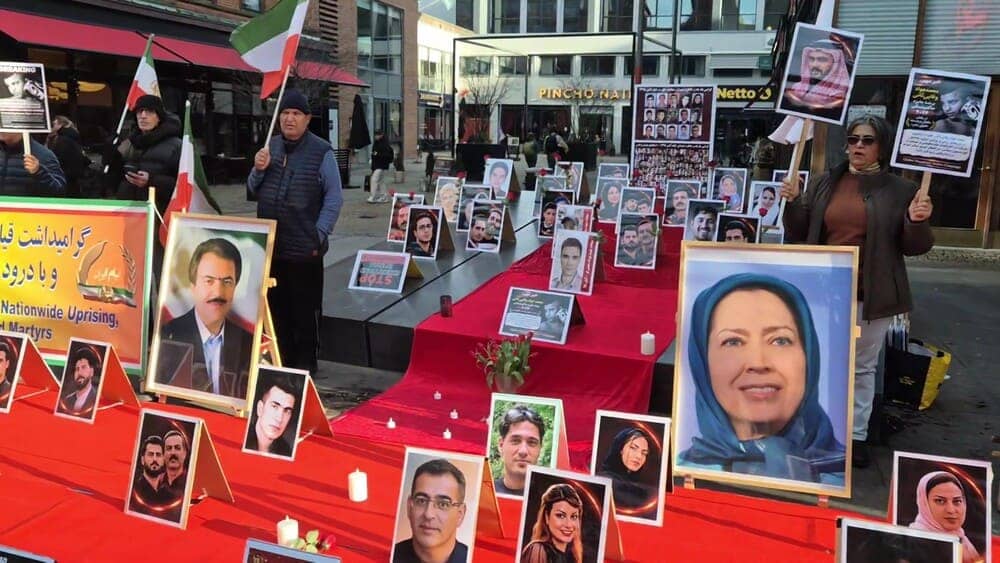
Bern, Switzerland – November 14, 2026 – Supporters of the People’s Mojahedin Organization of Iran (PMOI/MEK) held a rally featuring a photo exhibition and a book table in Bern to mark the seventh anniversary of the nationwide November 2019 uprising in Iran. The event honored those who lost their lives during the protests and called for an immediate halt to executions in Iran.
Participants renewed their pledge to the martyrs of the November 2019 uprising and Iran’s other popular uprisings, vowing to pursue justice for the victims until those responsible for crimes against humanity in Iran—the leaders of the mullahs’ regime—are held accountable. They also reaffirmed their commitment to supporting the Resistance Units of the PMOI and the Iranian people’s struggle to overthrow the clerical dictatorship.

The rally condemned the Iranian regime authorities’ continued use of the death penalty and drew attention to political prisoners and protesters at risk of execution. Demonstrators demanded respect for the rights and dignity of all political prisoners in Iran.
Vancouver Rally Marks 2019 Iran Uprising Anniversary, Calls for End to Executions
Vancouver, Canada – November 14, 2026: Supporters of the People’s Mojahedin Organization of Iran (PMOI/MEK) gathered in Vancouver to mark the seventh anniversary of the nationwide November 2019 uprising in Iran. The event honored those who lost their lives during the protests and called for an immediate end to executions, while reaffirming demands for freedom, human rights, dignity, and justice in Iran. The participants also rejected any appeasement of the mullahs’ regime and called for support for the Iranian Resistance.

Participants remembered the more than 1,500 protesters who were killed during the November 2019 uprising while courageously demanding freedom and fundamental rights. Although their voices may have been silenced, the speakers and attendees said, their aspirations continue to inspire the struggle for a free and democratic Iran.