

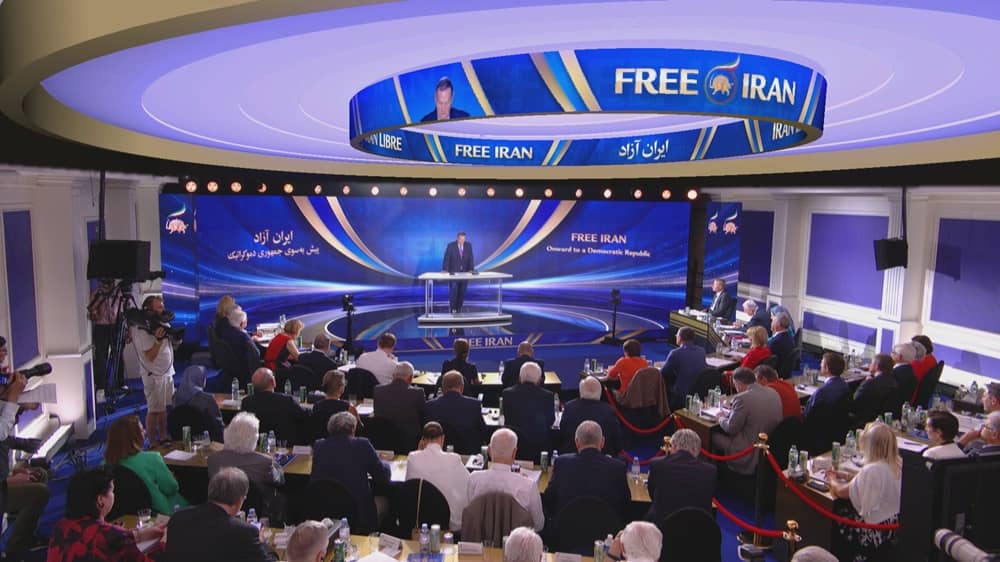
On June 21, at the second day of the Free Iran 2026 World Summit in Paris, General James L. Jones, former US National Security Advisor, delivered a poignant speech marking his 15th year of solidarity with the Iranian Resistance and residents of Ashraf. Gen. Jones opened with deep personal gratitude to Maryam Rajavi for honoring his late wife, before directly addressing the critical geopolitical transition facing the Iranian regime.
Gen. Jones forcefully criticized the host nation’s decision to restrict the diaspora’s right to rally, warning that any policy of appeasing the clerical regime or legitimizing the Pahlavi network severely undermines democratic progress. He noted that despite recent ceasefire agreements or memorandums of understanding, the internal struggle for Iran is far from over. Today, the surviving elements of the regime find themselves at their weakest point in half a century, presiding over an economy in shambles and widespread popular fury carried over from the January 2026 domestic uprising.
According to General Jones, the critical parameters for a successful democratic transfer are now fully aligned: an explosive internal crisis of legitimacy, a population desperate for change, and the existence of an organized, self-sacrificing force in the NCRI and MEK. Highlighting that senior US officials have publicly rejected Reza Pahlavi, Gen. Jones urged international allies to robustly counter Tehran’s media disinformation campaigns. He concluded by calling on Western governments to officially recognize Maryam Rajavi’s Ten-Point Plan, reiterating that the Iranian people possess the internal power to topple the dictatorship without foreign military intervention.
Excerpts of General James L. Jones‘ speech follow:

Thank you. Thank you and good afternoon to everyone.
If you don’t mind, I’d like to start by thanking Mrs. Rajavi and her team for bringing us all together one more time for a very, very important meeting.
And if I may on a personal basis, thank you, Mrs. Rajavi, for mentioning my wife, who passed away on October 17th last year. You are very kind in doing that, and I appreciate it, and my family does as well.
Distinguished speakers from yesterday, may I say that I’ve been coming to this gathering for a long time, and I have never heard such passion, such commitment, and such illuminating vocal expression of support for Iran and the future of Iran.
You’ve inspired me. I will not achieve the same degree of passion that you have demonstrated. As a military guy, I tend to be short, but yesterday was a wonderful day, and I thank you all for your words.
To the Iranian people, especially those at Ashraf who’ve lived through Ashraf 1, 2, and 3, this year marks my 15th year in support of your group and support of the suffering that you’ve endured and the appallingly late and weak response by the international community to recognize the NCRI and Mrs. Rajavi as the true leader of what is destined to be the future of Iran.
Ladies and gentlemen, thank you all for being here.
In my original draft of my remarks, I had hoped to start by mentioning the success of yesterday’s rally as an opening statement, but yesterday’s speakers covered the extreme disappointment of the host nation’s decision.
But suffice it to say that anyone that appeases Iran and the regime and the Pahlavi network, especially at this time, is not helpful to what our goals are for Iran’s future, which is destined to be aligned with Mrs. Rajavi’s Ten-Point Plan.
So, my message today will be a little bit different, but is about what could come next—by next, I mean this year. This battle is not over, regardless of [whatever] MOUs are signed, regardless of what leaders are saying on television in support of their positions. This battle is not over.
In actuality, the surviving members of the regime are at their weakest point in almost a half a century in terms of capability, in terms of managing an economy which is in shambles.
Tehran itself is running out of water, and services for the people are critically lacking.
Ladies and gentlemen, there are three parameters for regime change.
One is the condition of an explosive weakness, a crisis of legitimacy in the country, dysfunction of the economy, corruption, repression, genocide. All of those things continue in Iran undiminished.
The widespread dissatisfaction of the January 2026 uprising and the increasing instability for the regime—we have all of that as we look at the situation today.
The existence of [an] organized self-sacrificing force such as the MEK, and the NCRI with democratic aspirations and a leader like Madame Rajavi, the one organization the regime truly fears—we have that.
Executions to create fear, genocide, don’t seem to be mentioned in the MOU, by the way.
Gen. James Jones, former US National Security Advisor: Anyone that appeases Iran, the regime, and the Pahlavi network is not helpful to our goals for Iran's future, which is destined to be aligned with @Maryam_Rajavi's #FreeIran10PointPlan. https://t.co/SsknI9or5B
— NCRI-FAC (@iran_policy) June 21, 2026
The fragility of the regime is now revealed.
And when organized resistance convenes and converges with widespread discontent, a pathway to democratic transfer emerges very clearly and very quickly.
The false narratives of the Pahlavi candidacy were also clearly addressed yesterday.
Partnership with the regime and halting peaceful demonstrations, the emergence and even the mention of SAVAK is shameful.
President Trump and Vice President Vance have recently spoken publicly rejecting the candidacy of Reza Pahlavi.
It is now time to make sure that both of those gentlemen understand the existence of Mrs. Rajavi and the NCRI.
Ladies and gentlemen, it seems to me that despite the military success over the past few months, the struggle for a future and democratic Iran is certainly not over.
We gather here once again to give our support to Mrs. Rajavi, the NCRI, the MEK, and their quest to bring democracy to the long-suffering Iranian people.
We should do more to ensure that the nature of the genocidal history of the regime in Tehran is on the front pages of our news media, particularly in our democratic countries.
Second, we should redouble our efforts to gain official invitations for Mrs. Rajavi to visit our governments in a long-overdue effort to gain recognition for her and her vision for the future.
There are still too many false histories about the MEK and NCRI roles and missions, especially in our media.
The regime’s disinformation campaign, which shows its fear of the NCRI, has not been adequately countered, but ladies and gentlemen, it can be and it must be.
Gen. James Jones stressed that executions, repression, and human rights abuses continue in Iran. The world must stand with political prisoners and the Iranian people in their struggle for freedom and democracy.#NCRIAlternative #StopExecutionsInIran https://t.co/qsj23MEa7x
— Iran Freedom (@4FreedominIran) June 21, 2026
Third, we should remind and educate our governments and media organizations—this is long overdue.
We should remind them that Mrs. Rajavi has never asked for foreign military intervention to create regime change, and she’s always maintained that the Iranian people will achieve that goal themselves.
All she has asked for is recognition of her democratic vision and support for that vision.
Yesterday’s speakers all addressed the fact that with regard to the regime, appeasement does not work.
A lesson Washington has practiced, unfortunately, for too long and has slowly learned, and we certainly hope that as we consider the future.
But as we go forward from this day, our governments should do so with the awareness that the regime in Tehran is a genocidal regime, which should be addressed in all ongoing discussions, and they have never lived up to any agreement that they have signed.
Ladies and gentlemen, the issues regarding Iran and all of us are not over.
That means our collective support for Mrs. Rajavi, and the NCRI and MEK, is also not over.
When we meet again, let us resolve to better involve our governments, our people, and our media about the only great hope for the future and democratic Iran, and it is led by a woman named Madame Rajavi.
Thank you.