

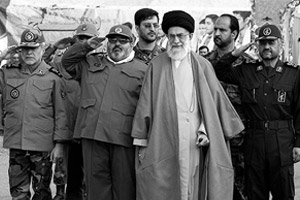
On Wednesday, October 21, Iranian regime supreme leader Khamenei who is deeply concerned about the consequences of the Joint Comprehensive Plan of Action (JCPOA) with P5+1 for the survival of the clerical regime, inescapably approved the deal after a 100-day delay in a letter to Rouhani and stated that he approves the August 10, 2015 resolution of regime’s Supreme National Security Council in this regard.
Meanwhile, he resorted to charlatanism special to him to take advantage of the feeble policy of the West and its appeasement of mullahs. He raised some arguments or new conditions and made ambiguous statements to keep the option of violating the accord and to pave the way for stonewalling its implementation, while attempting to prop up his dispirited forces.
Previously, on October 13, Khamenei put an end to the unprecedented crises and infighting that unfolded in parliament’s deliberations of the accord and consumed it by reining in his own faction. Regime’s factions described this measure as a coup d’état against the parliament with its speaker Larijani stating on October 18: “I am not involved in the assessment of the nuclear file. This file belongs to the supreme leader of the revolution.”
Three months into the nuclear accord the infighting between regime’s factions is boiling and the position of the supreme leader and consequently the entirety of the regime is imperiled. In such circumstances, Khamenei referred to some vague and multifaceted conditions in his letter to Rouhani to state that if the conditions are violated by P5+1, “The government has to take the necessary steps and halt the implementation of the JCPOA”. He further stressed that JCPOA “has some structural ambiguities and weaknesses and there are multiple issues that absent an exact and constant monitoring may lead to great damages to the country at present and into the future”. Khamenei also wrote: “In the declaration of the European Union and the U.S. President it should be stipulated that the sanctions will be removed in their entirety and any statement conveying that the structure of the sanctions would remain will be considered a violation of JCPOA.”
On Wednesday night, October 21, in an interview with state television, the Iranian regime’s senior nuclear negotiator and deputy foreign minister Abbas Araqchi noted: Some of Khamenei’s remarks in his letter to Rouhani has already been covered by the JCPOA, but “there was another section that Khamenei added that the government needs to obey and take into account”.
Fearful of the abhorrence of the international community regarding the antihuman atrocities of the Iranian regime and its brutal terrorism in the region, Khamenei wrote: “In the 8-year period, imposition of any sanctions [including for terrorism or human rights] by any country involved in the negotiations would be considered a breach of JCPOA and the government has… to halt the implementation of the JCPOA.” Araqchi acknowledged that this is a new context and perception and that the government is obedient to Khamenei’s remarks and interpretation.
Secretariat of the National Council of Resistance of Iran
October 22, 2015