

Three-minute read
The Iranian economy is currently navigating its most precarious juncture since the 1940s, as the compounding pressures of post-war logistics, aggressive currency devaluations, and a total digital blackout converge. While a fragile ceasefire has quieted the direct exchange of fire, the commercial arteries of the state remain constricted. The Strait of Hormuz, a chokepoint responsible for the vast majority of the nation’s trade, saw a 90 percent collapse in transit volume during the height of the conflict. This logistical paralysis has not merely impacted the oil sector but has effectively severed the supply of essential raw materials, forcing importers to seek erratic and expensive land routes through Turkey.
The domestic fallout is most visible in the pharmaceutical sector, which is currently enduring a systemic failure of its supply chain. The crisis is a byproduct of both external disruption and a deliberate shift in monetary policy. According to internal reports, the government has slashed the allocation of preferential exchange rates, which now covers only 10 percent of imported drugs and raw materials. The remaining 90 percent must be sourced via the Nima rate, which experienced a historic surge following the currency unification in early 2026. This fiscal pivot has sent the price of basic medicines climbing by over 300 percent, leaving specialized patients—particularly those requiring insulin or cancer treatments—in a state of life-threatening uncertainty.
The clerical dictatorship is again doing to the world economy what it has done for decades to people, governments and entire societies: taking hostages.#IranWar https://t.co/LiXkqu7QaH
— NCRI-FAC (@iran_policy) March 25, 2026
The Architecture of Failure and the Myth of Resilience
Despite the visible shortages, state officials continue to insist that the infrastructure remains intact. The Food and Drug Organization has publicly maintained that “the country is not facing a serious shortage of medicine” due to strategic stockpiling and a reliance on the network of 18,000 pharmacies that act as a “capillary reserve” for the nation. However, this narrative of “resilience” is increasingly at odds with the physical reality of the industrial sector. The Organization for Renewable Energy and Energy Efficiency recently reported a staggering 1.5 billion dollar loss following strikes on solar equipment warehouses, which destroyed critical inventories of panels and inverters.
International data confirms that Iran’s total renewable capacity remains a negligible fraction of its own stated requirements, falling short of targets by thousands of megawatts. This widening deficit is a direct result of chronic mismanagement and an inability to modernize aging facilities. Consequently, the nation’s energy sector has been marginalized on the regional stage; neighboring states such as Saudi Arabia, Israel, and the United Arab Emirates now possess power capacities four to five times greater than Iran’s actual output. This gap underscores a terminal decline in the state’s ability to provide stable energy, leaving the domestic grid increasingly prone to collapse.
#Iran’s Imploding Economy Exposes a Regime Beyond Preservationhttps://t.co/7N3OT7UFT2
— NCRI-FAC (@iran_policy) October 17, 2025
Inflationary Pressure and the Decimation of the Digital Workforce
The macroeconomic indicators released by the Central Bank of the regime illustrate a landscape of hyper-inflation. The price index for the specialized commodity group spiked by 95.7 percent this April compared to the previous year. Perhaps more devastating is the reality that basic food items now account for 85 percent of the minimum wage. The Food and Agriculture Organization of the United Nations (FAO) has officially placed Iran in its “Food Price Inflation Warning” category, a status shared with nations like Sudan. With the official annual inflation currently standing higher than 50 percent, the International Monetary Fund predicts it could peak at 69 percent by year-end, the highest rate recorded in Iran since the occupation of the country during World War II.
Compounding this misery is the state-mandated digital blackout, which has now become the longest nationwide internet shutdown in global history. While the IRGC-run Tasnim News Agency justified the move as a necessity to combat a “psychological war machine” and “fake news,” the economic cost has been catastrophic. Minister of Communications Sattar Hashemi admitted that approximately 10 million people—mostly from low-to-middle income brackets—are employed in activities that rely on stable digital connectivity. For these millions, the blackout is not an inconvenience but a total suspension of livelihood. As the Minister noted, “the continued instability of the internet is a direct threat to the jobs of this massive population.”
#Iran’s Collapsing Economy: Corruption, Price Hikes, and a Regime Feeding on Its Peoplehttps://t.co/XqTwJ8kT7S
— NCRI-FAC (@iran_policy) October 17, 2025
Industrial Stagnation and the Erosion of Social Welfare
The manufacturing sector is also showing signs of exhaustion. Reports from domestic labor agencies confirm that at the Borujerd Textile Factory, one of the region’s major employers, 700 out of 800 workers have been dismissed as their contracts were not renewed for the new year. The factory, which once operated across spinning, weaving, and tailoring units, has cited a total lack of raw materials as the reason for the layoffs. Only a skeleton crew of security and service staff remains, while years of worker experience are being discarded as the facility awaits a hypothetical reopening in three months.
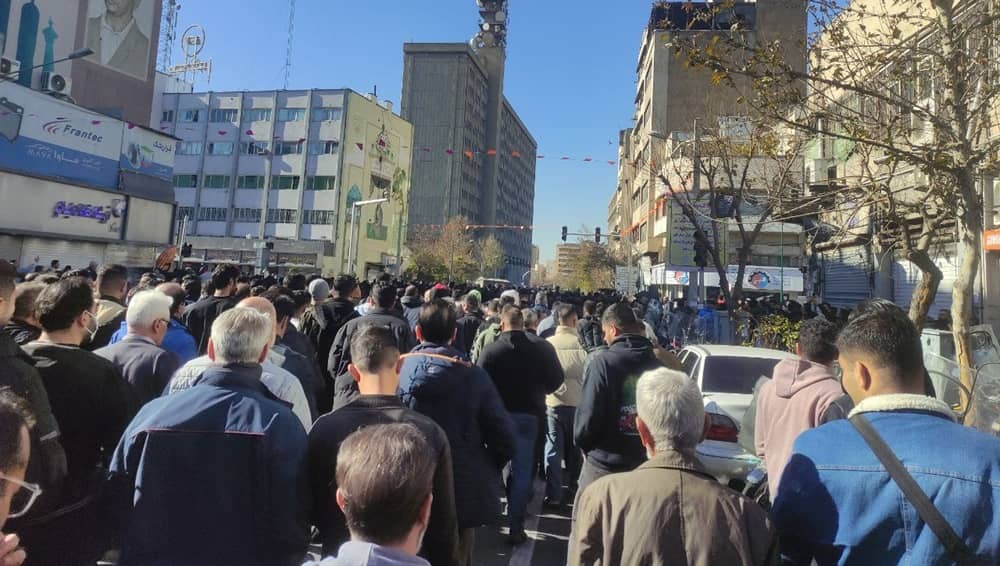
As the industrial base erodes, the insurance system is nearing a breaking point. Debt-burdened providers cannot bridge the gap between fixed coverage and skyrocketing medicine costs, forcing workers to choose between health and survival. With food inflation hitting 112 percent and millions of digital livelihoods erased, the state’s narrative of “resilience” has collapsed. This systemic desperation is no longer merely an economic crisis; it is a volatile catalyst. As the population is pushed beyond the limit of endurance, the current economic paralysis is paving the way for inevitable nationwide uprisings.