

THIS PAGE WILL BE UPDATED WITH THE LATEST NEWS
UPDATE: 09:30 PM CET
Exiled Iranian Dissident Visits ‘City of Peace’ Ypres

Exiled Iranian opposition leader Maryam Rajavi visited Ypres on Friday. She made a speech at city hall, visited the In Flanders Fields Museum and attended the nightly Last Post ceremony at the Menin Gate.
Rajavi was invited by Ypres resident and former prime minister Yves Leterme after the two met in Paris, VRT reports.
“The large crowd that came to the city hall shows that she represents what Iranians in exile think about the need for change in their country, the restoration of democracy and an end to executions and terrible persecution,” Leterme said. “She is someone who is greatly appreciated by the Iranian people.”
In her speech, Rajavi – the president of the National Council of Resistance of Iran – praised Ypres for its role in promoting peace. “Ypres is a city whose history still speaks to the world,” she said.
UPDATE: 01:00 PM CET
US Forces Raids Ship Headed to Iran as Iran Seizes Oil Tanker

WASHINGTON: A US special operations team in the Indian Ocean raided a ship headed to Iran from China last month and seized military-related articles, the Wall Street Journal reported on Friday, citing US officials. The cargo consisted of components potentially useful for Iran’s conventional weapons, one official said, adding the shipment had been destroyed.
US forces boarded the ship several hundred miles off the coast of Sri Lanka, according to the newspaper, which added the vessel was later allowed to proceed.
Iran’s Execution Surge Spurs US Demands to Topple Regime

The recent record of executions of opponents of the theocratic regime in Iran has fueled the latest calls for its overthrow by prominent Democrat and Republican leaders in the U.S.
At a standing-room-only meeting hosted by the Organization of Iranian-American Communities, prominent Americans from Ben Carson, secretary of housing and urban development in President Donald Trump’s first term, to Democrat Sens. Cory Booker of New Jersey and Jeanne Shaheen of New Hampshire called for the end to the 46-year-old Islamic Republic of Iran.
Retired Gen. James Jones, onetime U.S. Marine Corps commandant and national security adviser to former President Barack Obama, was the first to say that “1,192 [Iranians] were hanged in the last year, and 56 of them were women.”
UPDATE: 08:00 AM CET
Speech at the City Hall of the Historic City of Ypres in Belgium

Allow me to address you as my dear sister. I sincerely thank you for your warm words. It is also an honor for me that Mr. Yves Leterme is here with us today, someone whose political and human values were shaped in this region not far from Ypres. He has maintained his admiration for and connection to Ypres, the city that stands as a symbol of peace. Every night at 8 p.m., it reminds us of the lessons of war and offers hope to those who strive for human dignity, peace and freedom. A city that, through remembrance of brutal battles, total destruction, and nameless soldiers lost to deadly mustard gas has become a moral reminder of the cost of war and the value of peace. The world will never forget the sacrifices Ypres made. So, salutes to Ypres; salutes to those who sacrificed their lives for peace and freedom in this land.
How The IRGC’s ‘Industrial Mafia’ Engineered Iran’s Pollution Crisis

On Thursday, December 11, 2025, Ali Khamenei, the Iranian regime’s Supreme Leader, met with a group of government eulogists. In a display of callous indifference reminiscent of his denial of the COVID-19 pandemic—which he famously dismissed as “not a big calamity”—Khamenei downplayed the environmental catastrophe suffocating the nation. He referred to the suffocating dust storms and pollution in Khuzestan as “one of the smallest problems,” claiming that the Islamic Republic continues to “progress” despite these issues. While the regime’s leader lives in denial, the reality for the Iranian people is a daily struggle for survival. Khamenei’s claims of progress stand in stark contrast to the medical emergency unfolding in Khuzestan.
Zeinab Hezbapour Transferred to Sepidar Prison in Ahvaz amid Intensifying Pressure on the Jamee’i Family

Zeinab Hezbapour, the wife of Massoud Jame’i—a political prisoner sentenced to two death penalties—has been transferred to the women’s ward of Sepidar Prison in Ahvaz to begin serving a 15-year sentence. Her transfer comes as her daughter, Nahid Jame’i, has also received a 12-year prison sentence, both issued through proceedings that fell far short of internationally recognized standards of due process. This escalation represents a growing pattern of security-driven repression targeting the family of Massoud Jame’i, who has been held in Sheiban Prison, Ahvaz, in severely deteriorating health after two years of imprisonment without access to medical care. His condition has become so critical that concerns are mounting he may die even before his execution is carried out.
Iranian Resistance Supporters Rally in Brussels on Human Rights Day to Condemn Executions in Iran

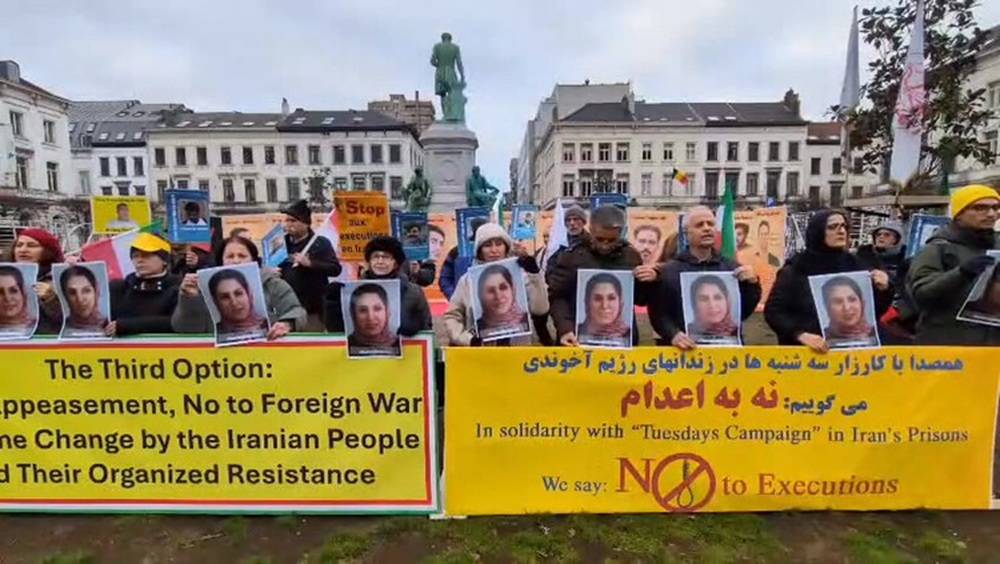
Brussels, Belgium – December 10, 2025 – Supporters of the Iranian Resistance staged a rally and an exhibition on Human Rights Day outside the European Parliament to condemn the Iranian regime’s escalating wave of executions. The event was held in solidarity with the “No to Execution Tuesdays” campaign, expressing outrage over the regime’s brutal killing spree and systematic human rights violations.
Iranian Community Rallies Outside Regime’s Embassy in Berlin Against Executions and for Democratic Change

Berlin, Germany — December 11, 2025: Freedom-loving Iranians and members of the Iranian community in Berlin gathered in front of the Iranian regime’s embassy on Human Rights Day to protest executions and call for fundamental political change in Iran.
Rally in Los Angeles on Human Rights Day Against Executions and Calls for Regime Change in Iran

Los Angeles, California — December 9, 2025: Members of the Iranian community in Los Angeles who support the People’s Mojahedin Organization of Iran (PMOI/MEK) held a rally on the eve of Human Rights Day to protest the regime’s executions and to call for fundamental political change in Iran.
Security Corruption and Human Trafficking – Part 3

This report is the third part of our analytical series on the structure of corruption within the ruling regime in Iran. The first report outlined the overall architecture of systemic corruption, and the second revealed the mechanisms of large-scale economic corruption and state-sponsored rent networks. The present report turns to an area whose human, social, and rights-related consequences are deeper and more devastating than any other: security-linked corruption and the role of state institutions in the trafficking of women, girls, and children. This report demonstrates that human trafficking in Iran is not a scattered or marginal criminal activity; it is embedded within the regime’s underground economy and security apparatus.
The Price of Essential Goods Spike in Iran

As prices of goods, food items, and essential supplies continue to rise in Iran, the state-run ILNA News Agency quoted a labor activist saying that the price of a single grain of rice is now 800 rials. ILNA reported on Thursday, December 11, that the price of medicine is once again increasing and, according to official reports, will rise by four to twelve times. Nader Moradi, a labor activist, told this state-run outlet that the soaring prices of essential goods mean “the result of this trend is breaking the backs of poor and defenseless people. Pressure of this magnitude has no precedent in recent years.” Criticizing the steep rise in basic living necessities, he added, “Today, each kilo of Iranian rice costs about 400,000 tomans. With a simple calculation, we see that the price of a single grain of rice is about 80 tomans (800 rials).” He also noted that each U.S. dollar is currently traded at around 125,000 tomans (1.25 million rials).
A Parliament in Meltdown: Iran Regime’s Ruling Elite Turns on Itself
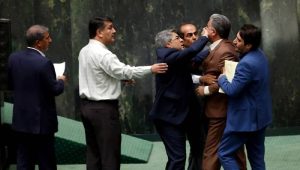
The chaotic December 9 session exposes a fractured power structure, failing governance, and a political system running out of answers. The December 9 session of Iran regime’s parliament was not merely a heated debate; it was a public unraveling of a political order under extreme internal strain. On full display was a system no longer capable of masking its contradictions. Instead of projecting authority, the parliament revealed deepening fractures within the ruling establishment—fractures born of crises the regime can no longer manage, let alone resolve. What unfolded was less a legislative session than a collective confession. One after another, lawmakers tore into the state’s failures: the collapse of water and wastewater management, runaway inflation, systemic fuel smuggling, astronomical banking corruption, and—most explosively—direct attacks on the judiciary and its chief, Gholam-Hossein Mohseni Ejei.