

THIS PAGE WILL BE UPDATED WITH THE LATEST NEWS
UPDATE: 05:00 PM CET
Iranian Protesters Clash with Security Forces as Tear Gas Fills Tehran Streets Amid Nationwide Unrest

Protests escalated across Iran on Monday as demonstrators confronted security forces in Tehran and Mashhad, with authorities deploying tear gas amid strikes and street clashes, according to reports.
An Iranian opposition group, the National Council of Resistance of Iran, reported that a large crowd of demonstrators marched along Jomhouri (Republic) Street before moving into nearby areas, including Naser Khosrow Street and Istanbul Square in Tehran.
Central parts of Tehran turned into flashpoints as protesters and regime security forces engaged in running street clashes near major government and commercial areas.
Police units fired tear gas and used batons to break up crowds in the city center, according to accounts from the scene.
Center of Power Shifting in Iran from State to Society

In recent political discourse in Iran, phrases like “the regime has returned to factory settings” or “we must not return to factory settings” are being frequently used by political activists and officials. But what does this metaphor really mean?
And why are some analysts warning that if Iran’s political system fails to align itself with ongoing social transformations — in intellectual, security, judicial, and executive dimensions — it may struggle to navigate the Iranian year 1405 (beginning March 21, 2026)?
A senior official of the Islamic Republic recently acknowledged societal changes underway, emphasizing that the center of power is gradually shifting from the state toward society.
Abbas Abdi, a prominent figure among reformists, has also issued a warning, “If the current trajectory does not change, we may not easily reach the year 1405.”
UPDATE: 08:00 AM CET
Protests Erupt in Iranian Capital Following Record Drop in Rial Value
In a striking display of defiance that signals the deepening vulnerability of the Iranian regime, the Grand Bazaar of Tehran and major commercial centers across the capital have erupted into intense anti-government protests. What began on Sunday, December 28, as a strike against the catastrophic devaluation of the national currency has rapidly evolved into a political uprising targeting the highest echelons of the clerical establishment, including regime Supreme Leader Ali Khamenei. The unrest, which entered its second day on Monday, December 29, 2025, has shattered the illusion of stability the regime has desperately tried to project more than a year into the presidency of Masoud Pezeshkian.
Switzerland: Exhibition in Effretikon Condemns Executions in Iran and Calls for Release of Political Prisoners

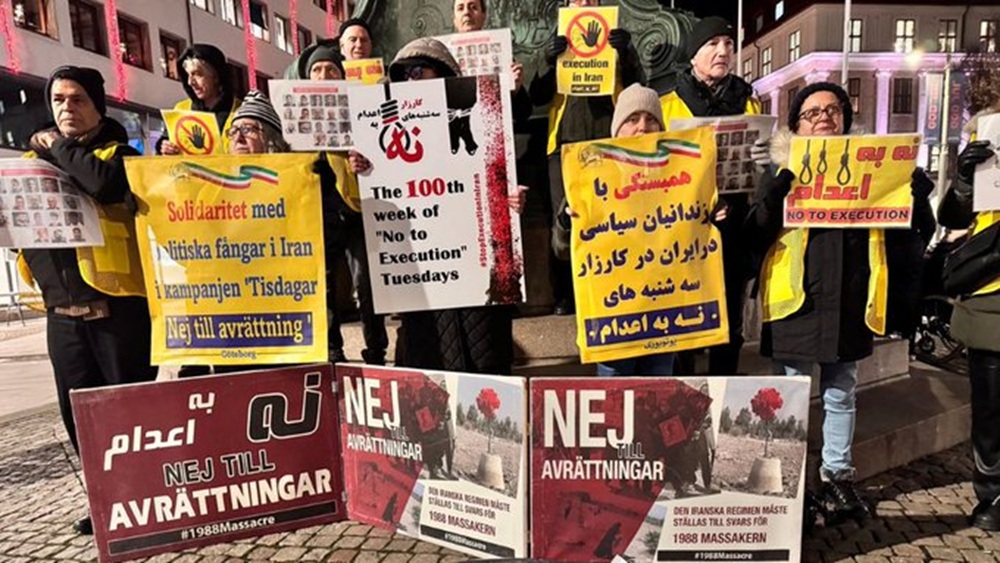
Effretikon, Switzerland – December 27, 2025 – Supporters of the People’s Mojahedin Organization of Iran (PMOI/MEK) held a photo exhibition and book stall to protest the Iranian regime’s increasing use of the death penalty, particularly against political prisoners. The event also expressed solidarity with the “No to Execution” campaign.
Denial of Family Visits for Saeed Masouri at Qezel Hesar Prison
On Saturday, 27 December 2025, Saeed Masouri, one of Iran’s longest-held political prisoners, was denied all family visits by order of the Tehran Prosecutor’s Office. The measure was imposed following his public opposition to the death penalty and the dissemination of messages emphasizing steadfast resistance to repression. The decision comes amid escalating pressure on political prisoners who openly oppose capital punishment. Saeed Masouri, a political prisoner currently held at Qezel Hesar Prison in Karaj, was formally informed that he is prohibited from all in-person and cabin visits with his family until further notice. Prison authorities cited a direct order from the Tehran Prosecutor’s Office. According to sources close to his family, the ban is directly linked to Masouri’s recent activities and statements opposing executions.
Iran’s Suffers from Negative GDP Growth in First Half of Persian Year

Tasnim News Agency, affiliated with Iran’s Islamic Revolutionary Guard Corps (IRGC), reported that according to the latest figures released by the Central Bank, gross domestic product growth in the first six months of the current year (from March 21 to September 22, 2025) once again entered negative territory, with economic growth including oil recorded at minus 0.6% and excluding oil at minus 0.8%. The outlet wrote on Sunday, December 28, that among the main economic sectors, agriculture experienced negative growth of 2.9% and the industries and mining group recorded negative growth of 3.4%. Tasnim emphasized that these figures stem from the continued recession in industrial production, energy constraints, declining investment, and rising cost pressures.
December 2017: The Uprising That Exposed the Myth of Reform in Iran

How the Slogan “Reformist, Hardliner—The Game Is Over” Redefined Iran’s Political Landscape. After nearly four decades of religious fascism ruling Iran, December 28, 2017 marked a historic rupture in the country’s political trajectory. What unfolded was not merely another protest cycle, but the emergence of a new political reality—one that drew a clear and irreversible line between the Iranian people and their anti-popular rulers. With one shockwave, the long-running political theater of the regime collapsed. The slogan “Reformist, hardliner—the game is over” did more than express anger; it shut down, once and for all, the illusion of factionalism within Iran’s ruling system and inaugurated a new phase in the struggle for freedom. For years, the clerical regime—benefiting from international appeasement—cultivated the illusion that Iran possessed competing political factions. According to this narrative, some insiders remained loyal to the system’s reactionary foundations, while others supposedly sought reform and gradual change.