

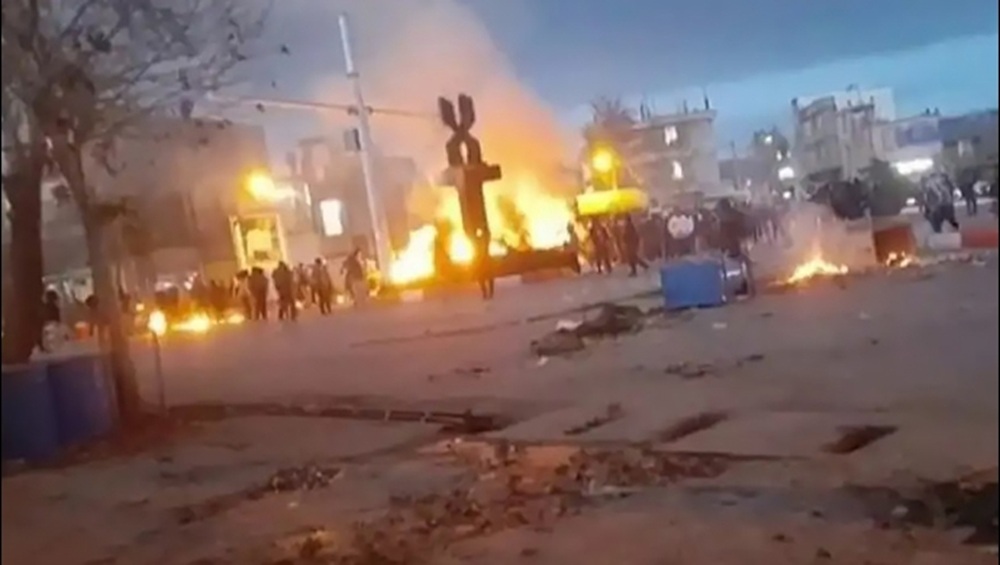
THIS PAGE WILL BE UPDATED WITH THE LATEST NEWS
UPDATE: 10:30 PM CET
The Mask Slips: Tehran’s Inadvertent Admission of Resistance

As Iran erupts once again, the clerical regime has stumbled into a historic “self-own.” After decades and billions of dollars spent insisting that organized opposition has no foothold within the country, Tehran’s own propaganda apparatus is now documenting the resistance’s effectiveness in real time. Immediately following the recent protests that swept the nation, state media — including the Islamic Revolutionary Guard Corps-affiliated Fars News Agency, began casting blame on organized groups, specifically the People’s Mojahedin Organization of Iran (PMOI/MEK). Fars reported that opposition leaders orchestrated a “chain of protests” via social media, with eyewitnesses describing disciplined units of activists steering crowds toward bold political slogans.
Tehran’s Brutal Regime Will be Overthrown

Both Iranian society and the ruling regime are rushing, at unprecedented speed, toward a new situation. The regime, due to 47 years of dictatorship, corruption, and bloodshed, has reached a dead end. It has no way forward or backward and is incapable of addressing even the most basic needs of the Iranian people. And the people are no longer willing to tolerate this situation.
The uprising and protests that began in Tehran’s bazaar in the final days of 2025 and rapidly spread to dozens of cities reflect the anger of 92 million Iranians. They are exhausted by the steady collapse of their purchasing power, driven by state-engineered price hikes and the plundering of national wealth to fund the Revolutionary Guard. The regime tried, but clearly failed, to prevent the emergence of yet another uprising by intensifying repression. According to the National Council of Resistance of Iran, there were 2,200 executions in 2025, among them political prisoners.
UPDATE: 4:30 PM CET
BRUTAL CRACKDOWN Iranian Regime Thugs Raid Hospital and ‘Kidnap’ Protesters They Shot During Unrest

ANTI-REGIME protesters seeking urgent medical care have been “kidnapped” from hospital by the Ayatollah’s thugs as Iran brutally cracks down after more than a week of unrest.
Brave Iranians have taken to the streets to oppose soaring inflation brought on by international sanctions and depleted oil sales, with some evidence suggesting security forces have opened fire on demonstrators.
Other reports say the brutes fired tear gas into the hospital in an effort to clear out people seeking shelter.
Maryam Rajavi, president‑elect of the National Council of Resistance of Iran (NCRI), told The Sun the abduction of wounded protesters is “an unforgivable crime”.
“When a regime turns to courts as weapons and hospitals as hunting grounds, it signals not strength, but existential panic,” she said.
Rajavi said the hospital raid, “did not occur in a vacuum”.
UPDATE: 11:00 AM CET
Iran in 2025: 45 Years of Appeasement – One Year of Truth
The year 2025 marks a turning point in Iran’s recent political history. Not because repression is new, but because boundaries were crossed in a way that can no longer be explained away. The death penalty became the state’s clearest language — not as an instrument of justice, but as a tool of governance aimed at a society that, after the Jina uprising, has not returned to silence.
Over the course of the year, the number of executions reached a level that appears extraordinary even when compared with previous decades. Documentation from independent human rights organizations and the United Nations shows that in 2025 Iran was among the countries with the highest number of carried-out executions worldwide. Many of these executions took place without public notice, without fair trials, and within a closed, security-dominated judicial system. Among those executed were political prisoners, protest participants, ethnic minorities, and migrants.
UPDATE: 08:00 AM CET
Live report: Day 9 of Iran Uprising: Protests resume in multiple cities as regime launches mass arrests in Ilam

The nationwide uprising against the religious dictatorship in Iran entered its ninth consecutive day on Monday, January 5, 2026. Following a bloody Sunday marked by the regime’s attack on a hospital in Ilam and intense clashes in Tehran, the unrest has shown no sign of abating. On Monday, reports from across the country indicate that protests have resumed in Tehran’s commercial districts and expanded significantly in western provinces, particularly in Kermanshah. Despite a heavy security presence and internet blackouts in key areas, citizens in Sonqor, Yasuj, and Tehran have taken to the streets, chanting slogans against the regime’s foreign interventions and domestic repression. The uprising, initially sparked by economic collapse, has firmly established itself as a political movement seeking the overthrow of the ruling theocracy.
December 2025 Report: A Year in Review: Iranian Women’s Resistance Against Religious Dictatorship

December 2025 Report: A Year in Review: Iranian Women’s Resistance Against Religious Dictatorship. In 2025, Iranian women faced escalating challenges and deepening injustices. Yet, they never surrendered in their struggle against the ruling religious dictatorship. Once again, they stood firm, carrying the banner of resistance. The final 2025 issue of the monthly publication of the NCRI Women’s Committee is dedicated to reviewing the most significant developments of the year, focusing on the resistance of women and political prisoners sentenced to death across Iran, despite crushing economic pressure, widespread poverty, and entrenched structural discrimination.
MEK Supporters Rally in Gothenburg for Iran Uprising, Democratic Republic

Gothenburg, Sweden — January 3, 2026 — Supporters of the People’s Mojahedin Organization of Iran (PMOI/MEK) held a rally in Gothenburg in solidarity with the nationwide protests in Iran. Braving snowy, sub-zero temperatures, participants chanted anti-regime slogans to express their support for compatriots who have risen up inside Iran.
Iranians Rally in Hamburg in Support of Iran Protests, Calling for a Free and Democratic Republic

Hamburg, Germany — January 3, 2026 — Freedom-loving Iranians and supporters of the People’s Mojahedin Organization of Iran (PMOI/MEK) held a rally in snowy, sub-zero temperatures to express solidarity with the nationwide protests in Iran that began on December 28, 2025. Braving the freezing weather, participants echoed the call of their compatriots inside Iran for a free and democratic republic.
Iranians Rally in Oslo Backing Iran Protests and Demanding a Free, Democratic Republic in Iran

Oslo, Norway — January 3, 2026 — In solidarity with the nationwide protests in Iran, freedom-loving Iranians, supporters of the People’s Mojahedin Organization of Iran (PMOI/MEK) and the National Council of Resistance of Iran (NCRI) held a rally in Oslo. Braving snowy, sub-zero temperatures, participants chanted anti-regime slogans to express their support for compatriots who have risen up inside Iran.
Annual Report on Human Rights Violations in Iran in 2025 – Part 2

In 2025, the use of the death penalty in Iran entered a new and dangerous phase; one in which execution no longer functioned as a judicial response to crime, but as a central instrument of governance aimed at preserving regime survival. An examination of execution patterns shows that the commonly used distinction between “political” and “non-political” executions is misleading. This distinction obscures the true function of capital punishment and normalizes state violence under the guise of law enforcement. In terms of function and impact, all executions in Iran today carry a political character. Whether imposed directly under security-related charges against political prisoners or categorized under offenses such as drug-related crimes or homicide, capital punishment in each case serves the same purpose: instilling public fear, suppressing social dissent, and preventing protests and popular uprisings.
“Protest Yes, Riot No”: How the Regime Turns Dissent into a Death Sentence

On the seventh day of Iran’s nationwide uprising in January 2026, Ali Khamenei the regime’s supreme leader addressed a gathering he described as “families of the martyrs of the 12-day war” and declared: “Protest is legitimate, but protest is different from rioting.” He went on to add: “Officials must speak with protesters, but speaking with rioters is pointless; they must be put in their place.” At first glance, this statement appears conciliatory. In reality, it is a confession. When the regime says “protest yes, riot no,” it is announcing that it alone acts as judge, prosecutor, and executioner. Within this framework, “peaceful” is not an objective description of behavior; it is a political permit issued exclusively by the state. Any action that disrupts the regime’s balance of power—even a calm labor strike or a coordinated economic boycott—is immediately reclassified as “riot” and therefore criminalized. Once relabeled, it becomes subject to military-style repression. The terminology does the work of the bullet long before the trigger is pulled.