

THIS PAGE WILL BE UPDATED WITH THE LATEST NEWS
UPDATE: 09:00 PM CEST
I Witnessed Unimaginable Horrors in Iran’s Torture Dungeons

For 70 days, Shabnam Madadzadeh lived alone in a cell measuring roughly three metres by two.
The room contained almost nothing apart from three blankets, a thin carpet and a searing fluorescent light overhead that never switched off.
Her watch had been confiscated when she arrived, along with every personal belonging she carried, leaving her with no way to tell whether it was day or night.
But the silence rarely lasted long enough to become comforting, as from elsewhere inside Section 209 of Evin Prison, Madadzadeh could hear women screaming from beatings and rape.
‘You hear people screaming, crying, begging. Sometimes you imagine the voices are your family members. You think maybe it is your brother or your sister. They want you to hear it and they want you to break,’ she recounts.
UPDATE: 11:30 AM CEST
The Iranian Royalists’ Thuggish Edge

In early February, while much of the world was focused on a looming war in the Persian Gulf, an outspoken Iranian exile named Masood Masjoody disappeared in Canada. Days later, 10 other well-known diaspora figures were tagged in a menacing anonymous message on X: “Soon you’ll have to find the corpses of many.”
But when Masjoody’s body was found in March, the investigation did not point toward the Islamic Republic. Instead, the Canadian police brought murder charges against two followers of Reza Pahlavi, the 65-year-old son of Iran’s last shah and the most prominent leader in the Iranian opposition. Masjoody, a fierce critic of Pahlavi’s, had been denouncing the prince’s movement for months and had singled out the two suspects by name, saying that they were plotting to silence him.
The murder, in other words, appears to have been part of a war within the Iranian opposition—one that pits Pahlavi against a growing host of critics who see him and his movement as dangerously autocratic.
UPDATE: 08:30 AM CEST
PMOI Resistance Units in Zahedan Prove the Regime’s Executions Have Backfired
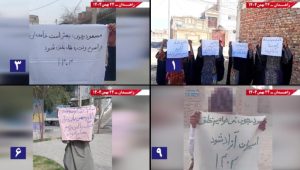
On May 9, PMOI/MEK Resistance Units in the southeastern city of Zahedan resumed their anti-regime activities, boldly condemning the Iranian regime’s new wave of executions.
Operating against a backdrop of severe repression, these courageous activists reiterated their unwavering commitment to overthrowing the ruling religious dictatorship and establishing a democratic republic. By taking to the streets and holding placards in public locations, the Resistance Units delivered a clear message: the regime’s attempts to rule through terror have backfired, and the spirit of resistance cannot be extinguished. “The regime’s criminal executions will not save it; they only strengthen the resolve of Iran’s youth to overthrow it,” read one of the messages displayed by the rebellious youth.
The activists in Zahedan explicitly rejected all forms of tyranny, drawing a firm line against both the historical monarchy and the current religious dictatorship. Demonstrators held signs declaring, “No to monarchy, no to the supreme leader. Yes to freedom and equality,” and “From Zahedan to Tehran, down with the oppressor, be it the shah or the supreme leader.”
Iran: Female Protesters Held in Legal Limbo Amid Dire Conditions

Female protesters held in legal limbo for over three months at Vakilabad Prison in Mashhad are facing increasingly harsh treatment. These women, arrested during the nationwide protests in January 2026, remain in a state of undetermined status without clear judicial rulings. According to social media reports, Azadeh (Masoomeh) Yaghoubi, a resident of Mashhad, was detained by security forces on February 3, 2026. She is currently being held in the quarantine ward of Vakilabad Prison.
Additionally, Samira (Fatemeh) Rezvanifar, another detainee from the January 2026 nationwide protests, has been held at Vakilabad Prison for nearly four months. She was arrested on January 17, 2026, and transferred to the prison’s quarantine ward. More than 100 days later, her judicial status remains uncertain.
The Aramesh ward is a warehouse-like structure situated below ground level, positioned lower than other sections of the prison and facing Ward 1. Its semi-underground design contributes to its harsh conditions. A recently released protester described the ward as resembling an “ant nest.”
Iran’s Internet Blackout Shields Surge in Secret Executions

A new report published by the British newspaper The Guardian has shed further light on the Iranian regime’s escalating campaign of secret executions and internal repression, unfolding alongside one of the country’s longest and most severe internet disruptions in recent years. Based on testimony from human rights organizations and sources close to prisoners’ families, the report describes a system in which executions are increasingly carried out in secrecy, often without prior notification to relatives and under heavy security measures.
According to the report, at least 24 prisoners have been executed in Iran since March. Several of those executed had reportedly been arrested on charges such as “acting against national security,” “espionage,” or alleged links to anti-regime protests. Human rights groups cited in the investigation say the pace of covert executions has intensified in recent months, while authorities have simultaneously worked to suppress information surrounding these cases and prevent public scrutiny.
Iran’s Female Political Prisoners Face Escalating Repression Behind Bars
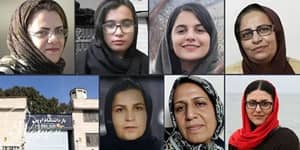
The Iranian regime’s pressure campaign against female political prisoners appears to be entering a more aggressive phase, particularly against women accused of supporting the People’s Mojahedin Organization of Iran. Recent reports from inside Iranian prisons point to a growing pattern of punitive measures that includes new criminal cases, additional prison sentences, denial of medical treatment, and restrictions on family visits.
The developments highlight the regime’s continuing reliance on the prison system not merely as a tool of detention, but as a mechanism for psychological punishment and political intimidation. In recent weeks, several imprisoned women have reportedly faced retaliatory actions for protesting prison conditions and opposing executions.
Among the latest cases are Shiva Esmaeili and Elaheh Fooladi, two political prisoners held in Evin Prison. According to reports, both women received new legal cases and were each sentenced to an additional six months in prison on charges of “insulting the leadership” after protesting the death of Somayeh Rashidi.
Iran’s Poverty Crisis Reaches State Employees as Food Security Workers Struggle to Survive
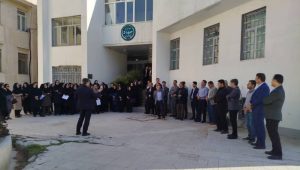
For years, the Iranian regime has attempted to portray economic hardship as a temporary consequence of sanctions, war, or external pressure. But the growing anger among employees of the Ministry of Agriculture Jihad reveals a deeper reality: Iran’s economic collapse is no longer confined to the unemployed or the marginalized. It is now consuming the very state workforce tasked with keeping the country functioning. The latest complaints from ministry employees expose a staggering gap between official wages and the actual cost of survival in Iran. While estimates place the urban poverty line at nearly 75 million tomans per month, many employees in the ministry reportedly receive average salaries of only 24 million tomans ($135). The difference is not merely economic; it represents the widening distance between the ruling establishment and the daily realities faced by millions of ordinary Iranians.
According to reports published by the state-affiliated labor outlet ILNA, workers in both the Ministry of Agriculture Jihad and the education sector remain among the lowest-paid employees in Iran’s government system. This comes despite the increasing workload placed on these sectors during the country’s ongoing economic crisis and regional instability.
Iranians Struggle to Afford Basic Food Basket as Prices Surge

While only about five months have passed since the implementation of the plan to remove subsidized foreign currency rates for some essential goods, the latest economic reports show that the cost of the basket of goods covered by the electronic coupon program has risen sharply and far exceeded the amount of government support being paid.
According to statistics published by economic media outlets affiliated with Iran’s regime, the total price of items included in the electronic coupon basket, which was around 21.8 million rials before the removal of subsidized currency rates, has now reached approximately 37.8 million rials. Meanwhile, the amount of support paid to eligible households has remained fixed at 10 million rials with no increase. It is worth noting that the U.S. dollar exchange rate has surged in recent months to an unprecedented 1.9 million rials per dollar, while a worker’s salary is approximately $126.
Iranian Citizens Face Drug Shortages and Health Crisis

Turmoil in the pharmaceutical and medical supply market and the emergence of brokers on the streets of the capital reflect the depth of the crisis. Securing foreign currency and importing foreign products for patients with special illnesses has become an unsolvable problem that has destabilized the market. This situation has caused vital medical items either to become scarce or to be sold at astronomical prices in unofficial markets.
Mohammad Jamalian, a member of the Health Commission in the Iranian regime’s parliament, stressed on May 2 the necessity of choosing between higher prices or the absence of medical supplies. He believes that rising prices of raw materials and plastic have created serious difficulties for manufacturers in continuing operations. Jamalian stated: “Today, one of the main concerns is the sharp increase in the price of plastic, raw materials, and other pharmaceutical necessities. To preserve the ability to continue production, we have no choice but to increase drug prices.”
Iran’s Social Crisis Deepens: Citizens Describe Hunger, Fear, and Silent Resistance
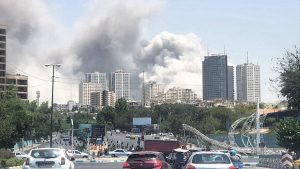
Iran’s social crisis is no longer an abstract trend—it is being lived, street by street, paycheck by paycheck. Citizen reports gathered in May 2026 point to a country where rising poverty, relentless inflation, and an increasingly militarized public space are reshaping daily life in ways that feel both immediate and unsustainable. In parts of Tehran, especially around Republic Street, the atmosphere has shifted in ways residents describe as unmistakable. One citizen likened the capital to “a military garrison,” pointing to the visible deployment of armored vehicles near sensitive areas and the blocking of key routes leading to government centers.
Police patrols are stationed at major intersections. In narrower side streets, special motorcycle units—known for rapid response—are reportedly lying in wait to intercept young protesters. Checkpoints are largely handled by Basij forces, while near Alaeddin Passage, units affiliated with the IRGC’s Sarallah headquarters have been seen maintaining a steady presence.
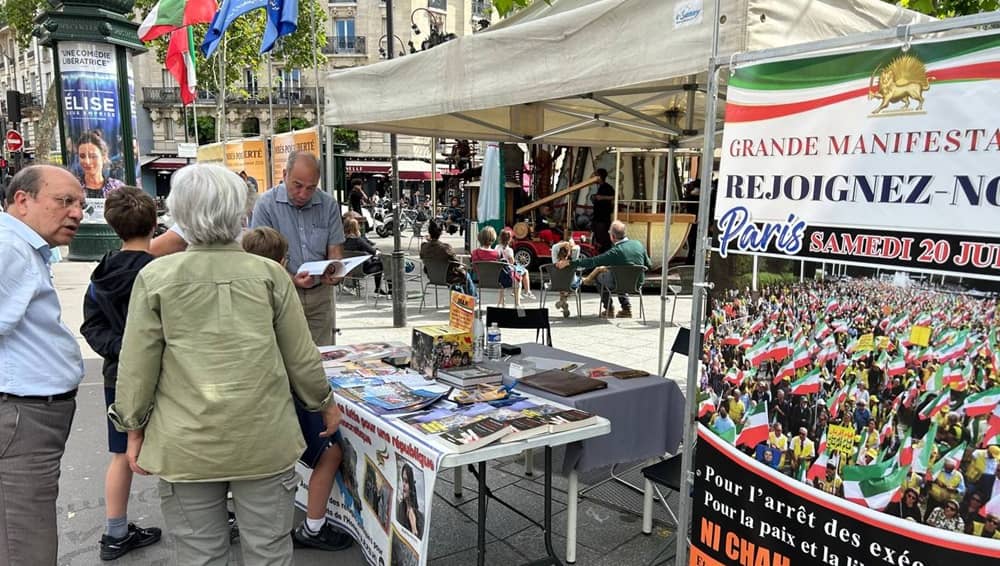
Paris Exhibition Denounces Executions in Iran and Calls for Democratic Republic Ahead of June 20 Rally
Paris, France – May 8, 2026 – Supporters of the People’s Mojahedin Organization of Iran (PMOI/MEK) organized a bookstall and photo exhibition in Paris to denounce the execution of political prisoners and protesters following the January 2026 uprising. The event renewed calls for freedom, justice, and human rights in Iran.

The exhibition paid tribute to those executed by the Iranian regime, highlighting their sacrifice through powerful images and personal testimonies. It underscored the Iranian people’s ongoing resistance and their demand for a democratic republic.