

THIS PAGE WILL BE UPDATED WITH THE LATEST NEWS
UPDATE: 6:30 PM CEST
Halkbank Rejected by US Supreme Court on Criminal Charges

The US Supreme Court rejected an appeal by Turkey’s state-owned Halkbank, leaving it facing criminal charges that accuse it of helping Iran evade economic sanctions.
The high court without comment refused to consider Halkbank’s contention that it is protected from prosecution by sovereign immunity.
Shares of Halkbank fell as much as 10% before trading 8.3% lower at 26.42 liras as of 5:43 p.m. in Istanbul. If closed around these levels, it will be the biggest drop since March 21.
UPDATE: 8:00 AM CEST
Geneva Conference Calls for International Action to Stop Iran’s Execution Surge
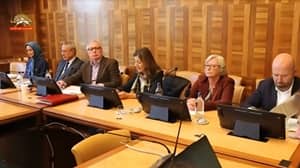
Against the backdrop of the 60th session of the UN Human Rights Council, a conference at the United Nations European headquarters sounded the alarm on the escalating human rights crisis in Iran. The event brought together prominent political figures, international jurists, parliamentarians, and human rights advocates to address the Iranian regime’s surge in executions and its culture of impunity, with a particular focus on the unpunished 1988 massacre of political prisoners. In a video message, Maryam Rajavi, the president-elect of the National Council of Resistance of Iran (NCRI), delivered a stark assessment of the situation, stating that human rights in Iran “urgently demand the world’s attention.” She detailed a horrifying wave of executions, noting that since early July, at least 450 people had been executed, bringing the total over the past 14 months to 1,850, including 59 women.
Ten Bahaii Women Handed Down a 90-Year Prison Sentence by Isfahan Court

Branch 47 of the Isfahan Court of Appeals has upheld a total sentence of 90 years in prison and additional penalties against ten Bahaii women, marking one of the harshest collective verdicts against Bahaii women in recent years. The verdicts were issued against Shana Shoghi-Far, Negin Khademi, Neda Badakhsh, Arezoo Sobhanian, Yeganeh Rouhbakhsh, Mojgan Shahrezaei, Parastoo Hakim, Yeganeh Agahi, Bahareh Lotfi, and Neda Emadi. According to the ruling, eight of these women were each sentenced to 10 years of imprisonment and fined 100 million tomans, while Bahareh Lotfi and Neda Emadi each received 5 years in prison and a 50-million-toman fine. Additionally, the appeals court confirmed travel bans and restrictions on social media use for all ten Bahaii women.
Cologne Rally Honors Zahedan Bloody Friday, Condemns Executions in Iran

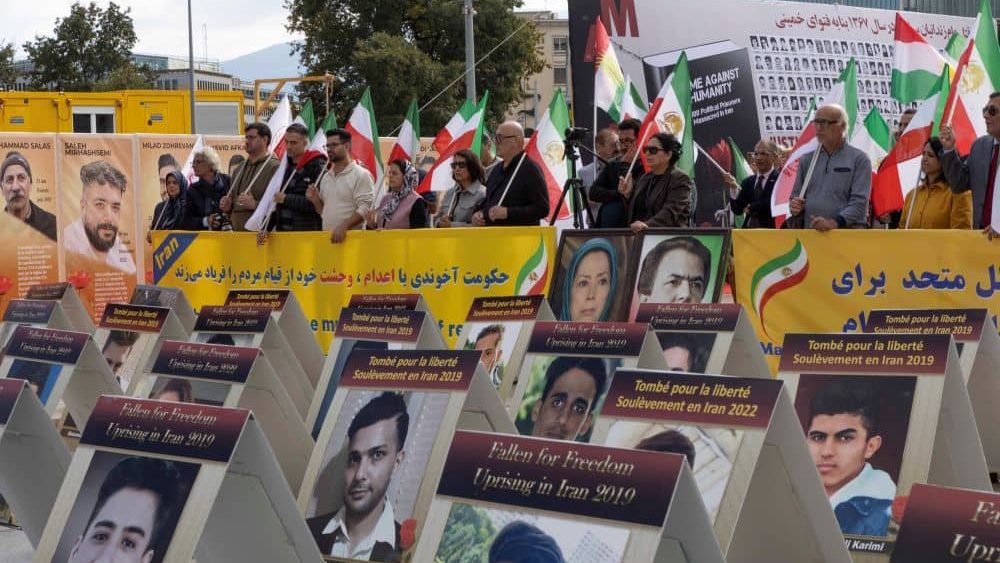
Cologne, Germany – October 4, 2025 – Supporters of the People’s Mojahedin Organization of Iran (PMOI/MEK) gathered in Cologne to honor the memory of Zahedan’s Bloody Friday during the 2022 nationwide protests. Participants strongly condemned executions in Iran and urged the immediate release of political prisoners.
World Day Against the Death Penalty and Iran’s Resistance Against Executions
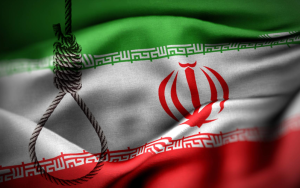
October 10 marks the World Day Against the Death Penalty, established in 2003 by the World Coalition Against the Death Penalty. Now in its 22nd year, this global day unites human rights defenders, NGOs, and citizens worldwide in calling for an end to executions. It serves as a reminder of the universal right to life and the urgent need to abolish capital punishment in all its forms. In 2025, Iran has witnessed an unprecedented surge in executions. According to Amnesty International, over 1,000 people have been executed in the past year — a horrifying assault on the right to life. The regime uses the death penalty not as a tool of justice but as an instrument of fear, aiming to suppress dissent, intimidate society, and stifle any spark of uprising among a population yearning for freedom.
Beijing And Tehran Trade Car Parts for Copper and Zinc to Bypass Sanctions, according to Bloomberg
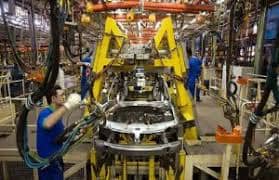
Bloomberg News reported that Chinese companies are trading car parts for Iranian metals such as copper and zinc — part of a new barter mechanism between Beijing and Tehran designed to circumvent Western sanctions. On Monday, October 6, Bloomberg reported that car parts manufactured by companies in China’s Anhui province — including Chery and Tongling — are shipped to Iran in semi-assembled form, while China receives industrial metals from Iran in return. According to the report, this barter is part of a complex network in which cars are exchanged for metals or even agricultural products such as cashews — a system designed to evade restrictions imposed by U.S. sanctions.
Keeping the Mask On: How Regime Media Push Reformism to Block Iran’s Revolution

State-aligned outlets promote “national unity” and cosmetic reform to preserve the clerical regime — while the people and the Resistance prepare the decisive struggle for freedom. Despite a clear majority of Iranians having rejected the regime, a persistent campaign in the media sphere tries to redirect public energy from toppling the state toward “reforming” it from within. That narrative — cloaked in the language of “national unity” — is not neutral. It is a deliberate political strategy to preserve the regime by blunting the popular movement that has already matured through four nationwide uprisings. When state spokespeople speak of “priorities” and “national cohesion,” they mean one thing: keeping the regime intact. In his most recent remarks on October 3, 2025 the regime’s president Masoud Pezeshkian stated, “Our priority is the policy favored by the Leader.” Such declarations make clear that loyalties to the clerical hierarchy come before the people’s urgent demands for freedom, decent livelihoods, and social justice.