

THIS PAGE WILL BE UPDATED WITH THE LATEST NEWS
UPDATE: 7:30 AM CEST
Message to Conference on World Day Against the Death Penalty

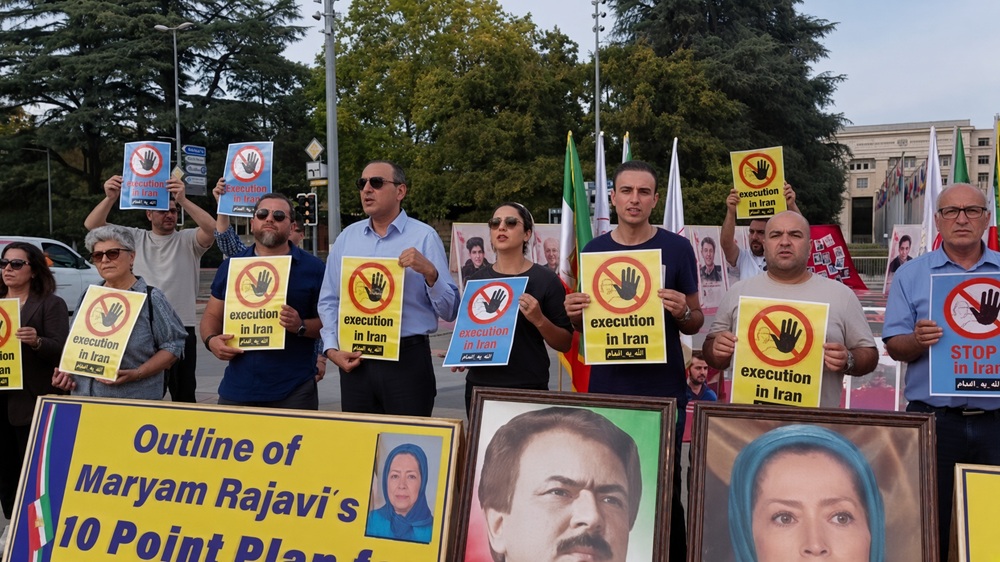
Mrs. Maryam Rajavi’s message: “We pay tribute to heroes like Vahid Bani-Ameriyan, Mohammad Taghavi, Babak Alipour, Pouya Ghobadi, Akbar Daneshvarkar, Abolhassan Montazar, Mohammad Masoum-Shahi, Hamed Validi, and Mehdi Khanaki. These courageous men stood strong against the terror of execution. Standing before the gallows, they sang songs of freedom. As we are speaking there are many more political prisoners on the death row including Mohamad Javad Vafai Sani who has been in prison since 2019. We honor the rebellious souls who were executed this year for joining the uprisings. In unjust courts, they bravely declared that they rose up to end this tyranny. We honor the political prisoners deep inside the regime’s prisons. They carry the banner of ‘No to Execution.’ For over two years, they have continued the ‘No to Execution Tuesdays‘ campaign. We honor the courageous families who gather outside the regime’s most notorious torture centers to protest against the death penalty. The World Day Against the Death Penalty is humanity’s clear ‘No’ to this regime—a regime defined by executions and massacres.”
Parviz Sabeti, Senior Official in the Shah’s SAVAK, Faces Torture Case in U.S. Court
WASHINGTON, Oct. 9, 2026 — A federal court ruling allowing a torture lawsuit against former senior SAVAK official Parviz Sabeti to move forward has reopened the record of repression under the Shah as Iran’s democratic movement insists that the country’s future must break with both hereditary and clerical dictatorship. On October 7, U.S. District Judge Gregory A. Presnell rejected Sabeti’s attempt to end the case on statute-of-limitations grounds. Three former political prisoners are suing him under the Torture Victim Protection Act, alleging that SAVAK abducted, imprisoned, and tortured them during Mohammad Reza Shah Pahlavi’s rule. Sabeti denies involvement in torture.
Sabeti headed SAVAK’s powerful Third Directorate, responsible for internal security and political opposition. SAVAK torture was documented well before the Shah’s overthrow. A 1976 congressional hearing examined extensive evidence of political repression. Amnesty International documented beatings, electric shocks, burning, and other abuses. In June 1979, The New York Times reported that former SAVAK interrogator Bahman Naderipour, known as “Tehrani,” admitted in court to torturing hundreds and participating in killings.
Iran’s Economy Could Spark Popular Uprising

Thousands of motorcyclists affiliated with government institutions on Tehran’s streets, military training in a public square, and commanders warning that a “spark” could become a blaze raise an important question: What confrontation is Iran’s regime preparing for? The official narrative emphasizes defense against foreign threats. But security officials’ statements reveal another concern: renewed domestic protests connecting with opponents capable of organizing them.
For observers who view Iran primarily through negotiations, its nuclear program, and its military capabilities, these preparations carry an important message.
The regime may withstand external pressure while still fearing that protests over living conditions could challenge its political control.
In a Sept. 25 report, the Spanish news agency EFE described thousands of motorcyclists attending an event billed as a “parade of 40,000 motorcyclists.”
Participants included members of the Islamic Revolutionary Guard Corps (*IRGC), the Basij militia, police, and other government institutions.
The same report described Tehran’s Imam Hussein Square being converted into a military training ground, complete with walls and barbed wire.
Ashraf Faraji: From Financial Strain and Mental Illness to the Gallows

On the morning of Wednesday, September 30, the death sentence of a female prisoner was carried out in the Central Prison of Sari. The prisoner has been identified as 57-year-old Ashraf Faraji, originally from Ahvaz and residing in Sari, the capital of the northern province of Mazandaran.
According to published reports, Ashraf Faraji was a mother of four who had been struggling with severe neurological and psychiatric conditions for years, having been under medical treatment and psychiatric care for approximately two years prior to the incident.
Reports indicate that on the day of the incident, in October 2022, following an intense argument with her husband over financial difficulties, including funding their daughter’s education, an altercation took place under critical emotional distress, leading to her husband’s injury and subsequent death.
Ashraf Faraji’s case was processed by Branch 2 of the Sari Criminal Court, which ultimately sentenced her to qisas (retribution-in-kind, death penalty). The verdict was later upheld by Branch 6 of the Supreme Court. According to explicit international laws, individuals suffering from mental disorders must not, under any circumstances, be sentenced to death or executed.
Iran’s Human Rights Crisis: How the Resistance Keeps Executions and Prisoner Abuse on the UN Agenda

The Iranian regime’s escalating human rights violations, particularly its growing use of executions and repression of political prisoners, have become a central focus of the Iranian Resistance’s international campaign. At the UN Human Rights Council in Geneva, this campaign extends beyond public statements. It involves documenting abuses, identifying victims, presenting evidence to international representatives, and pressing governments to pursue accountability.
The work is continuous. Resistance supporters and human rights activists collect information about executions, arrests, prison conditions, and the treatment of political prisoners. They record names and details of individual cases, building a body of documentation that can be presented to international institutions and diplomatic representatives.
This process is essential because the volume of global crises makes it difficult for governments and international organizations to follow every human rights violation in detail. Without sustained documentation and advocacy, abuses in Iran risk losing visibility as other international developments dominate the agenda.
The Resistance’s presence in Geneva is intended to keep these violations before the international community and ensure that the victims are not reduced to statistics or forgotten cases.
Iran’s Dollar Surge to 270,000 Tomans Deepens Workers’ Purchasing-Power Crisis
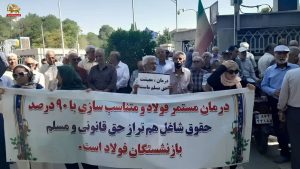
Iran’s currency crisis is intensifying pressure on workers and low-income households as the dollar trades between 265,000 and 270,000 tomans, up from approximately 155,000 tomans at the beginning of 2026. The sharp depreciation of the rial has eroded the value of wages, increased production costs, and further strained household budgets, while workers’ salaries have failed to keep pace.
The dollar’s increase of approximately 110,000–115,000 tomans in less than a year illustrates the scale of the economic deterioration. Because imports, exports, production, and many services are directly or indirectly affected by the exchange rate, currency depreciation feeds into prices throughout the economy. For households whose incomes remain largely fixed, the result is a growing inability to afford essential goods and services.
The minimum monthly base wage for workers was set at approximately 16.6 million tomans at the beginning of 2026. At an exchange rate of around 158,000 tomans per dollar, that salary was equivalent to approximately $105 per month.
With the dollar now trading at around 265,000 tomans, the same wage is worth only about $63.
The comparison highlights the extent of the decline:
- Beginning of 2026: 16.6 million tomans, equivalent to approximately $105.
- At the current exchange rate: 16.6 million tomans, equivalent to approximately $63.
- Decline in dollar-equivalent wages: Approximately 41 percent.
- Wage needed to preserve the initial dollar equivalent: Approximately 27.8 million tomans per month.
German Critics Challenge Reza Pahlavi’s Role in 2026 Freedom Prize for Iranian People

The decision by Germany’s Friedrich Naumann Foundation for Freedom to designate Reza Pahlavi as the recipient of its 2026 Freedom Prize on behalf of the Iranian people has triggered a public controversy over who has the right to represent Iran’s struggle for freedom. More than 70 prominent German figures have reportedly signed an open letter urging the foundation to reconsider the arrangement, arguing that honoring the Iranian people should not become a vehicle for granting political legitimacy to the son of the former shah.
The foundation announced on September 14 that the 2026 prize would honor the Iranian people for their struggle for freedom, civil rights, and democracy. The award ceremony is scheduled for November 7 at St. Paul’s Church in Frankfurt, with Reza Pahlavi designated to receive it in a fiduciary capacity until it can be presented to freely elected representatives of Iran. The foundation describes him as a prominent opposition figure and maintains that the country’s future political system should be decided by its people.
The open letter challenges the implications of that decision. Its central argument is that a prize dedicated to an entire people should not be entrusted to a politically divisive individual whose family history is inseparable from Iran’s former dictatorship. The signatories reportedly argue that the arrangement conflicts with democratic values and risks creating the impression that a German democratic institution has endorsed Pahlavi as the representative of a nation whose political future remains undecided.
Tanker Attack Risks Rise as Iran Vows to Block More Hormuz Routes

TEHRAN — As attacks on tankers around the Strait of Hormuz increase and Iran threatens to restrict more shipping routes, hardline media in the Islamic Republic are defending continued pressure on trade and energy as a tool against the United States, while Mehdi Karroubi and a number of political figures and experts close to more moderate currents have called on President Masoud Pezeshkian’s government to resume negotiations with Washington.
The two approaches have become more visible at a time when Reuters has reported increased risks to tankers in Hormuz, while Kayhan, citing maritime security sources, has reported that at least 12 attacks on tankers and gas-carrying vessels were recorded around the waterway within one week.
Kayhan has portrayed the shipping crisis as evidence of Iran’s ability to impose global costs, writing that traffic through Hormuz remains far below pre-war levels. The newspaper has also highlighted the view that ending the war — rather than Washington’s account of reopening the strait — is the main way to reduce pressure on energy markets.
Exhibition in Paris Highlights Brutal Executions by Iran’s Regime and Its Human Rights Crisis

Paris – October 7, 2026 — Supporters of the People’s Mojahedin Organization of Iran (PMOI/MEK) held a book table and photo exhibition in Paris, drawing attention to Iran’s worsening human rights crisis and the regime’s systematic use of executions against political prisoners and protesters detained during nationwide uprisings.
The event also promoted a symbolic 3.5-kilometer run on Saturday, October 10, at Parc Montsouris in Paris, marking the World Day Against the Death Penalty and calling for public support for the campaign to #StopExecutionsInIran.
Organizers said the gathering reflected the Iranian people’s demand for a democratic republic and their aspirations for peace, freedom, justice, and fundamental rights. They also underscored the Iranian Resistance’s call for greater international solidarity with the people of Iran.
They urged the French public and the international community to recognize the suffering of Iranians and their rejection of dictatorship in both monarchical and theocratic forms.
Photographs, personal testimonies, and other materials showcased the courage and sacrifices of those who took part in the Iranian uprisings. The exhibition also pointed as the Iranian regime’s ongoing human rights violations, including executions of political prisoners and the continued imprisonment of protesters.