

THIS PAGE WILL BE UPDATED WITH THE LATEST NEWS
UPDATE: 7:00 AM CET
Iran’s Purchasing-Power Crisis Is Becoming a Political Crisis
For millions of Iranian households, the country’s economic crisis is no longer an abstract discussion about inflation, exchange rates or economic growth. It is measured in food removed from shopping baskets, medical treatment postponed, rent that consumes most of a salary and wages that lose value almost as soon as they are paid.
Recent figures show how severe the collapse in purchasing power has become.
Official data cited by state media show that consumer prices in September were nearly 90 percent higher than a year earlier, while food and beverage prices had risen 121.8 percent. The average monthly wage was worth roughly $92 at the free-market exchange rate, compared with an estimated minimum monthly cost of around $336 for a three-person working-class household.
The gap is no longer marginal. For many workers, a salary cannot cover even basic monthly expenses.
The International Monetary Fund projects another sharp contraction in Iran’s economy in 2026 alongside extremely high inflation. The consequences can already be seen in declining consumption, rising unemployment and the exhaustion of household savings.
UN Rapporteur Exposes Iran Regime’s Escalating Repression, Executions, and Internet Blackouts

Iran’s regime continues to use executions, arbitrary arrests, and restrictions on communications to suppress dissent and conceal human rights violations, UN Special Rapporteur Mai Sato warned on October 28, 2026, when presenting her report to the United Nations General Assembly’s Third Committee.
Covering the period from February to August 2026, Sato’s report documented a widening crackdown in the aftermath of the nationwide protests of January 2026. Protesters, political prisoners, human rights defenders, lawyers, journalists, women, and members of ethnic and religious minorities remain targets of repression.
The report also highlighted the authorities’ efforts to intimidate families seeking information about relatives killed during the protests, restrict independent documentation, and portray dissent as a national security threat.
Sato warned that the scale of the violations remains difficult to establish because of the regime’s restrictions on information and the risks faced by people attempting to communicate with international human rights bodies.
Reza Pahlavi’s Latest Telegram Bot: Trust Us With Your Identity, Security Comes Later
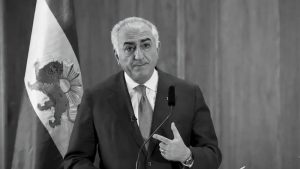
Reza Pahlavi has apparently discovered a new shortcut to organizing Iran’s opposition: a Telegram bot. His latest appeal invites Iranians to join a campaign called “National Cooperation for Saving Iran” and establish direct contact with his team. The pitch is ambitious. The practical questions are considerably less reassuring.
Within days of the announcement, users were circulating screenshots of conversations with the bot and questioning why it requested personal information. Concerns emerged over the collection of real names and other identifying details, the security of the system, and the risks facing people who might use it from inside Iran. Reports of fake bots with usernames resembling the purported official account added another complication.
For a political figure who has repeatedly presented digital registration systems as secure channels for organizing opposition to Iran’s regime, this is an inconvenient development. The promise is national cooperation. The immediate public debate is about whether people should hand their personal information to a Telegram bot.
Apparently, before saving Iran, the campaign must settle a more basic question: can prospective participants safely register?
Iran’s Soaring Food Prices Expose the Gap Between Official Inflation Figures and Daily Reality

Iran’s escalating cost-of-living crisis is widening the gap between official inflation figures and the daily experience of households struggling to afford basic necessities. From bread prices rising by as much as 250 percent to sharp increases in household products and agricultural inputs, mounting costs are eroding purchasing power while wages struggle to keep pace.
In October 2026, the regime reported annual inflation of 89.5 percent. Yet price increases documented by consumers suggest that the pressure on household budgets is far more severe in several essential categories. The contrast raises questions about whether official indicators adequately reflect the costs families face when purchasing food, hygiene products, and other necessities.
The crisis is not limited to consumers. Farmers say they are squeezed between low prices for their produce and the rising cost of fertilizers, pesticides, and other inputs. Meanwhile, the substantial gap between production and retail prices for some goods points to broader problems in distribution and pricing.
Iran’s Nuclear Defiance, Regional Interference, and Executions Draw Wider International Criticism

Iran’s nuclear program, regional interference, and human rights violations are drawing renewed criticism from a broad range of countries at the United Nations, highlighting the multiple fronts on which the regime faces international pressure.
During the UN General Assembly First Committee’s annual discussions on disarmament and international security in October 2026, representatives from European countries, Middle Eastern states, and other regions raised concerns about Iran’s nuclear activities and its failure to resolve outstanding issues with international monitoring bodies. The discussions also brought attention to Tehran’s regional conduct and its record of executions and other human rights abuses.
The breadth of these concerns underscores that the dispute over Iran’s nuclear program cannot be separated entirely from the regime’s wider policies. For neighboring countries, particularly those in the Middle East, the prospect of a nuclear-armed Iran compounds existing security concerns arising from Tehran’s regional activities.
Structural Collapse of the Iranian Labor Market
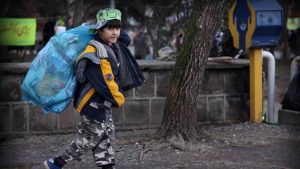
In an on-the-record interview published by the Iran’s regime state-run Labour News Agency (ILNA), Seyyed Malek Hosseini, Deputy Minister of Cooperatives, Labour, and Social Welfare for Entrepreneurship and Employment, acknowledged an unprecedented hemorrhage across Iran’s formal labor market. Hosseini revealed that between late winter and the end of summer, roughly 1.15 million workers dropped off the compulsory insurance rolls of the Social Security Organization. He issued a stark warning that if the prevailing economic contraction persists, an additional 1.2 to 1.4 million jobs will be eradicated by the end of the year. Critically, the senior official admitted that only 300,000 of these displaced workers managed to access unemployment insurance funds, leaving more than 70 percent stripped of even minimal institutional safety nets. With the official tally of the unemployed climbing to 2.5 million and the share of unregulated, precarious informal labor swelling to 54 percent, these confessions corroborate Statistical Center data recording a net loss of 450,000 jobs year-over-year. Factored against a projected GDP contraction of 7 to 8 percent—where historical benchmarks dictate that every 1 percent drop in growth eliminates approximately 170,000 jobs—and set against annualized headline inflation near 90 percent and food inflation exceeding 120 percent, the country is hurtling toward a World Bank-projected poverty rate approaching 40 percent.
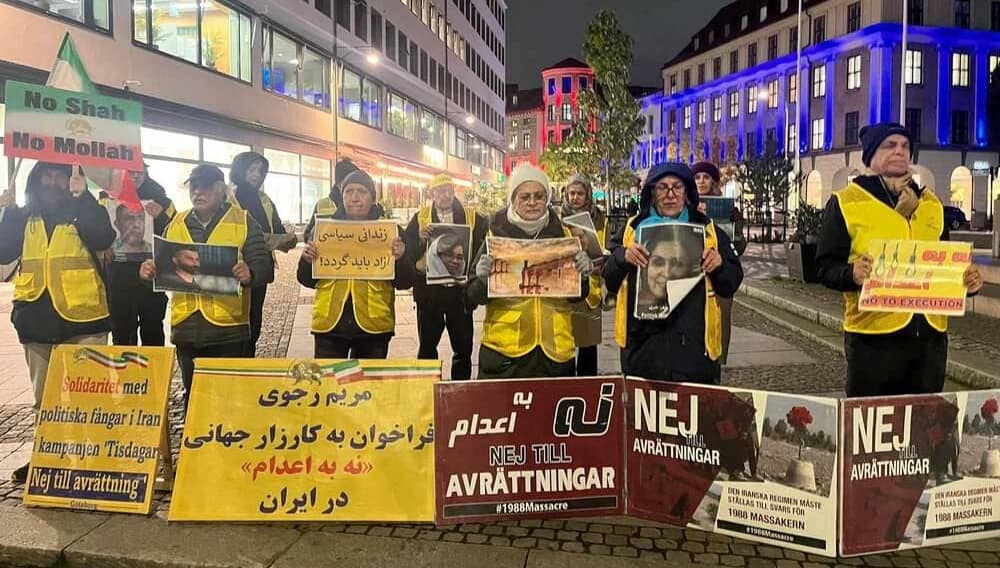
Gothenburg Rally Supports 144th Week of “No to Execution Tuesdays” in 66 Prisons Across Iran
Gothenburg, Sweden — October 27, 2026: Supporters of the People’s Mojahedin Organization of Iran (PMOI/MEK) held a rally in solidarity with the 144th consecutive week of the “No to Execution Tuesdays” campaign, a movement protesting the Iranian regime’s escalating executions and systematic repression.
Participants also highlighted the regime’s intensifying crackdown, the rising number of executions, and broader repressive measures. They chanted slogans such as “Down with the executioner regime” and called for the immediate release of all political prisoners.
Freedom-loving Iranians in Gothenburg expressed support for Mrs. Maryam Rajavi, President-elect of the National Council of Resistance of Iran (NCRI), and her call to expand the “No to Executions” campaign globally.

At the Gothenburg gathering held in solidarity with the “No to Execution Tuesdays” campaign, protesters warned that political prisoners in Iran face an increasingly grave risk of execution amid an escalating wave of repression. They expressed deep concern over the growing number of death sentences against political detainees and protesters, arguing that the Iranian authorities are using executions to silence dissent and spread fear across society. Calling for urgent international action, the demonstrators urged the global community to help prevent further executions and protect the lives of prisoners facing death sentences.